
Vandaag of morgen in huis

Kwaliteit gegarandeerd

Welkomstaanbiedingen ontgrendelen: GRATIS bezorging | Tot 80% korting | Gratis 30 dagen JoyPlus-proefperiode
Download de app
Outdoor solar lights are a convenient choice if you do not want to run an electricity cable to your garden, exterior wall, driveway or balcony. They charge via a solar panel during the day and many models switch on automatically once it gets dark. However, outdoor solar lighting and a solar-powered outdoor light can vary considerably in brightness, battery capacity, sensor performance and weather resistance.
If you focus only on the number of LEDs or a low price, you may be disappointed after a few weeks. Below, you’ll find out which specifications really matter and which type of solar garden lighting best suits your needs.
A product name featuring hundreds of LEDs may sound impressive, but on its own it says little about the actual light output. It is better to look at lumens. A decorative solar garden light usually provides a gentle level of brightness, while a solar security light for a driveway or back door needs to produce considerably more light.
Also consider the difference between ambient and functional lighting:
A waterproof solar light is not automatically suitable for immersion. The IP rating indicates which external influences the housing protects against. An IP44 solar light is protected against solid objects and splashing water. IP65 offers a higher level of protection against dust and water jets, but even a light with this rating should not be placed underwater.
Therefore, check:
The stated operating time is generally based on a fully charged battery. In the UK, short winter days, cloudy weather, shade and dirt on the panel can affect charging performance. A light described as operating for 8 to 14 hours will not necessarily achieve this every night.
Position the panel as openly as possible facing south or south-west, away from overhanging branches or a tall fence that creates significant shade. Clean the panel regularly with a soft, damp cloth.
A colour temperature of 2,700 to 3,000 K produces warm white light. This works well on a patio, pergola or with a solar lantern. At around 4,000 K, the light appears more neutral. 5,000 to 7,000 K produces bright, cooler light, which is often chosen for driveways or security purposes.
Also consider the beam angle. A light with one fixed beam illuminates a smaller part of the garden. A model with adjustable heads or multiple light points can provide wider coverage of an exterior wall, shed or path.
An outdoor light with a motion sensor only switches to full brightness when movement is detected. This can help save battery power, but the sensor must be positioned at the correct height and facing the right direction. Check the detection range and see whether there are multiple settings, such as:
A motion sensor is particularly useful by a front door, garage, rear path or driveway. For a seating area, a solar string light or solar lantern is usually more pleasant.
Check the type and capacity of the built-in battery when this information is available. A larger capacity may provide more reserve power, but the final operating time also depends on brightness and charging conditions.
Also choose an installation style that suits the location:
Before installation, check that the surface is sturdy enough. In rented properties, spike lights and freestanding models are often more practical than wall lighting that requires drilling.
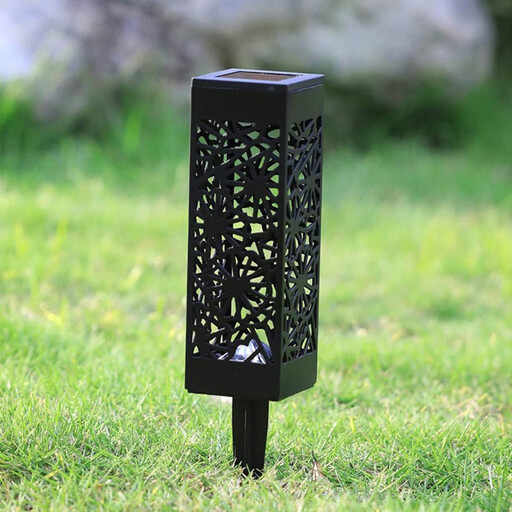
Why it suits this profile: Six spike lights offer a simple way to illuminate a border, garden path or flowerbed without cables or tools.
The description states an IP65 rating, a charging time of 4–6 hours and an expected operating time of 5–8 hours. This makes the limitations clearer than a general claim about “long-lasting operation”.
Set of 6, warm white LED lighting, spike installation and the stated IP65 protection.
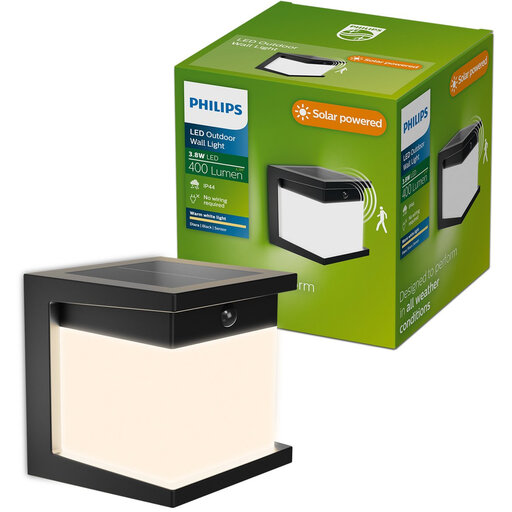
Why it suits this profile: This solar wall light is ideal for an exterior wall, balcony or patio where a fixed light with a warm glow is preferred.
The product specifications clearly state 400 lumens, 2,700 K, IP44 and two lighting modes. This allows you to compare the model using measurable specifications rather than appearance alone.
Integrated LED, motion sensor, warm light and a minimum statutory warranty of 2 years according to the product information.
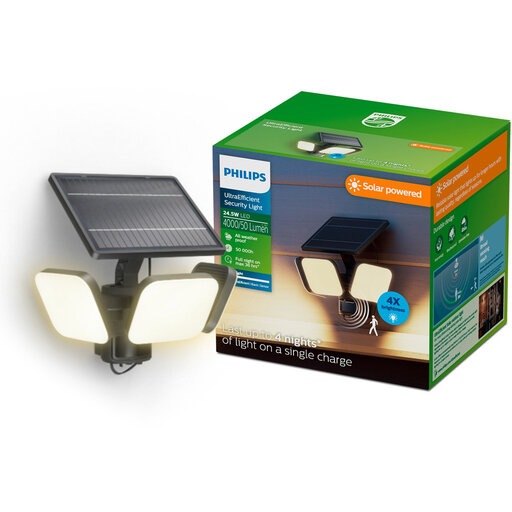
Why it suits this profile: This model is designed for broad-area lighting by a driveway, garage or large grounds where a motion sensor and high light output are important.
The product information states 4,000 lumens, IP65, an adjustable lamp head and a PIR detection range of 8 metres for direct approach and 16 metres from the side. According to Philips, a fully charged battery can provide lighting for up to 4 nights; actual operating time depends on usage and weather conditions.
4,000 lumens, IP65 rating, motion and dusk sensors, plus a choice of warm white or cool white in the available versions.
We have put together a complete, up-to-date list of products that fully meet these strict selection criteria and the applicable European safety regulations.
Choose a location where the panel receives several hours of direct sunlight. Avoid shade from trees, walls and roof edges. Point a sensor light towards the route people take, rather than at a busy road or moving branches. Test the detection angle after installation and make sure spike lights are firmly secured in the ground.
Their lifespan depends on the battery, housing, charging conditions and maintenance. According to the product specifications, LED light sources can have a long nominal lifespan, but the battery is a wear component. Clean the solar panel, check the mounting and only replace the battery if the manufacturer offers a suitable replacement option.
During normal use, they get their energy from the solar panel rather than the mains. This means no connection cables to a socket are required. Performance does, however, remain dependent on sufficient daylight, the battery level and the selected lighting mode.
