
Vandaag of morgen in huis

Kwaliteit gegarandeerd

Welkomstaanbiedingen ontgrendelen: GRATIS bezorging | Tot 80% korting | Gratis 30 dagen JoyPlus-proefperiode
Download de app
An outdoor sensor light is a smart addition to any home. It offers convenience when you arrive after dark, security by illuminating unexpected visitors, and ambiance for your garden. But the search can be frustrating. Many lights make lofty promises but prove to be a disappointment in practice. As a Product Recommendation Officer at Joybuy, I see where things go wrong every day. In this article, I'll help you see through the marketing jargon and choose a model that's right for your situation.
Before you make a choice, it's wise to be aware of the most common problems. This will prevent you from wasting money on a light that fails to meet your needs after just a few months.
To avoid the pitfalls mentioned above, there are a few technical specifications you should always check.
Based on these criteria, we've selected several popular choices that suit different needs and situations.
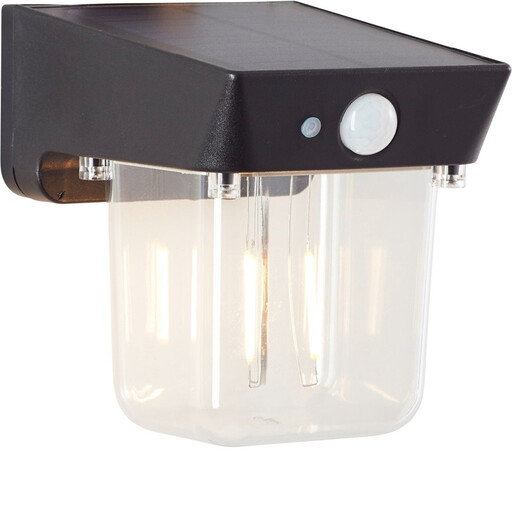
Why This Fits Their Persona: This is a simple, affordable, and wireless solution for anyone needing functional light by a shed, back door, or next to the bins, without the hassle of cables.
This light sidesteps the 'weak solar cell' pitfall. Its modest light output (180 lm) is realistic for its compact solar cell, ensuring it functions reliably for its purpose even on shorter days.
Tool-free, cable-free installation and no electricity costs. The IP44-rating makes it suitable for most sheltered locations.
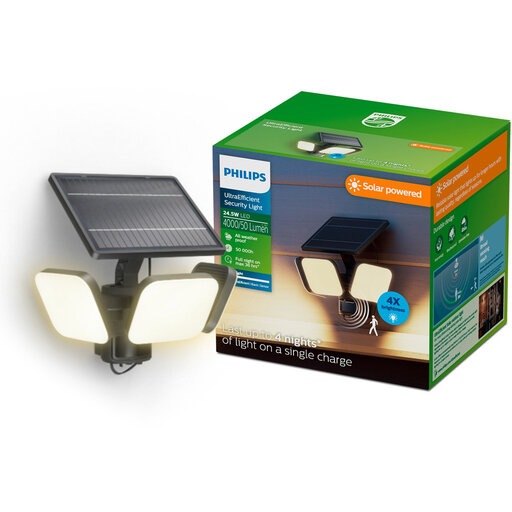
Why This Fits Their Persona: Ideal for those who want to illuminate an entire driveway, garden, or dark alley. This light functions as a fully-fledged floodlight and effectively deters unwanted visitors.
This light tackles all the pitfalls. Its very high light output (4000 lm) is supported by an efficient solar panel and a large battery. The IP65-rating guarantees reliability in any weather.
A very powerful beam and a wide detection angle (up to 16 metres sideways). According to Philips, the light can run for up to 4 nights on a fully charged battery.
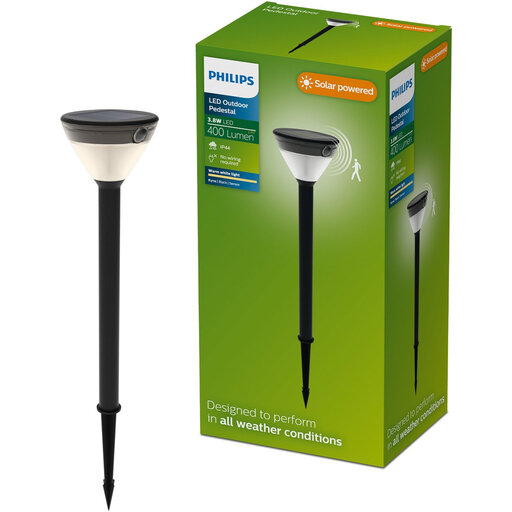
Why This Fits Their Persona: Perfect for creating atmospheric light accents along a garden path, in a flowerbed, or on the patio. This spike light provides functional light without disrupting the ambiance.
As a movable spike light, you can always place it in the sunniest spot in your garden for optimal charging. This solves a common problem with fixed wall lights on a shady wall.
Maximum placement flexibility and a warm white light colour (2700K) for a cosy feel. Installation is as simple as sticking the spike into the ground.
We have compiled a complete, up-to-date list of products that fully meet these strict selection criteria and safety standards.
How reliable is a solar-powered outdoor light in the winter? Reliability heavily depends on quality. Cheaper models with small solar panels and batteries struggle during dark winters. Models with efficient panels and larger battery capacity, like the Philips Zyren, are designed to function for several nights even with less sunlight. Always place the light where it will catch the most direct sunlight during the day.
Can I install an outdoor sensor light myself? Yes, in many cases. A solar-powered outdoor light or a battery-operated model requires no electrical knowledge. You just need to screw it to the wall. For a mains-powered light (230V), it's a different story. If you are replacing an existing light fixture, you can often do it yourself. For creating a new power point, it is wise and safer to hire a qualified electrician.
What is the difference between an IP44 and an IP65 outdoor light? The difference lies in the degree of water resistance. IP44 means 'splash-proof'. This is sufficient for a light hung under an overhang, carport, or in a porch, where it isn't directly exposed to driving rain. IP65 means 'jet-proof'. These lights can withstand water jets from any angle, making them a much safer choice for mounting on an exposed outdoor wall.
