
Vandaag of morgen in huis

Kwaliteit gegarandeerd

Welkomstaanbiedingen ontgrendelen: GRATIS bezorging | Tot 80% korting | Gratis 30 dagen JoyPlus-proefperiode
Download de app
A light that switches on automatically by your driveway, front door or shed is practical. But outdoor lighting with a motion sensor can disappoint in practice. The light may react too late, the battery may run flat after a few dark days, or the housing may prove less suitable for rain than the product photo suggests.
These common pitfalls are worth watching out for:
The IP rating consists of two digits. The first indicates protection against dust and solid particles; the second indicates protection against water.
An IP rating depends on correct installation. Also check that cable entries, seals and screws are fitted according to the instructions.
Lumens indicate the amount of light produced. For a small wall light by the door, 300 to 500 lumens may be enough. A higher light output makes more sense for a driveway or larger garden area. Also consider the colour temperature:
A light with several adjustable heads can distribute light more effectively. The UME light below, for example, has three heads and a stated beam angle of 270 degrees.
A solar-powered outdoor light uses a solar panel during the day and a built-in battery. This removes the need for a fixed power connection, but performance depends on the season, cloud cover and where you install it. A solar wall light is therefore especially useful in places where running cables is difficult and the panel can receive direct sunlight.
When choosing a solar outdoor light, check:
With fixed 230V lighting, you don’t need a solar panel or charging cycle, but installation may need to be carried out by a qualified electrician. This is worth bearing in mind when choosing a mains-powered outdoor wall light.
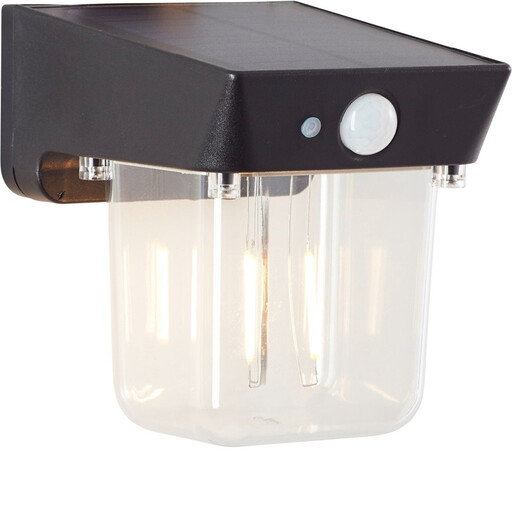
Why it suits this profile: This compact solar wall light is designed for an entrance, patio or small exterior wall where there’s no wiring. Its stated light output is 180 lumens and its colour temperature is 2700K.
The specifications make it clear that this is a modest light source, so don’t expect it to illuminate a large driveway. The IP44 rating means protection against splashing water, not suitability for installation where it will be directly exposed to a water jet.
Solar power, an integrated motion sensor and no fixed wiring. According to the product specifications, the light has a built-in battery and a dimming function.

Why it suits this profile: The Fyns combines an integrated motion sensor with a stated light output of 1000 lumens and a colour temperature of 3000K. This makes it a good fit for an entrance, garage or larger exterior wall.
The stated 1000 lumens gives you a clearer idea of the light output than a vague claim of “bright light”. IP44 is suitable for splashing water, so choose a sheltered place to install it.
Two lighting modes, solar power, a motion sensor and a stated 3-metre cable for connecting the panel.

Why it suits this profile: This solar security light is designed for larger areas such as a driveway, garden, garage or patio. The product information lists three adjustable heads, 3000 lumens and a detection distance of 60 feet.
The light distribution is described clearly, with three heads and a stated angle of 270 degrees. Check in advance that the high light output is suitable for your surroundings and won’t disturb your neighbours.
IP65 rating, three lighting modes, 302 LEDs and a 1800 mAh lithium-ion battery according to the product specifications.
We’ve put together a complete, up-to-date list of products that meet these strict selection criteria and current European safety regulations.
Don’t place the motion sensor directly opposite a busy road or a tree that moves constantly in the wind. Point the sensor towards the route people take and test the light before fully tightening all the screws. With solar lighting, the panel should have as clear a view of the sky as possible.
Clean the solar panel and sensor window regularly with a soft cloth. Don’t use harsh cleaning products. For a fixed wall light, check that the power is switched off before touching a lamp or fitting. Models with a GU10 or E27 fitting are often sold without a light bulb, so check in advance that your chosen LED bulb is compatible.
Yes, but its run time may decrease because of shorter days, cloudy weather and less sunlight. Position the panel somewhere as unshaded as possible and keep it clean. Choose a light with a suitable lighting mode if you mainly need it to switch on automatically for short periods.
Its lifespan depends on the LED module, battery, seals and exposure to the weather. With integrated LEDs, the light source usually isn’t designed to be replaced by the user. A replaceable GU10 or E27 bulb offers more flexibility in this respect.
A solar outdoor light doesn’t use mains electricity, but it relies on a charged battery. A fixed LED outdoor light only switches on when it detects movement, thanks to the sensor, so it may be on for less time than a light that stays on all evening. Focus on comparing the power rating in watts, run time and selected lighting mode.
