
Vandaag of morgen in huis

Kwaliteit gegarandeerd

Welkomstaanbiedingen ontgrendelen: GRATIS bezorging | Tot 80% korting | Gratis 30 dagen JoyPlus-proefperiode
Download de app
A light that only switches on when someone walks past is useful by the front door, shed, driveway or balcony. However, not every piece of outdoor lighting with a motion sensor is suitable for every location. Some lights are mainly designed to create atmosphere, while others are intended to illuminate a larger area brightly.
The biggest buying mistakes usually result from three incorrect assumptions:
Light output is measured in lumens (lm). For a balcony, path or small entrance, 180 to 500 lumens may be sufficient. For a driveway or wide façade, a higher output is more practical. For example, the Philips Zyren range lists 4,000 lumens, while the Brilliant Parson lists 180 lumens.
Also consider the colour temperature:
An LED outdoor light with an integrated light source generally uses little electricity. However, make sure you check the actual wattage, not just the product’s marketing name.
The IP rating indicates how well a product is protected against solid particles and moisture. A weather-resistant IP44 outdoor light is suitable for normal outdoor use and splashing water. Ideally, do not install the light where rainwater can run directly into the housing.
For a more exposed façade or a location where water is more likely to reach the light, IP65 may be a more suitable choice. According to the product specifications, the Philips Zyren models have an IP65 rating. Even with this classification, the light must not be submerged and the installation instructions should be followed.
There are three common power options:
Also check the sensor. A wall light with a dusk sensor only switches on when it is dark enough. A motion sensor responds to movement within a specific range. The exact detection angle, distance and activation time are not listed for every product. If this information is not shown on the product page, do not assume a particular range.
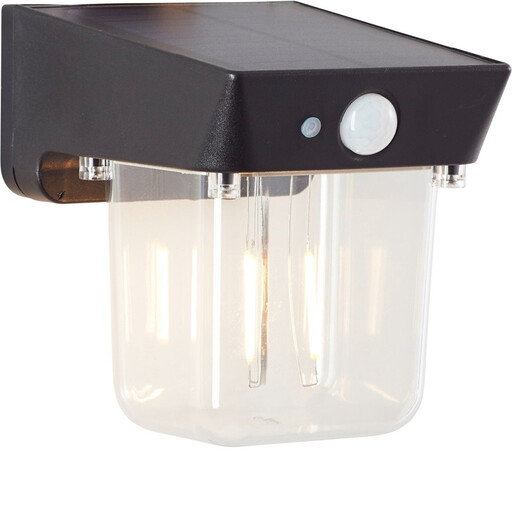
Why it suits this profile: This compact solar-powered outdoor wall light works without permanent wiring and is suitable for a garden, balcony, patio or entrance where you need basic lighting.
The specifications clearly state solar power, motion detection, 180 lumens and IP44. This means you can see in advance that it is more of a compact orientation light than a powerful floodlight.
180 lm, 2 W, 2,700 K, integrated battery and IP44. The manufacturer lists a motion sensor and dimming function.
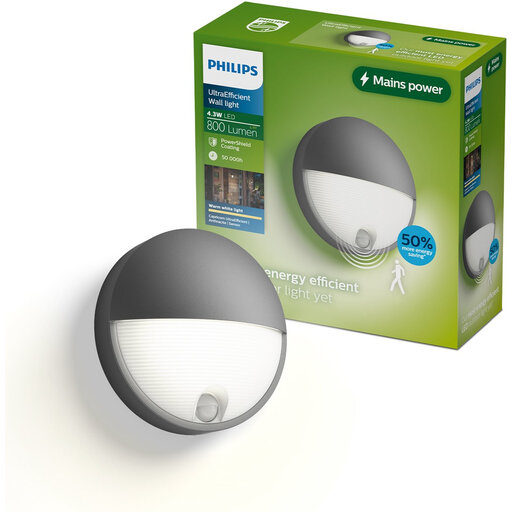
Why it suits this profile: A permanent outdoor wall light with a sensor is ideal if you are looking for a neat lighting solution for the entrance, garden or balcony.
The product information mentions both a motion sensor and a dusk sensor. The IP44 classification makes the usage limits clear: splash-resistant, but not suitable for submersion.
800 lm, integrated LED, aluminium housing, 2,700 K and 4.3 W according to the listed specifications.

Why it suits this profile: For a large driveway, wide façade or location where a particularly high light output is needed, this model offers greater brightness and more detailed sensor information.
The light output, colour temperature and IP rating are specified. According to the Philips product information, the detection range is 8 metres for direct approach and 16 metres for sideways movement.
4,000 lm, 5,000 K, IP65, solar power and adjustable light head. Battery life and performance depend on sunlight, settings and usage conditions.
We have put together a complete, up-to-date list of products that fully meet these strict selection criteria and the applicable European safety regulations.
Position a solar security light so that trees, roof edges and walls cast as little shadow as possible over the panel. After installation, check that the sensor is not constantly being triggered by traffic, moving branches or pets. This can drain the battery more quickly.
For a permanent outdoor wall light with a sensor, check that the wall is suitable for mounting. A 230-volt model, such as a light with an E27 fitting, must be connected by a qualified electrician. A wireless model with a USB-rechargeable battery is more flexible, but it still needs to be charged regularly.
Clean the solar panel and light with a soft cloth. Do not use harsh cleaning products, and do not clean an IP44 light with a powerful jet of water.
Yes, but its output may be lower because of shorter days, cloudy weather and the lower position of the sun. Position the panel as freely as possible and keep it clean. Also check whether the light has several lighting modes, so you can limit energy consumption.
That depends on the size and how you intend to use it. For a small entrance or pathway, around 180 to 500 lumens may be sufficient. For a wide driveway, a model with 800 to 4,000 lumens may be more practical. Also consider glare and the direction in which the light is projected.
A motion sensor responds to movement. A dusk sensor measures whether the ambient light falls below a specific threshold. A light with both types of sensor therefore will not simply switch on during the day when movement is detected.
