
Vandaag of morgen in huis

Kwaliteit gegarandeerd

Welkomstaanbiedingen ontgrendelen: GRATIS bezorging | Tot 80% korting | Gratis 30 dagen JoyPlus-proefperiode
Download de app
A light that only comes on when someone walks past sounds simple enough. However, models vary considerably in their power source, light output, sensor range and protection from rain. If you only look at the number of LEDs or the low price, you could end up with a light that comes on unnecessarily during the day, gives off little light in winter or isn’t suitable for the location you have in mind.
Use this practical guide to focus on the features that really matter when choosing outdoor lighting with a motion sensor.
A light with a high lumen rating can be bright, but that doesn’t automatically mean the light is evenly distributed. A focused beam is often enough for a front door. A driveway or large garden needs wider coverage. So, as well as lumens, consider the beam spread, mounting height and sensor range.
Also check the colour temperature. Warm white light of around 2700 to 3000 K works well by an entrance or on a patio. Cooler light of around 4000 K or higher may be more practical for a driveway, shed or dark passageway.
Always check the IP rating. An IP44 outdoor light is protected against splashing water, but isn’t designed to withstand direct water jets or immersion. IP65 outdoor lighting offers greater protection against dust and water jets, making it better suited to an exposed wall, provided the installation instructions allow for it.
A higher IP rating doesn’t automatically make a product suitable for every situation. Also check the mounting method, cable entry and exposure to wind and rain.
A solar outdoor light with a motion sensor needs to receive enough direct sunlight during the day. On a north-facing wall, beneath a balcony or behind tall trees, the battery may not charge as well. The light may also stay on for less time during the darker winter months.
Some brands mention a more efficient solar panel or a larger battery in their product information. Treat this as a product specification, not a guarantee of the same performance in every garden.
Check:
A wide detection angle is useful along a garden path. By a front door, a shorter range may help prevent the light from switching on every time someone moves on the pavement.
A fixed outdoor wall light connected to 230 V provides a constant power supply, but according to the product information, the Brilliant Todd model must be installed by a qualified electrician. This type is suitable if you already have a connection point.
Solar lighting avoids wiring and electricity use from the mains. A rechargeable outdoor light with a USB connection can be placed flexibly, but needs regular charging. Check whether a battery is included, what type it is, and how to replace or recharge it.
With integrated LED lighting, you don’t need to buy a separate bulb. However, check whether the light source can be replaced. A model with an E27 fitting, such as the Brilliant Todd, lets you choose a suitable LED bulb yourself, up to the stated maximum of 60 W.
Clean the panel regularly if you have solar lighting. For any sensor light, it’s a good idea to keep the sensor clear of dirt, leaves and cobwebs. This helps your automatic outdoor lighting respond correctly.
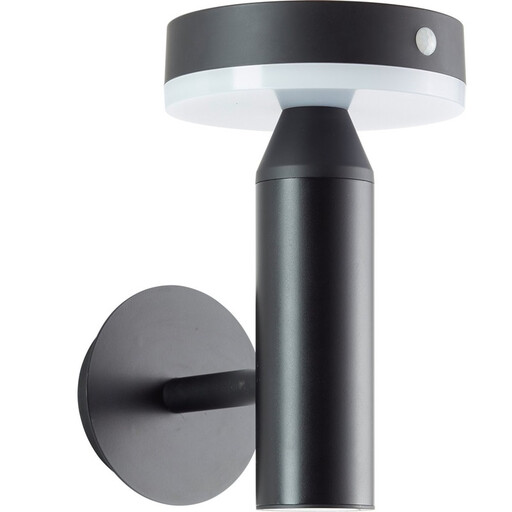
Why it suits this buyer: This solar outdoor light can be mounted without wiring by a balcony, patio, garden path or entrance. Its integrated battery and solar panel mean it doesn’t need to be connected to the mains.
The specifications state 350 lm, a 120° detection angle and IP44. This makes it clear what the light can and can’t do, so you don’t have to rely on marketing claims alone.
Solar power, integrated LED, dimming function and a compact height of around 20.8 cm.
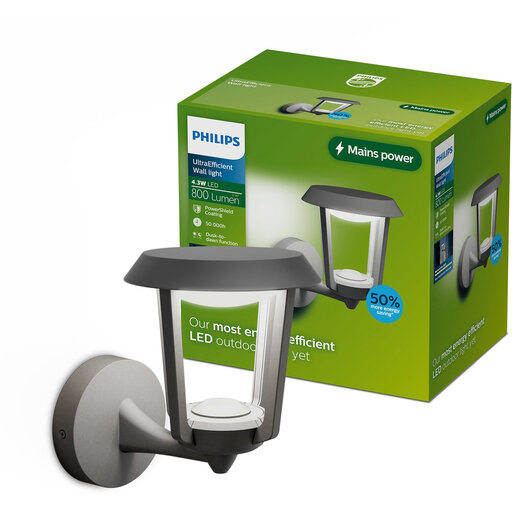
Why it suits this buyer: This fixed wall light is a good fit for an entrance, exterior wall or balcony where you want warm, even LED lighting and have a mains connection available.
The product information gives specific figures for 800 lm, 2700 K, 4.3 W and IP44. This makes it easy to compare the light colour and protection with other outdoor wall lights.
Integrated LED, warm white light at 2700 K and an aluminium housing with a specified PowerShield coating.

Why it suits this buyer: The three adjustable light heads and wide coverage are designed for larger areas such as a driveway, garage, yard or spacious garden.
The stated IP65 rating and range of 60 feet with a 180° angle make it possible to check whether it’s suitable for a larger, more exposed area.
302 LEDs, a stated output of 3000 lm, three lighting modes and a solar panel with an integrated 1800mAh battery.

Why it suits this buyer: This rechargeable outdoor light works without fixed wiring and has a magnetic attachment. That makes it handy for a balcony, rented home or temporary lighting.
The light has an IP44 rating and is designed to withstand splashing water, not to be completely waterproof. This makes its placement limitations clear.
USB-C charging, integrated battery, 300 lm according to the product specifications, and a motion sensor with a day/night function.
We’ve put together a complete, up-to-date list of products that meet these strict selection criteria and the applicable European safety regulations.
Yes, but it may stay on for less time if the solar panel receives less direct daylight. Place the light somewhere as open as possible and keep the panel clean. Choose a fixed mains-powered light if consistent lighting matters more to you than wireless installation.
Around 300 to 800 lm can work well for an entrance, depending on the mounting height and beam spread. A larger driveway or garden area may need more light. Don’t just look at the lumen rating; also consider the detection angle and number of light heads.
An LED light that only switches on when it detects movement will usually be on for less time than one that stays on continuously. Actual consumption depends on the wattage, how long it stays on for and how often it’s activated. Solar and battery-powered versions don’t use mains electricity, but they still need enough sunlight or regular charging.
