
Vandaag of morgen in huis

Kwaliteit gegarandeerd

Welkomstaanbiedingen ontgrendelen: GRATIS bezorging | Tot 80% korting | Gratis 30 dagen JoyPlus-proefperiode
Download de app
Outdoor lighting with a motion sensor can instantly make a dark entrance, driveway or garden path more practical. However, not every outdoor light with a sensor is suitable for every location. A powerful beam is useful by a garage, for example, but may be too bright on a balcony. A solar light is easy to install, but works less predictably when a façade is heavily shaded.
So don’t just look at lumens or an attractive product photo. Pay particular attention to the sensor, protection rating, power supply and installation. This will help prevent the light from running for less time after a few months, switching on unexpectedly or failing to withstand the Dutch weather sufficiently.
The number of lumens indicates how much light a lamp produces according to the product specification. Light distribution is just as important. A light with a wide beam can illuminate a driveway more evenly, while a compact wall light mainly illuminates the immediate area around a door.
For garden path lighting, a gentle light output is often sufficient. According to the product specification, the UME solar path lights provide 10 lumens per light and are designed to subtly mark paths, borders and driveway edges. For a garage or large grounds, a much higher light output makes more sense.
The IP rating provides information about protection against dust and water:
According to the product specification, the UME solar floodlight and UME path lights have an IP65 rating. The Brilliant and Philips wall lights in this selection include IP44 models. It is therefore best to position an IP44 light beneath an overhang or somewhere that is not constantly exposed to driving rain.
Solar outdoor lighting does not need a cable connected to the mains, but the solar panel must receive enough direct light. A panel beneath a balcony, next to a tall fence or under dense foliage will charge less efficiently.
According to the product specification for the UME solar path lights, around 6 to 8 hours of sunlight are needed for a usage time of 8 to 12 hours. The Huacan lights state a charging time of 4 to 6 hours and a usage time of 5 to 8 hours. Treat these figures as product specifications under the stated conditions, rather than guaranteed performance on dark or cloudy days.
Look at three points:
According to the product specification, the UME Solar Outdoor Lights 302 LED have a detection distance of 60 feet, an angle of 180 degrees and three lighting modes. This may be suitable for a wide driveway or back garden. However, check beforehand that the mounting height and direction of movement correspond with how the sensor operates.
A light colour of around 2700K to 3000K generally creates a warmer appearance. This suits a patio, balcony or entrance. A higher colour temperature, such as 5000K, looks whiter and can be useful when visibility around a garage or grounds is the priority.
Also pay attention to the stated light output. A 180-lumen solar wall light is primarily suitable for orientation lighting. An 800-lumen LED outdoor light can illuminate an entrance more generously. According to the product specification, the Philips Zyren provides 4000 lumens and is therefore intended for larger outdoor areas, rather than just a small garden path.
Solar outdoor lighting and rechargeable wall lights can usually be installed without fixed wiring. A fixed 230-volt wall light, on the other hand, requires connection by a qualified installer. This applies, for example, to the Brilliant Todd with an E27 fitting.
Also check:
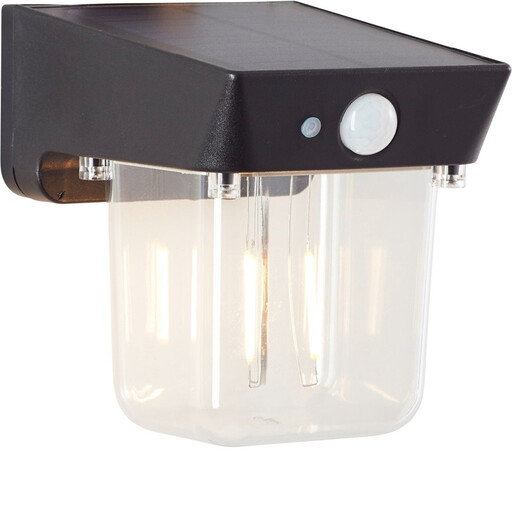
Why it suits this profile: This compact solar wall light is designed for an entrance, small patio or garden façade without a fixed power connection.
The product specification clearly states solar power, a motion sensor and IP44 splash protection. However, install the light in a sheltered position on a sunny façade.
180 lumens, 2700K warm white light, integrated battery and no fixed wiring required.
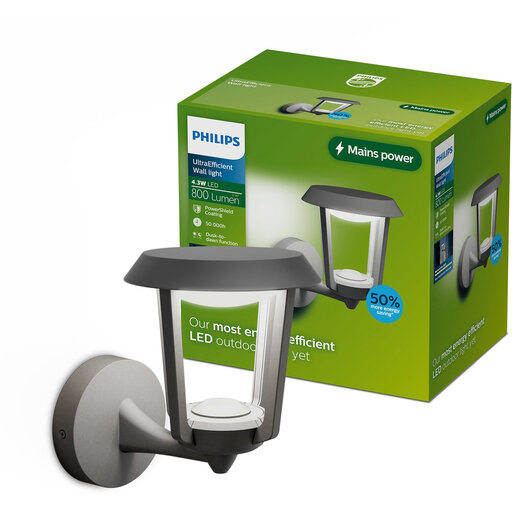
Why it suits this profile: A fixed wall light with integrated LED is a good fit for a well-presented façade, entrance or balcony where a consistent appearance is important.
The product specification states an IP44 rating and 230V connection. This makes it clear in advance that the light should be installed in a sheltered position and may require fixed installation.
800 lumens, 2700K, integrated LED and aluminium housing with PowerShield coating according to the product information.

Why it suits this profile: According to the product specification, this solar floodlight is designed for large areas, such as a wide driveway, grounds or garage area.
The IP65 rating and stated sensor ranges are clearly specified. However, check that 4000 lumens will not be too bright for the chosen location.
According to the product information, 4000 lumens, IP65, a range of up to 8 metres for a direct approach and up to 16 metres for a sideways approach.
We have put together a complete, up-to-date list of products that fully meet these strict selection criteria and the applicable European safety regulations.
Do not point a motion sensor directly at a busy road or moving branches. This can cause unnecessary activation. Mount the light securely and test the range before tightening all the screws fully.
With solar outdoor lighting, regularly cleaning the panel with a soft, slightly damp cloth can help. Also check the sensor opening and remove any leaves or dirt. Maintenance of a fixed 230V wall light must always be carried out safely and in accordance with the instructions.
It can, but the usage time may decrease due to shorter days, cloudy weather and the lower position of the sun. Position the panel as freely as possible towards direct daylight and keep the surface clean. For critical lighting by a front door or garage, a fixed connection may be more predictable.
The lifespan depends on battery capacity, charging conditions, temperature and frequency of use. Manufacturers sometimes state an expected operating time or LED lifespan. Treat these figures as product specifications under certain conditions. An integrated battery or LED cannot always be replaced by the user, so check this before buying.
A light with a motion sensor only comes on when movement is detected, so it may use less energy than lighting that remains switched on continuously. With a solar outdoor light, the energy comes from the solar panel. With a 230V light, consumption depends on the wattage, operating time and number of activations. So, as well as lumens, pay attention to wattage and the sensor duration setting.
