
Vandaag of morgen in huis

Kwaliteit gegarandeerd

Welkomstaanbiedingen ontgrendelen: GRATIS bezorging | Tot 80% korting | Gratis 30 dagen JoyPlus-proefperiode
Download de app
An outdoor light with a motion sensor can make your entrance, garden path, façade or patio more practical. The light switches on when movement is detected, so you do not have to search for a switch in the dark. However, not every light is suitable for every outdoor location.
Many disappointing purchases come down to three recurring pitfalls:
So check the technical specifications and installation location first, and only then consider the colour, brand or design.
Light output is measured in lumens (lm). For a keyhole or small balcony, a compact outdoor LED light with a few hundred lumens may be sufficient. A driveway or larger garden path requires more light.
Colour temperature is measured in kelvin (K):
Also consider the light distribution. A lamp with a high lumen output but a narrow beam may illuminate less area than expected.
The IP code indicates how well a light fitting is protected against dust and moisture. IP44 is a common rating for outdoor lighting with a sensor. In practice, this means protection against solid objects and splashing water.
An IP44 outdoor light is suitable for many sheltered façades, entrances, balconies and patios, but it must not be exposed to direct water jets or submerged in water. According to the product classification, an IP65 solar outdoor light offers greater protection against dust and water jets. Nevertheless, check the installation instructions and do not position the light where water can collect for long periods.
There are three practical options:
Also check whether the light has a motion sensor, dusk sensor or both. A motion sensor responds to movement, while a dusk sensor determines whether it is dark enough to switch the light on. Look at the detection range and mounting direction too. A sensor aimed directly along a route may be less effective at detecting movement from the side.
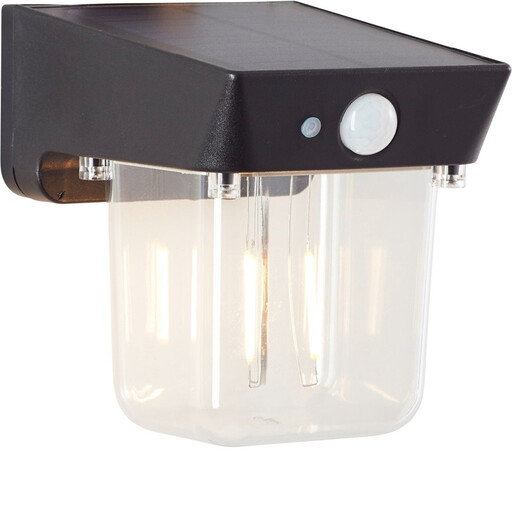
Why it suits this profile: This compact solar outdoor light is designed for a façade, entrance, balcony or patio where there is no existing wiring. It produces 180 lm and has a warm white colour temperature of 2700 K.
The product specifications state that it is solar-powered, has a motion sensor and is rated IP44. This makes it clear from the outset that the light is splash-resistant, but is not designed for submersion or direct water jets.
Integrated LED, 2700 K, 180 lm and a built-in battery. Installation does not require a connection to the mains electricity supply.

Why it suits this profile: Suitable if you want a recognisable brand, permanent wall mounting and brighter lighting by your front door or in your garden.
The specifications list 1000 lm, 3000 K, IP44 and two lighting modes. This makes it easier to assess whether the lamp is intended for ambient or functional lighting.
Solar power without a mains connection, built-in motion sensor, 1000 lm and warm-neutral 3000 K light.

Why it suits this profile: Ideal for a driveway, broad façade or any other area where you want to illuminate a large surface. According to the product description, the light produces 4000 lm, has IP65 protection and an adjustable lamp head.
The stated IP65 rating is higher than IP44. However, check that the mounting is sturdy enough, as the product weight is listed as approximately 1,51 kg.
4000 lm, IP65, 5000 K and a detection range specified by Philips as 8 metres for direct approach and 16 metres from the side.
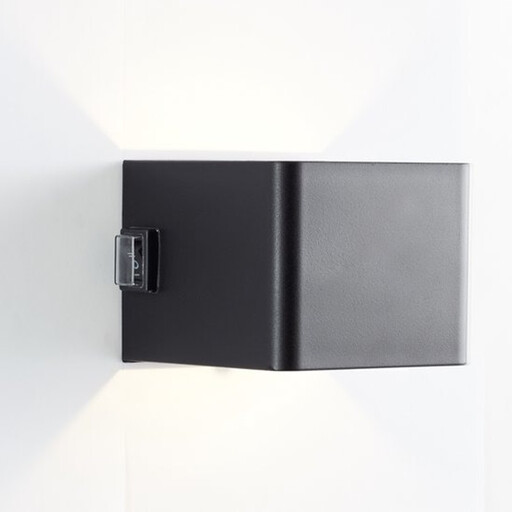
Why it suits this profile: The magnetic mounting and USB-rechargeable battery are useful if you do not want to install permanent wiring or want to use the light flexibly.
The specifications clearly state IP44 and battery power. The light therefore does not depend on a socket, but it does need to be charged and protected from direct water jets.
300 lm, 3000 K, integrated LED, motion sensor and magnetic mounting. According to the product details, the light runs on two 18650 lithium-ion batteries.
We have put together a complete, up-to-date list of products that fully meet these strict selection criteria and the applicable European safety regulations.
Do not use an indoor night light as garden lighting with a motion sensor. For example, the Aigostar LED Sensor Night Light is specified for an indoor environment and is therefore not intended for outdoor use.
A solar outdoor light does not use mains electricity, but its performance depends on sunlight, battery capacity and operating time. A 230-volt light has a stated wattage. You can estimate the energy consumption yourself using the wattage and number of hours the light is on. A motion sensor can limit the operating time compared with outdoor lighting that stays on continuously.
Lifespan varies from model to model and according to the conditions in which it is used. Product details may specify a lifespan of 25.000 or 50.000 operating hours, for example. This is a product specification, not a guarantee that every individual unit will work for exactly that long. With solar lighting, the internal battery is also worth considering, as it cannot be replaced by the user on every model.
This is only possible if the solar panel still receives enough direct light. A covered area, tree or tall façade can reduce charging performance. Also check the IP rating and make sure the light is not exposed to water running down from the edge of the roof.
