
Vandaag of morgen in huis

Kwaliteit gegarandeerd

Welkomstaanbiedingen ontgrendelen: GRATIS bezorging | Tot 80% korting | Gratis 30 dagen JoyPlus-proefperiode
Download de app
An outdoor light with a motion sensor can automatically illuminate an entrance, garden path, patio, balcony, garage or driveway. However, not every light is suitable for the same location. A model that works perfectly well under a covered veranda may be less suitable on a wall that is directly exposed to rain and wind.
The most common mistakes are usually not related to appearance, but to unclear product specifications. Pay particular attention to these three pitfalls:
A high lumen rating without suitable light distribution
More light is not always more practical. A powerful LED outdoor light can cause glare, while a narrow beam may illuminate only a small part of the driveway. Also check the number of adjustable light heads and the lighting angle.
A sensor that is unsuitable for the installation location
A motion sensor responds to movement within a specific range and angle. If the light is mounted too high, positioned behind an obstacle or aimed at a busy road, it may switch on too often or not often enough.
Misinterpreting an IP rating
IP44 means protection against splashing water; it does not mean that a light can withstand direct jets of water. For an unprotected wall or a large outdoor area, IP65 may be more practical. Always check where the light can be installed.
Light output is measured in lumens (lm). For a balcony or front door, around 300 to 400 lm may be enough for orientation. For a garage, wide driveway or larger garden, a more powerful model may provide better coverage.
Colour temperature is measured in kelvin (K):
A solar outdoor light with multiple light heads can spread light across a larger area. According to its product specifications, the UME light has three adjustable heads and a lighting angle of up to 270 degrees. Its stated light output is 3000 lm. This makes the model particularly suitable for a large garden, garage area or driveway, provided that the solar panel receives enough direct sunlight.
Wireless outdoor lighting is useful when you do not want to run a cable. Solar models charge during the day and use an internal battery once it gets dark. Performance depends on positioning, the season, shade and dirt on the solar panel. In the Netherlands, output may be lower than expected on overcast days.
A light powered by a rechargeable battery gives you more freedom when choosing where to install it, but it needs to be recharged regularly. A mains-powered model, such as a fixed outdoor wall light with a sensor and E27 fitting, must be installed by a qualified electrician. The advantage is that it does not depend on sunlight or having to recharge a battery.
The IP code indicates how much protection a product offers against solid particles and moisture:
Also check the installation height, weight and supplied mounting materials. A magnetic light is flexible, but it is only safe when the metal surface or mounting plate is clean, flat and sturdy.
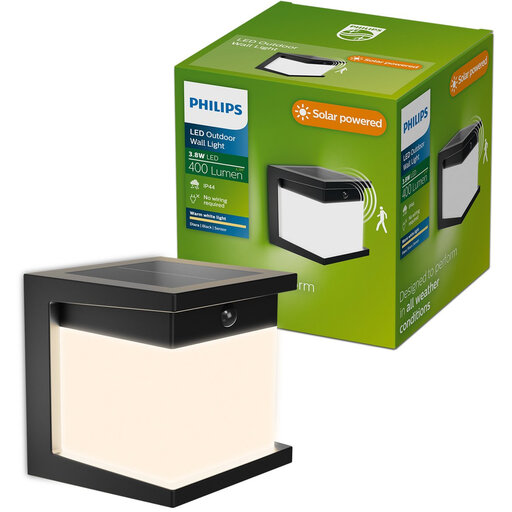
Why it suits this profile: A compact solar-powered outdoor wall light that does not require fixed wiring. Suitable for a balcony, garden wall or sheltered entrance.
The product specifications state 400 lm, 2700K, two lighting modes and a dusk sensor. This makes the light output and operation clearly defined.
Solar power, integrated LED, 400 lm and IP44 splash protection.
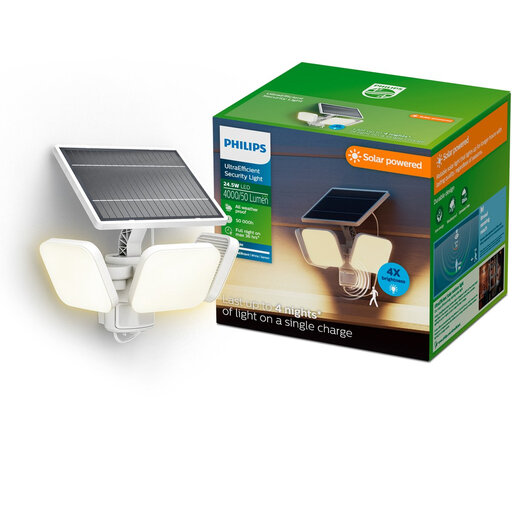
Why it suits this profile: A powerful model for anyone who wants to illuminate a larger driveway, garage area or exterior wall with solar outdoor lighting.
The stated specifications include 4000 lm, IP65, a sensor range of up to 8 metres when approached directly, and two lighting modes.
IP65 protection, adjustable light head, 3000K colour temperature and solar power.

Why it suits this profile: For large outdoor areas where broad light distribution and a wide motion-detection range are required.
The description states a detection distance of 60 ft, a sensor angle of 180 degrees and three lighting modes. Before installation, check that these values suit your outdoor space.
302 LEDs, stated 3000 lm, three adjustable heads and IP65 water resistance.

Why it suits this profile: A wireless light for a balcony, patio or temporary installation without a fixed connection.
The light runs on a rechargeable battery and does not require fixed wiring. However, IP44 means you should avoid direct water jets and immersion.
300 lm, 3000K, integrated 4W LED, magnetic mounting and USB-C charging according to the product description.
We have compiled a complete, up-to-date list of products that fully meet these strict selection criteria and the applicable European safety regulations.
Place a solar outdoor light where the panel receives as much direct sunlight as possible during the day. Avoid shade from trees, roof edges and walls. Do not point the sensor directly at a busy footpath if you want to limit unwanted activation.
A mains-powered outdoor wall light with a sensor must be connected in accordance with local regulations by a qualified electrician. A portable LED light can be used without professional installation, but with magnetic mounting, always check that the fixing can support the weight.
Clean the solar panel and sensor window regularly with a soft, slightly damp cloth. For models with IP44, do not use a pressure washer and do not install them somewhere they will be constantly exposed to heavy rain.
For a front door or balcony, 300 to 400 lm is often suitable for basic lighting. For a driveway, garage or spacious garden, a model with a higher stated light output and broader light distribution may be more practical. As well as lumens, consider the installation height and beam angle.
A solar outdoor light does not use mains electricity during normal operation. However, performance depends on sunlight, battery capacity and panel maintenance. In darker periods, the operating time may be shorter. A rechargeable battery model mainly offers the convenience of regular charging.
IP44 is designed to protect against splashing water and is mainly suitable for sheltered locations, such as beneath a covered area or on a balcony. For an unprotected wall or a light that receives a lot of rain, IP65 may be a more suitable choice. Always check the installation instructions for the specific product.
