
Vandaag of morgen in huis

Kwaliteit gegarandeerd

Welkomstaanbiedingen ontgrendelen: GRATIS bezorging | Tot 80% korting | Gratis 30 dagen JoyPlus-proefperiode
Download de app
A light that switches on automatically by your driveway, front door or garage is practical. However, not every outdoor light with a motion sensor is right for every situation. A solar light may look powerful on paper, but fail to charge sufficiently in a shady garden. A mains-powered wall light works reliably, but often requires installation by a qualified electrician.
Joybuy Product Recommendation Officer helps you assess the key differences, so you can make a more informed choice between a solar outdoor light with a motion sensor, an LED security light or a fixed light for lighting walls, gardens and patios.
A high lumen figure tells you about the maximum light output, but not how the light is distributed or how long it lasts. A light with a wide beam may illuminate a driveway more evenly than a compact model with a narrower beam. So check:
With a solar floodlight, battery capacity and the amount of sunlight it receives also play a major part. A north-facing wall or a spot beneath a balcony offers fewer charging opportunities than an open, south-facing position.
The IP rating is important for outdoor use. An IP65 outdoor light is dust-tight and protected against water jets from different directions. That doesn’t mean you can submerge it in water. Even with waterproof outdoor lighting, you should follow the fitting instructions and prevent water from collecting around the connections for long periods.
IP44 provides protection against splashing water and is suitable for some sheltered locations. It is not the same as IP65. So it’s best to place an IP44 wall light beneath a canopy or somewhere it won’t be directly exposed to heavy rain and water jets.
A sensor doesn’t always detect movement in the same way. Its range can vary depending on whether you walk directly towards it or move past it sideways. Check:
You don’t need a very wide detection angle for a narrow entrance. For a driveway or large plot, a wide angle can be useful.
An outdoor solar light works without fixed wiring. This makes it a convenient option for rented homes, sheds and parts of the garden without a power point. However, the solar panel needs enough direct daylight. Clean it regularly with a soft cloth.
A fixed 230 volt wall light doesn’t need a solar panel or built-in battery. On the other hand, it may need to be fitted and connected by a qualified electrician. This is particularly relevant for a light such as the Brilliant Todd, which is supplied without a bulb and has an E27 fitting.
Colour temperature is measured in kelvin:
Also check whether the light has an integrated LED or uses a separate bulb. With an E27 light, you can choose a suitable bulb yourself, whereas an integrated LED is usually ready to use straight away.
An outdoor light with a dusk-to-dawn sensor can respond to the surrounding light levels. A motion sensor then switches the light on when it detects movement. Some models combine both functions and offer additional light settings, such as switching on only when movement is detected or providing a lower level of ambient lighting.
Bear in mind that claims about battery life or detection are based on the product specifications. According to Philips’ own information, the Zyren can provide light for up to four nights on a fully charged battery. Actual performance depends on factors including sunlight, temperature, the selected light setting and how often the sensor is activated.

Why it suits this profile: A wireless solar outdoor light with a motion sensor for the garden, garage, patio or driveway. Its three light heads are angled to cover a wide outdoor area.
The specifications state a detection range of 60 feet, a 180° sensor angle and three light settings. Its IP65 rating makes it suitable for exposure to rain, provided it is fitted correctly.
302 LEDs, a stated light output of 3000 lumens, three adjustable heads and a built-in 1800mAh lithium-ion battery.
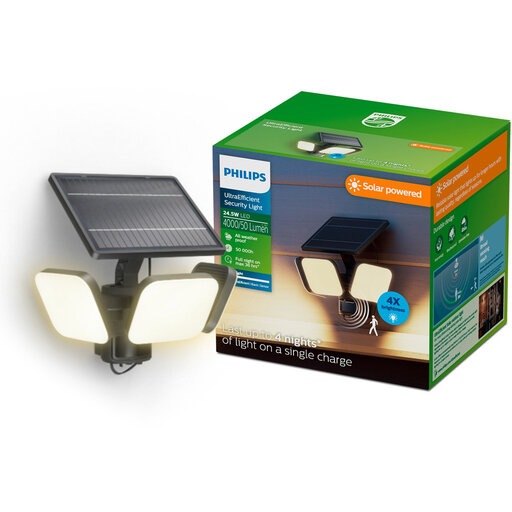
Why it suits this profile: A good fit if you’re looking for a powerful solar security light for a wall, garage or driveway, with a warmer colour temperature and an adjustable light head.
The product specifications list IP65, a dusk-to-dawn sensor and a detection range of 8 metres when approached directly and 16 metres when approached from the side.
A stated light output of 4000 lumens, 3000 K, two light settings and an integrated LED. According to Philips’ own information, the light can work for up to four nights after a full charge.
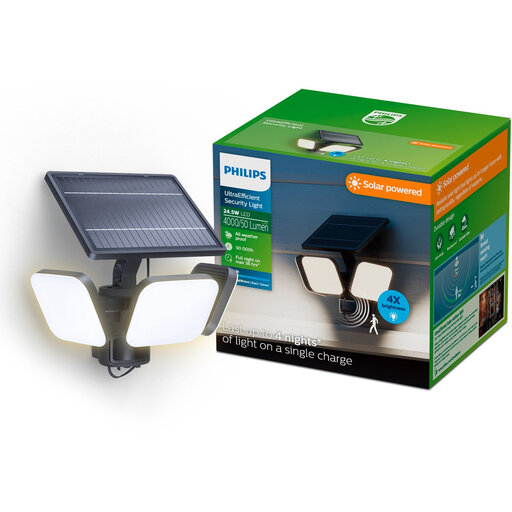
Why it suits this profile: The 5000 K version is a good choice for practical lighting across a wide driveway, work area or garage entrance where white light is preferred.
The combination of motion and dusk sensors prevents the light from coming on unnecessarily during the day. Its stated detection range makes it suitable for different directions of approach.
4000 lumens, 5000 K, IP65, two light settings and an adjustable light head. According to the product description, it can be fitted without fixed wiring.
Another option is the Brilliant Todd outdoor wall light. This model uses 230 volt, has an E27 fitting rated for up to 60 watts and is supplied without a bulb. Its IP44 rating makes it suitable for sheltered walls, entrances and gardens. Have it connected by a qualified electrician.
We’ve put together a complete, up-to-date list of products that meet these strict selection criteria and the applicable European safety regulations.
Choose a spot with as much direct sunlight as possible, and don’t point the panel towards a wall or beneath an overhang. Fit the light securely at the recommended height, then test the sensor by walking both directly towards the light and past it from the side. Clean the solar panel and sensor window regularly with a soft, damp cloth.
How long it lasts each night depends on the battery, charge level, temperature, light setting and number of times the sensor is activated. A spell of cloudy weather can limit how much it charges. So don’t look only at the stated number of operating hours; check the battery capacity and light settings too, and consider where you plan to fit the light.
A solar light doesn’t use mains electricity during normal operation. For a fixed LED security light, its power consumption depends on its wattage and how long it stays on. A sensor can limit the number of hours it is lit by switching it on only when it detects movement. Set the duration to suit your entrance, garden or driveway.
