
Vandaag of morgen in huis

Kwaliteit gegarandeerd

Welkomstaanbiedingen ontgrendelen: GRATIS bezorging | Tot 80% korting | Gratis 30 dagen JoyPlus-proefperiode
Download de app
An outdoor light with a motion sensor can be useful by the front door, garage, garden, driveway or balcony. The light only switches on when movement is detected, making it more practical than lighting that stays on all evening. However, models vary considerably in terms of power supply, brightness, installation and protection against rain.
If you focus only on terms such as “extra bright”, “waterproof” or “energy-efficient”, you could end up buying a light that is unsuitable for its intended location. Below, we highlight the key points to consider, along with some popular choices for different situations.
The number of lumens indicates how much light a lamp produces according to its product specifications. A high figure is not automatically suitable for every location. For a balcony or entrance, 400 lumens may be sufficient, while a wide driveway needs more light and a broader beam angle.
Also pay attention to the colour temperature:
An IP44 outdoor light is protected against splashing water, but is not designed for immersion or powerful jets of water. An IP65 outdoor light offers greater protection against dust and water jets. IP65 still does not mean that you can place the light underwater.
According to the product information provided by the relevant brands, the IP44 models are suitable for general outdoor locations such as a wall, balcony or garden. Ideally, do not place them somewhere where they are continuously exposed to direct water from a roof edge or sprinkler. Also check that the connection points and mounting holes are sealed in accordance with the instructions.
An outdoor solar light is wireless and does not require a permanent mains connection. This makes installation easy, but performance depends on where it is positioned. A panel facing north, beneath a balcony or behind tall plants may receive too little direct sunlight.
When choosing an outdoor solar light, consider:
Look beyond simply seeing “with sensor” in the product description. Check the detection distance, the horizontal angle and the direction from which people approach the sensor. Some sensors detect movement from the side more effectively than someone approaching head-on.
A compact sensor may be sufficient for a narrow entrance. For a driveway or back garden, a wide detection angle is more useful. A light with an adjustable head can also direct the light more precisely towards a path, door or garage.
A solar-powered light is a type of wireless outdoor lighting and is usually easy to install yourself. A battery-powered model offers similar flexibility, but needs to be recharged or have its batteries replaced periodically. A permanent 230-volt outdoor wall light works without a battery, but the connection must be carried out by a qualified installer whenever wiring is required.
Before buying, ask yourself:
IP44 may be suitable for a covered entrance. For a wall that is exposed to a lot of rain and dust, IP65 may provide better protection. Also check the material: plastic is lightweight and practical, while aluminium or metal offers a different appearance and places different demands on the mounting surface.
A magnetic model is quick to install, but the surface must be flat, clean and magnetic. A heavier light requires the mounting plate to be secured firmly. Always check the weight and the included mounting materials.

Why it suits this profile: This compact outdoor solar light works without permanent wiring and is intended for a garden, patio or entrance where modest light output is sufficient.
The specifications clearly state that it has an integrated battery, solar power, a motion sensor and IP44 splash protection. With 180 lumens, this light is not intended for a large driveway.
Integrated LED, 2700 K warm light, solar panel and a compact height of 11.5 cm.
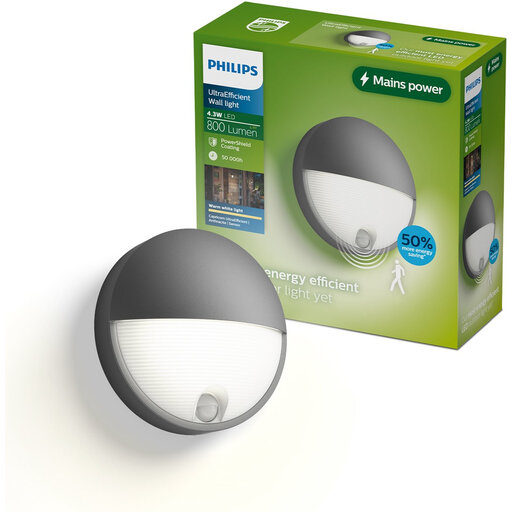
Why it suits this profile: A permanent wall light for a façade or entrance is ideal for households looking to combine a neat appearance, a permanent power supply and automatic activation.
The light output of 800 lumens, 2700 K colour temperature and IP44 rating are listed separately. Bear in mind that a permanent connection is required, and have the installation carried out in accordance with the applicable regulations.
Integrated LED, 800 lumens, dusk and motion sensor, and an aluminium housing.
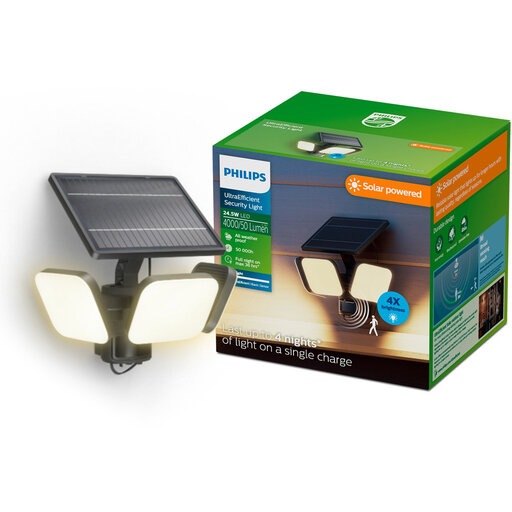
Why it suits this profile: For a driveway, garage or larger grounds, broad detection and high light output are more important than a decorative light source.
According to the product information, this model has IP65 protection, a detection distance of 8 metres when approached directly and 16 metres for lateral movement. Check the exact mounting angle for your location.
4000 lumens, 5000 K, solar power, two lighting modes and an adjustable light head.

Why it suits this profile: This wireless model is suitable if you do not want to drill holes or do not have a power point, and want to use lighting temporarily or in multiple locations.
The specifications state that it supports USB-C charging, magnetic mounting and IP44 splash protection. This means the light is not intended for direct water jets or immersion.
300 lumens, 3000 K, built-in LED, rechargeable battery and magnetic mounting.
We have put together a complete, up-to-date list of products that fully meet these strict selection criteria and the applicable European safety regulations.
An outdoor solar light does not use electricity from the mains during normal operation. The main ongoing tasks are keeping the solar panel clean and checking the battery. In winter, charging performance may be lower because of shorter days, cloudy weather and the sun’s lower position.
With a battery-powered model, you need to allow for charging or replacement. A permanent LED outdoor light may use very little electricity, but it does require a correct electrical connection. For integrated LED lights, always check whether the light source can be replaced; in several of the models mentioned, it is integrated and not intended to be replaced by the user.
Aim the sensor at the area where people actually walk, such as a path or driveway. Install the light securely and prevent branches, flags or traffic from triggering the sensor continuously. With solar lighting, the panel should receive as much direct sunlight as possible.
The operating time per night depends on sunlight, battery capacity, lighting mode, temperature and how often the sensor is triggered. A product specification stating the LED’s lifespan does not automatically indicate how long the battery will last. Therefore, check both figures separately.
A solar-powered light does not use mains electricity during operation. With a mains-powered model, the motion and dusk sensors limit the amount of time the light stays on. Actual consumption depends on the wattage and the number of hours the light is active. Therefore, check the stated power consumption in watts rather than looking only at the number of lumens.
