
Vandaag of morgen in huis

Kwaliteit gegarandeerd

Welkomstaanbiedingen ontgrendelen: GRATIS bezorging | Tot 80% korting | Gratis 30 dagen JoyPlus-proefperiode
Download de app
An outdoor light with a motion sensor can automatically illuminate a dark front door, driveway or garden path. However, not every light is suitable for every location. A model that works well on a sheltered balcony wall may not provide enough protection on an exposed façade. Terms such as “security lighting”, “solar” and “water-resistant” can also create expectations that do not always match the product specifications.
Joybuy Product Recommendation Officer selects products based on verifiable information, such as light output, IP rating, power source and mounting method. This helps ensure that you are not mainly paying for marketing language.
Lumens indicate how much light a lamp produces according to its product specifications. An LED outdoor light of 300 lumens may be sufficient for a front door or balcony, but is less suitable for illuminating a wide driveway. A 4,000-lumen light, on the other hand, is powerful enough for a yard or large garden, but may be unnecessarily bright for a small entrance.
Also consider the colour temperature. 2700K to 3000K produces warm white light, which is often pleasant for a patio or façade. 5000K looks cooler and provides greater contrast, which can be practical for a driveway or large outdoor area.
An IP44 outdoor light is protected against solid objects larger than 1 millimetre and splashing water. This makes IP44 suitable for many sheltered façades, balconies and entrances, but not for immersion or powerful, direct water jets.
An IP65 outdoor light offers greater protection against dust and water jets. Even so, check the mounting instructions and do not install the light where water can remain for long periods. The IP rating does not replace correct installation.
A solar outdoor light does not need to be connected to the mains, but its solar panel must receive enough direct daylight. Shade from a canopy, tree or neighbouring property can reduce charging performance. In winter, the days are shorter and less sunlight is available.
If you want to install a light on a north-facing wall or beneath a canopy, a rechargeable battery model or a fixed outdoor wall light may be a better choice.
Use lumens as your first point of comparison:
Also look at the direction of the beam. A light with adjustable heads can cover a larger area. A compact light with downward illumination is more suitable if you only want to light the keyhole or a narrow path.
Check whether the light has a motion sensor and, if applicable, a dusk sensor. A motion sensor switches the light on when movement is detected; a dusk sensor prevents this from happening during the day. The stated range applies under specific conditions. Therefore, do not position the sensor directly opposite a busy road if you want to limit unwanted activation.
Some models let you choose between automatic mode and a permanent-on mode. This is useful when you want to use the light temporarily as a conventional garden light.
A wireless battery-powered outdoor light can be positioned flexibly, but needs regular charging. A solar wall light charges independently, provided the location is suitable. A 230-volt light provides a constant power supply, but requires fixed wiring and, for some models, installation by a qualified electrician.
When installing, pay attention to:
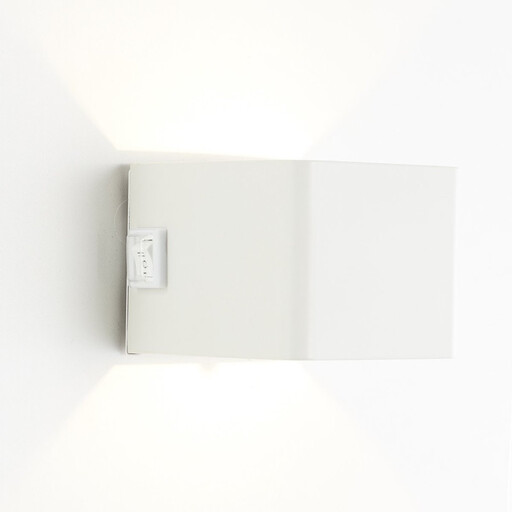
Why it suits this profile: This compact, wireless light is suitable for a balcony, veranda, hallway or small entrance where there is no nearby socket.
The specifications state 300 lumens, 3000K and IP44. This makes it clear that the model is intended for targeted lighting and splash protection, not for a large, exposed driveway.
4W integrated LED, two 18650 batteries, magnetic mounting and USB charging.
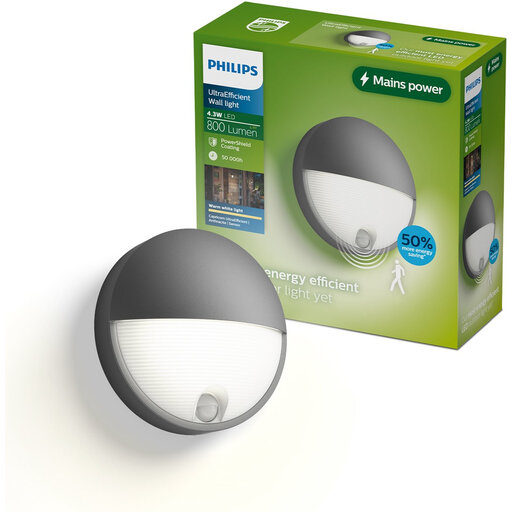
Why it suits this profile: A fixed aluminium wall light is ideal for an entrance or façade where appearance and a constant power connection are important.
The combination of 800 lumens, 2700K, IP44, plus a dusk and motion sensor makes the intended use easy to verify.
Aluminium housing, integrated LED, 4.3W power consumption and a statutory warranty of at least two years, according to the product information.

Why it suits this profile: This model is designed for larger gardens, driveways and façades where a broad, powerful beam is needed without a fixed power cable.
The product specifications state IP65, with a detection range of 8 metres for direct approach and 16 metres for sideways movement. This clearly positions the light differently from a compact IP44 model.
4,000 lumens, adjustable light head, solar power and two lighting modes. The manufacturer states that it can run for up to four nights on a full battery.
We have compiled a complete, up-to-date list of products that fully meet these strict selection criteria and the applicable European safety regulations.
Always follow the product’s installation instructions. Generally speaking, a sensor on a fixed façade works most predictably when it is not mounted too low and has an unobstructed view of the approach area. Do not point it directly at a busy road or moving branches to limit unnecessary activation.
A solar outdoor light does not use electricity from the mains during normal operation. There are, however, practical requirements: the solar panel must receive enough daylight and the battery has a limited lifespan. Therefore, check whether the battery can be replaced. For models with an integrated battery, do not open the housing yourself if the manufacturer advises against it.
IP44 is sufficient for many sheltered outdoor locations, such as a balcony, covered entrance or façade. This rating does not mean that the light is waterproof. For an exposed location with greater exposure to dust and water, IP65 may be a suitable choice. Always check the full product information and installation instructions.
