
Vandaag of morgen in huis

Kwaliteit gegarandeerd

Welkomstaanbiedingen ontgrendelen: GRATIS bezorging | Tot 80% korting | Gratis 30 dagen JoyPlus-proefperiode
Download de app
An outdoor light needs to do more than look good. In the Netherlands, outdoor lighting has to cope with rain, wind, damp and limited sunshine during winter. Yet when shopping, people often focus mainly on colour, shape and discounts. As a result, a light may end up somewhere its IP rating isn’t suitable, a solar outdoor light may barely shine in winter, or a wall light without a bulb holder may prove awkward to use.
Use these practical checks to compare outdoor lights based on the features that really matter.
An IP44 outdoor light is protected against solid objects and splashing water. This makes it suitable for many covered entrances, balconies, patios and exterior walls, but not necessarily for places exposed to direct jets of water. An IP65 outdoor light offers greater protection against dust and water jets, making it a better choice for an exposed driveway, shed or garden wall.
IP44 doesn’t mean a light is completely waterproof. Check where you plan to install it, too, and follow the manufacturer’s safety instructions.
An outdoor solar light doesn’t need a mains cable, but its panel needs enough direct sunlight during the day. Shade from a roof edge, tree or fence can reduce charging. In winter, shorter days and cloudy weather can further affect how long the light stays on.
According to information from Philips, the Fyns, Diara and Swyn models are solar-powered and have a motion or dusk sensor. Treat this as a useful feature, not a guarantee of a set operating time in all weather conditions.
Lumens indicate how much light a lamp produces. Wattage mainly tells you how much power it uses, so it’s less useful for comparing the brightness of LED lights. For ambient patio lighting, 180 to 400 lumens may be enough. For a driveway, gate or security-focused exterior lighting, a higher light output may be more practical.
Also consider the colour temperature. 2700 K to 3000 K generally gives a warm white light, while 4000 K looks more neutral. A high light output isn’t necessarily more comfortable in a small garden.
Start by checking the IP rating, then look at the construction. Aluminium can be a sturdy choice for fixed exterior wall lights, while plastic is often lighter and practical for solar products. Check whether the product is designed for a sheltered or exposed location.
A weather-resistant outdoor light also needs to be installed correctly. Make sure screws, wall plugs and connection points are suitable for the surface. Fixed 230V lighting should be installed by a qualified electrician.
There are three common options:
Always check whether an LED bulb is included. With a GU10 or E27 wall light, you may need to buy a suitable LED bulb separately.
An outdoor light with a motion sensor is useful by an entrance, garage or driveway. Check the detection angle and range, and whether the sensor only works in the dark. On solar products, a sensor can help conserve battery power, but performance still depends on the charge level.
For ambience, look for dimmability, warm light and different settings. A light with multiple colours or a flame effect is better suited to a patio than to functional exterior lighting.
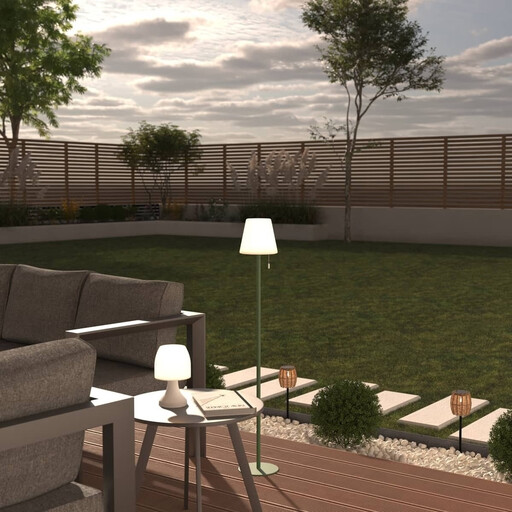
Why it suits this profile: This cordless garden light is easy to move around a balcony, patio or garden. Battery power means there’s no need for fixed wiring.
The specifications list IP44 and a battery life of up to ten hours. This makes it clear that the light is splash-resistant, but isn’t designed for direct jets of water.
108 cm tall, with three lighting modes and a removable light source. Ideal for ambient lighting without wall installation.
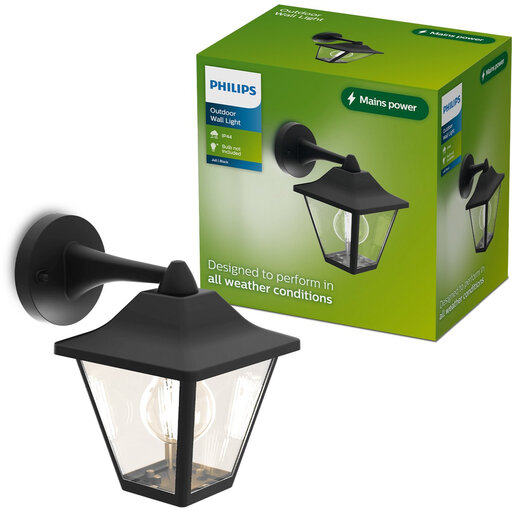
Why it suits this profile: This classic wall light works well by an entrance, on a veranda or on an exterior wall. Choose your own E27 LED bulb to get the light colour you want.
The fitting and IP44 rating are clearly stated. The light is supplied without a bulb, so you can factor in the extra purchase beforehand.
E27 fitting, aluminium housing and dimensions of 15 × 21.7 × 22.2 cm. Dimmability depends on the bulb and dimmer you choose.

Why it suits this profile: This solar floodlight is designed for a driveway, garage, large garden or rear area where broad light coverage is needed.
The product information lists IP65, three lighting modes and a sensor range of 60 feet. Make sure the panel is placed somewhere with enough direct sunlight.
302 LEDs, a stated light output of 3000 lumens, three adjustable heads and wide coverage of up to 270 degrees.

Why it suits this profile: This rechargeable wall light with magnetic mounting is handy for rented homes, balconies and places without a power connection.
The light runs on an integrated battery and recharges via USB-C. IP44 means it’s splash-resistant; avoid submerging it or exposing it to direct jets of water.
USB-C charging, motion sensor, magnetic mounting and 300 lumens at 3000 K, according to the product specifications.
We’ve put together a complete, up-to-date list of products that meet these strict selection criteria and the applicable European safety regulations.
Position a solar outdoor light with its panel facing the sunniest direction, and keep the surface clear of leaves and dirt. Clean the sensor and solar panel with a soft, slightly damp cloth. Switch off the power before working on a fixed outdoor wall light. Have 230V connections installed in accordance with local regulations.
For lights with magnetic mounting, choose a firm, flat surface. Check regularly that the fitting is still secure, especially after windy or frosty weather.
For ambient lighting on a balcony or patio, 180 to 400 lumens may be enough. A higher light output is more practical for a driveway, garage or large garden area. Check the beam angle, too: a wide beam lights up more space but can cause glare more easily.
An IP44 light is protected against splashing water, but not against direct jets of water or prolonged exposure to running water. Choose one for a sheltered exterior wall, balcony or covered area, and check the installation instructions. For a more exposed location, IP65 may be a better choice.
A solar outdoor light doesn’t use electricity from the mains. However, its integrated battery needs to charge during the day, and operating time can vary depending on the season, cloud cover and shade. Keep the solar panel clean and choose a spot with enough direct sunlight.
