
Vandaag of morgen in huis

Kwaliteit gegarandeerd

Welkomstaanbiedingen ontgrendelen: GRATIS bezorging | Tot 80% korting | Gratis 30 dagen JoyPlus-proefperiode
Download de app
Buying an outdoor light seems simple, until you discover that not every model is suitable for the spot where you want to use it. A light for a covered balcony has different requirements from one beside an open driveway. Terms such as ‘water-resistant’, ‘extra bright’ and ‘solar-powered’ only tell you so much, so it’s important to check the technical specifications.
In this buying guide from the Joybuy Product Recommendation Officer, you’ll find out what to look for in outdoor lights, which common pitfalls can lead to the wrong purchase and what type of outdoor lighting is right for you.
A light rated IP44 is protected against splashing water, but it isn’t designed to withstand direct jets of water or immersion. This makes an IP44 outdoor light suitable for a sheltered exterior wall, veranda or covered patio, but less suitable for a completely exposed spot where rain can come from any direction.
For an open garden, driveway or fence, IP54 or IP65 may be more practical. Always check the full product description and installation instructions. A higher IP rating doesn’t automatically mean that the light can be installed anywhere.
A higher lumen output means more light, but not necessarily better light for your needs. For atmospheric patio lighting, 300 to 550 lumens may be enough. For a driveway or security lighting, a more powerful model may make more sense.
Wattage mainly indicates energy consumption. For an LED outdoor light, it doesn’t tell you how much light you’ll get on its own. Check the lumens, colour temperature and direction in which the light is cast, too.
A solar-powered outdoor light doesn’t need mains electricity, but its solar panel needs enough direct sunlight during the day. If you install the light under a solid canopy or on a north-facing wall, its run time may disappoint. Trees, exterior walls and shade from other buildings can all affect charging.
According to the manufacturer’s product information, a solar product’s run time and charging performance can vary depending on the amount of sunlight, temperature and selected light mode. So don’t automatically assume that a solar-powered outdoor light can replace fixed lighting.
The IP code consists of two numbers:
For an outdoor wall light beneath a covered area, IP44 may be sufficient. For path lights in an open garden or a solar-powered outdoor light beside a driveway, IP54 or IP65 is worth considering, depending on the exact installation location.
Outdoor lights are generally available as:
An outdoor light with a motion sensor switches on only when it detects movement. Check the detection angle, range and whether the sensor can be switched off during the day. A sensor is especially useful by an entrance, garage, garden path or driveway.
Warm white light at around 2700K to 3000K usually creates a relaxing atmosphere for patio and balcony lighting. At around 4000K, the light looks more neutral and functional. A higher colour temperature can look cooler, so check that the product information describes it accurately.
When installing your light, consider:
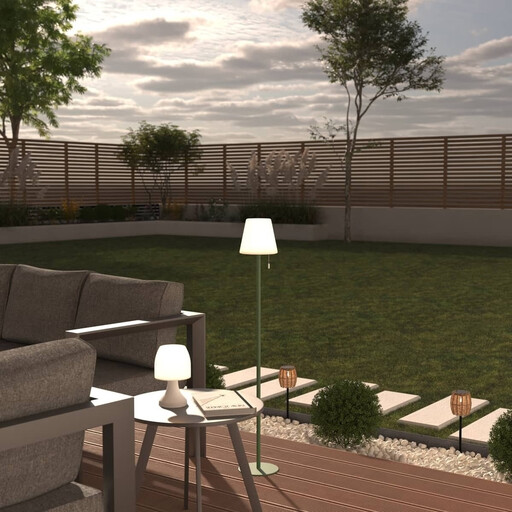
Why it suits this type of user: This freestanding light can be used on a balcony or patio without fixed wiring. Battery power and three light modes give you flexibility for ambient lighting.
The IP44 rating indicates that this model is designed to withstand splashing water. Place it in a sheltered spot, away from direct jets of water.
108 cm tall, manual controls, three light modes and a stated run time of up to ten hours.
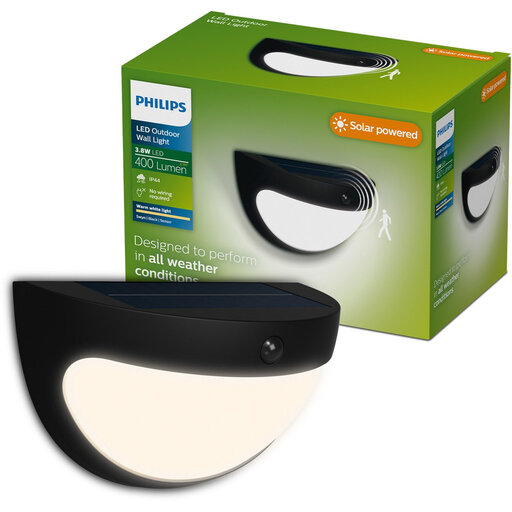
Why it suits this type of user: This solar-powered outdoor wall light combines a daylight sensor and motion sensor with warm white light. It’s a good choice for an entrance or sheltered exterior wall where you don’t want to install a cable.
The product information states that it has an IP44 rating and warns against immersing the light. It must therefore be installed in a sheltered spot.
Two light modes, integrated LED, 400 lumens per light and installation without a mains cable.

Why it suits this type of user: This model is designed for larger areas such as a driveway, garage or spacious garden. Its three adjustable heads and motion detection provide wide light coverage.
With an IP65 rating, this model is better protected against dust and jets of water than IP44 models, according to the product specifications. Choosing the right installation spot and ensuring it gets enough sunlight are still important.
Stated detection range of 60 feet, 180° detection angle, three light modes and three adjustable light heads.

Why it suits this type of user: This rechargeable outdoor light with magnetic mounting is handy for renters or anyone who likes to change the layout of their balcony or patio regularly.
USB-C charging means there’s no need for fixed wiring, but you’ll need to recharge it regularly. Its IP44 rating makes sheltered installation important.
Integrated LED, 300 lumens, 3000K, motion sensor and magnetic mounting without a fixed cable.
We’ve put together a complete, up-to-date list of products that meet these strict selection criteria and current European safety regulations.
IP44 may be suitable for a sheltered exterior wall or covered balcony. For an open garden, driveway or fence, IP54 and IP65 are often more suitable, depending on exposure to rain, dust and jets of water. Always check the installation instructions for the specific product.
Run time per night depends on battery capacity, the amount of sunlight, temperature and light mode. Clean the solar panel regularly and position it somewhere as free from shade as possible. Manufacturer figures are estimates; winter and cloudy conditions can affect performance.
LED lighting generally uses little electricity, but running costs depend on the wattage and how many hours it’s switched on. Calculate it easily using: wattage ÷ 1000 × hours of use × your electricity tariff. Solar-powered outdoor lights don’t use mains electricity while running, but remember that batteries age and may need replacing if they no longer charge properly.
