
Vandaag of morgen in huis

Kwaliteit gegarandeerd

Welkomstaanbiedingen ontgrendelen: GRATIS bezorging | Tot 80% korting | Gratis 30 dagen JoyPlus-proefperiode
Download de app
An outdoor light needs to do more than look good. In the Netherlands, outdoor lighting has to cope with rain, wind, damp and temperature fluctuations. Yet when choosing a light, people often focus mainly on its colour and shape. The result? It may prove too fragile, fail to provide enough light or be difficult to install.
Watch out for these common pitfalls:
The IP code consists of two digits. The first indicates protection against solid objects; the second indicates protection against moisture. An IP44 light is protected against solid objects measuring 1 millimetre or more and against splashing water from different directions.
This makes an IP44 outdoor light suitable for many sheltered locations, such as:
If the light will be exposed to constant rain, a higher protection rating may be more suitable. Always check the installation instructions and the manufacturer’s information.
A GU10 outdoor light uses a GU10 bulb. A fitting with an E27 socket is suitable for many standard screw-in bulbs. Check three things:
A fitting supplied with an LED bulb is quicker to set up. With a fitting that doesn’t include a bulb, you have more freedom to choose the colour temperature and brightness, but you’ll need to select and buy the bulb separately.
For table lighting, around 270 to 300 lumens is often practical, depending on the situation. For a driveway, path or wall, lumens aren’t the only thing to consider: the direction of the light matters too.
Also check the dimensions. A light that’s 34 cm tall needs a different spot from a compact fitting measuring around 10 cm.
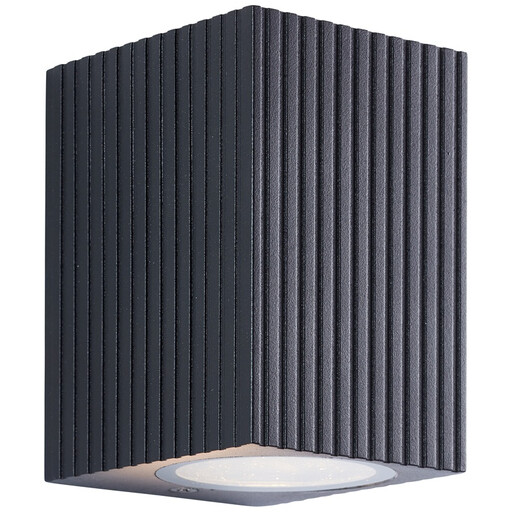
Why it suits this profile: This compact black outdoor light has a GU10 fitting and is ideal for a wall, fence or entrance where you want a discreet fitting.
The product information clearly states that the bulb is not included and that you can use a maximum of 10 W. This means you can choose a suitable GU10 LED bulb in advance.
Aluminium, glass and plastic; IP44; compact size of around 10 × 7 × 8 cm; can be dimmed externally with a suitable bulb and dimmer.
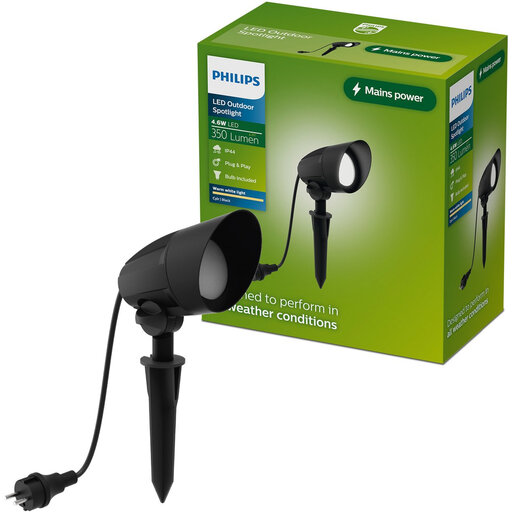
Why it suits this profile: This ground spotlight is designed for a driveway, lawn, gate or planted area, and comes with a GU10 LED bulb.
The light has a 150 cm cable and comes with a GU10 bulb. This means the fitting and bulb are clear from the outset, but you’ll need a suitable outdoor power socket.
IP44; 2700 K warm white light; 350 lumens; adjustable spotlight; aluminium and glass; suitable for installation with a ground spike.
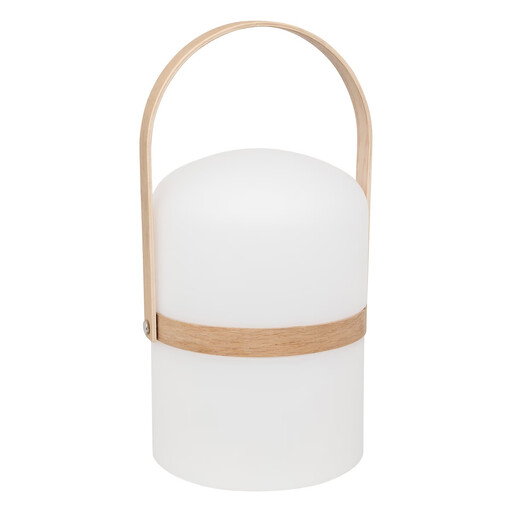
Why it suits this profile: This freestanding rechargeable outdoor light is a practical choice for a garden table, balcony or patio where there’s no fixed power connection nearby.
The light runs on a rechargeable lithium-ion battery and has three brightness levels. You won’t need to install a fixed cable, but you should allow around 7 to 8.5 hours for charging.
270 lumens; warm white light; IP44; carry handle; battery life according to the product information: 4 hours at full power, 9 hours at medium and 60 hours at low.

Why it suits this profile: This outdoor table lamp combines an integrated LED with a rechargeable battery, so you can move it between the patio, balcony and indoors.
There’s no need for a separate bulb or an external dimmer. The product information lists a touch dimmer, three brightness levels and an adjustable colour temperature from 3000 to 6500 K.
4 W integrated LED; 300 lumens; IP44; USB charging; up to 14 hours’ use according to the product information; copper-coloured metal housing.
We’ve put together a complete, up-to-date list of products that meet these strict selection criteria and the applicable European safety regulations.
A fixed outdoor light rated at 220–240 V must be connected to the mains correctly. Switch off the power before installation or maintenance, and follow local regulations. Have fixed models installed by a qualified electrician if the product information requires it.
With a rechargeable outdoor light, there’s something else to bear in mind: charge it indoors or in a suitable dry place, and position it securely. IP44 does not protect against immersion. Clean outdoor lights with a soft, dry cloth, and don’t direct a garden hose or pressure washer at the fitting.
Yes, IP44 is designed to protect against splashing water and is often used in sheltered outdoor locations. It does not mean the light is completely waterproof. So don’t place an IP44 outdoor light in a puddle, under direct jets of water or somewhere it will be constantly exposed to heavy rain without shelter.
Running costs depend on the wattage, the number of hours the light is on and your electricity tariff. A 4 W LED bulb uses around 4 kWh over 1,000 hours. With a fitting that takes a GU10 or E27 bulb, you can choose the wattage yourself. A rechargeable light also uses electricity while charging.
No. A light with a replaceable bulb needs a suitable dimmable bulb and usually a compatible external dimmer. For a light with an integrated LED, check whether it can be dimmed using touch controls or a built-in switch. Check the product specifications before you buy.
