
Vandaag of morgen in huis

Kwaliteit gegarandeerd

Welkomstaanbiedingen ontgrendelen: GRATIS bezorging | Tot 80% korting | Gratis 30 dagen JoyPlus-proefperiode
Download de app
Good outdoor lighting does more than illuminate a garden or entrance. The right light helps you find your keys, makes a patio usable in the evening and adds atmosphere to a balcony or façade. However, there are several purchasing pitfalls that can make an outdoor light less suitable than expected.
A high lumen count sounds appealing, but brighter is not always better. A 3,000-lumen light may be suitable for a driveway or large property, but too bright for a small balcony. Consider how you plan to use it:
Also consider the light colour. Warm white light around 2700 to 3000 K usually creates a softer atmosphere. Cooler light, such as 6500 or 7000 K, highlights details more strongly but can feel harsher.
IP protection consists of two digits. The first digit relates to solid particles and the second to moisture. An IP44 outdoor light is protected against splashing water, but is not designed to stand underwater or be exposed to direct water jets for long periods.
According to the product specifications, a product with IP65 offers greater protection against dust and water jets. This makes an IP65 solar light more suitable for a more exposed location, but correct installation is still essential. Always check:
An outdoor light with a motion sensor is only practical when the sensor can clearly detect the route people take. Do not install the light behind a wide planter or directly next to a busy road if you want to limit unnecessary activation.
With a solar outdoor light, positioning is just as important. Shade from a roof edge, tree or fence reduces the amount of solar energy that can be stored during the day. In winter and on cloudy days, the operating time may also differ from that in summer. This is not a fault, but a result of the amount of available daylight.
IP44 may be suitable for a sheltered veranda, balcony or covered patio. For a façade that is exposed to a lot of rain, it is worth considering a higher protection rating. Do not install an IP44 light where water collects or is sprayed directly onto the housing.
A wireless outdoor light means you do not need to run a cable to a socket. Solar lighting charges during the day and switches on at dusk or when movement is detected. A rechargeable wall light uses an integrated battery that is charged via USB. This gives you greater freedom when positioning the light, but it does require regular charging.
A fixed outdoor wall light connected to 230 volts provides a constant power supply. Bear in mind that professional installation by a qualified electrician may be required. Models with a GU10 or E27 fitting are sometimes supplied without a light source. You can then choose your own LED bulb and preferred light colour, but you must observe the maximum wattage limit.
Integrated LED outdoor lighting does not require a separate bulb. However, check whether the light source can be replaced. On many models, the LED is built in. A dimming function, several light modes or a day-night sensor can be useful, but only if you will actually use these features.
Measure the installation area before buying. A 34 cm-high light requires a different type of façade than a compact model measuring around 10 cm. Also check whether magnetic mounting is suitable for your wall. A magnet will not work on every surface, and the mounting plate must be securely fixed.

Why it suits this profile: This solar wall light is designed for anyone who wants to illuminate an entrance, fence or small façade without wiring. According to the product information, the model has two light modes, warm white light at 2700 K and a motion sensor.
The IP44 rating makes it clear that the light is splash-resistant, but must not be submerged. Positioning it away from direct water jets is therefore important.
Solar-powered, with an integrated 400-lumen LED per light point, and no connection to the mains required.
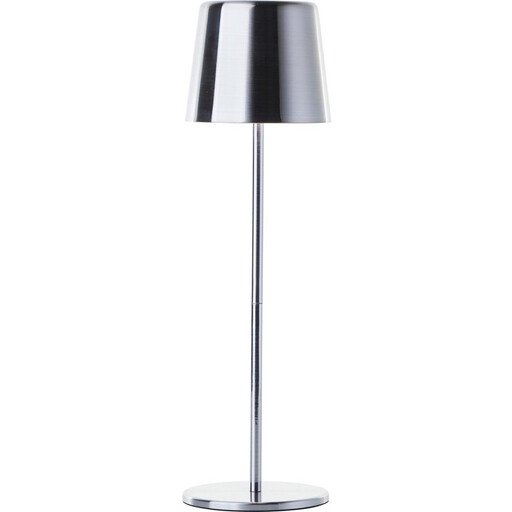
Why it suits this profile: This freestanding light is suitable for a table on the patio, balcony or in the garden. The specifications list a rechargeable battery, touch dimmer and adjustable colour temperature from 3000 to 6500 K.
The IP44 rating is clearly shown in the product details. This makes it clear that the light is intended for sheltered outdoor locations and not for submersion.
300 lumens, integrated 4W LED, continuously adjustable dimming and a choice of warmer or cooler light tones.

Why it suits this profile: This model is designed for a driveway, garage, large garden area or another location where a wide beam is needed. According to the product specifications, it has three adjustable heads and a motion sensor.
The product specification lists IP65, a detection angle of 180 degrees and three light modes. However, check beforehand that the stated coverage suits your property.
302 LEDs, a stated light output of 3,000 lumens, three light settings and three adjustable light heads.
We have put together a complete, up-to-date list of products that fully meet these strict selection criteria and the applicable European safety regulations.
For creating atmosphere above a dining table or along a balcony railing, an outdoor string light is a great choice. With plug-in models, consider the length, the distance to the socket and the protection provided for the plug and connections. A model with replaceable bulbs can be practical if one light point stops working.
A classic outdoor wall light with an E27 or GU10 fitting gives you greater freedom when choosing the light source. For example, the Philips Fylx has a GU10 fitting and, according to the product information, is supplied without a light source. This means you can choose between a warm, neutral or smart LED spotlight. A model with a fixed connection must be installed by a qualified electrician.
For a sheltered location, IP44 is often a practical choice. If the light is fully exposed to rain and dust, compare models with a higher IP rating, such as IP65. No rating makes incorrect installation or submersion acceptable.
The operating time per evening depends on sunlight, battery capacity, temperature, light mode and how often the motion sensor is activated. Keep the solar panel clean and position it where it receives as much direct daylight as possible. Always consult the product specifications for the expected battery life.
A solar outdoor light uses energy from the battery charged during the day while it is switched on. A rechargeable wall light must be charged via USB. A fixed LED outdoor light uses electricity from the mains; consumption depends on wattage and operating time. A timer, dusk sensor or motion sensor can help limit unnecessary operating hours.
