
Vandaag of morgen in huis

Kwaliteit gegarandeerd

Welkomstaanbiedingen ontgrendelen: GRATIS bezorging | Tot 80% korting | Gratis 30 dagen JoyPlus-proefperiode
Download de app
Good outdoor lighting doesn’t have to be complicated. Yet many people buy a light that runs for less time after a few dark days, doesn’t provide enough light or turns out to be unsuitable for the place where they want to install it. This is especially common with solar-powered outdoor lights, where features are sometimes interpreted more generously than the specifications justify.
Look out for these three common pitfalls:
Start by thinking about what you need it for. For a welcoming atmosphere on your patio, choose solar garden lights, an outdoor LED string light or decorative torches. For lighting a walkway, path lights with a low, even output are usually a better choice. A driveway, back door or garage needs more focused light, such as an outdoor light with a motion sensor or a solar security light.
For a wall or entrance, there are broadly two options:
An outdoor light with automatic on/off usually uses a light sensor, a motion sensor or both. Check which feature it has: switching on automatically at dusk is different from switching on only when movement is detected.
Brightness is usually given in lumens (lm). A path light with 10 lumens per light gives mainly guidance lighting. A wall light with 300 to 400 lumens is more practical by an entrance. For lighting a large driveway or a wide garden, look at outputs from around 1,000 lumens, depending on the mounting height and beam angle.
Colour temperature is measured in kelvin (K):
Also check the difference between integrated LEDs and a separate bulb fitting. With an E27 or GU10 bulb, you choose the light source yourself, while an integrated LED fitting has a fixed light module.
The IP code consists of two digits. The first indicates protection against solid particles; the second indicates protection against water.
Check the installation instructions as well as the IP rating. A product may be technically suitable for outdoor use but still need to be installed in a sheltered spot.
A solar garden light needs direct sunlight during the day to charge its battery. Don’t place the panel under an overhang or behind a tall fence. Clean it regularly with a soft, slightly damp cloth.
Bear in mind:
The recommendations below are based on the product information and specifications that can be verified. Any performance figures or test results quoted by a brand are not presented as guaranteed results.
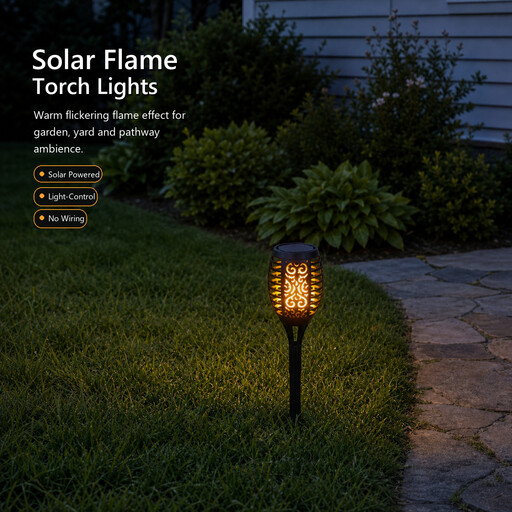
Why it suits this profile: These four solar torches are an easy way to add atmosphere to a patio, flower bed or garden path without any wiring.
The product information lists four lights, automatic on/off and IP65. Think of this model primarily as ambient lighting, not a powerful light for a driveway.
Set of four, 51 cm tall, 12 LEDs per torch and an IP65 rating according to the product listing.
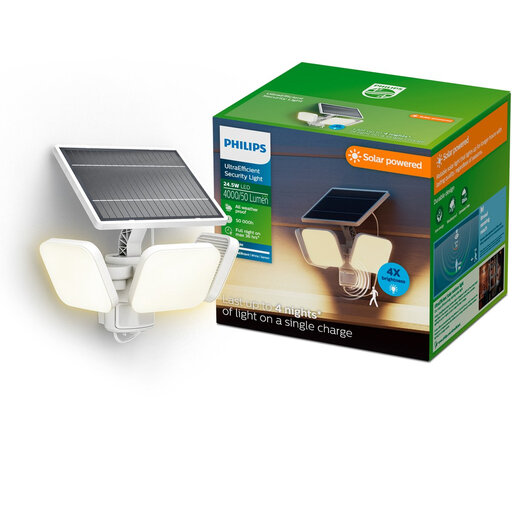
Why it suits this profile: This solar security light is designed to spread light over a wide area by a garage, driveway or large wall.
According to Philips’ product information, this model has IP65, a motion sensor and an adjustable light head. Check that the installation spot gets enough sunlight before fitting it.
4000 lumens, IP65, integrated LED and a sensor range that, according to the product information, provides direct detection up to 8 metres and lateral detection up to 16 metres.

Why it suits this profile: A good choice for a wide driveway, patio edge or garage where bright, focused light and motion detection matter.
The listed specifications include three lighting modes, three adjustable heads and IP65. This lets you tailor the spread of light more easily than with a fixed, narrow beam.
302 LEDs, stated output of 3000 lumens, 270° coverage and a motion sensor with a stated range of 60 feet and a 180° angle.
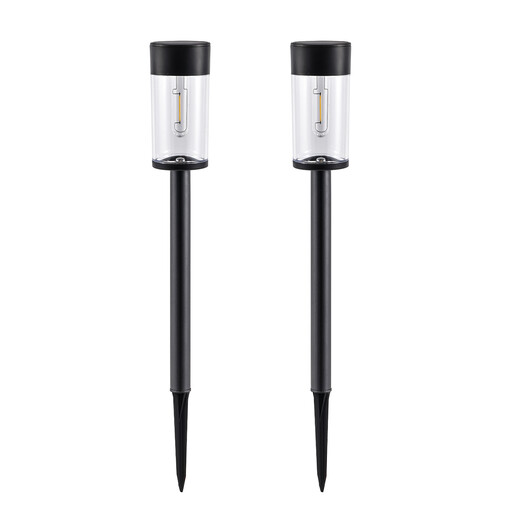
Why it suits this profile: These solar garden lights are ideal if you want to highlight a walkway, flower bed or driveway edge without bright security lighting.
The stated output is 10 lumens per light. That makes its intended use clear: gentle guidance and decorative lighting, rather than lighting a large area.
Set of two, warm white light at 3000 K, ground stakes for installation and IP65 according to the product information.
We’ve put together a complete, up-to-date list of products that meet these strict selection criteria and comply with the applicable European safety regulations.
Choose a spot where the solar panel gets several hours of direct sunlight. Don’t point the panel towards a shady corner, and keep it clear of leaves and dirt. Position lights with a motion sensor so that people pass through the detection area rather than walking straight towards it.
How long it stays lit depends on the battery capacity, sunshine hours, temperature and selected lighting programme. Manufacturers may state a particular run time, but according to the brand’s product information, actual performance depends on the conditions. Clean the panel regularly and check the fixings after storms or frost.
A solar light doesn’t use mains electricity during normal operation. For a mains-powered LED outdoor light, energy use depends on its wattage and how long it stays on. A motion sensor or dusk sensor can help reduce unnecessary running time. So when buying, check not only the light output but also the power rating, operating mode and whether it can switch off automatically.
