
Vandaag of morgen in huis

Kwaliteit gegarandeerd

Welkomstaanbiedingen ontgrendelen: GRATIS bezorging | Tot 80% korting | Gratis 30 dagen JoyPlus-proefperiode
Download de app
Good outdoor lighting should suit the location, the weather and the way you intend to use it. A light for a sheltered balcony needs different features from garden spotlights with ground spikes or a bicycle light with a brake sensor. Yet many products look similar at first glance. So don’t focus only on the design or colour; pay particular attention to the technical specifications.
An IP44 outdoor light is protected against solid objects larger than 1 millimetre and against splashing water. This does not mean that it is waterproof. Don’t place an IP44 light where rainwater can collect, and don’t expose it to a direct jet of water.
IP44 can be practical for a covered balcony or terrace. For an exposed spot in the garden, a higher protection rating, such as IP65, is often the more sensible choice. Always check the complete IP code in the product specifications.
A solar outdoor light works without a permanent power connection, but its output depends on daylight. In the Netherlands, short days, cloudy weather, shade and incorrect positioning can affect charging time. A light that supports both solar and USB charging offers greater flexibility.
Also consider the difference between a light that provides ambient illumination and one that needs to properly light a path or table. The number of hours of illumination often depends on the selected light setting.
A black, white or green outdoor table lamp may complement your décor, but also check its stability, dimensions and controls. A lightweight lamp weighing around 350 grams can topple more easily on a wobbly garden table. A portable lamp with a handle is convenient, but according to the product information it should be used in a sheltered location if prolonged exposure to rain is not recommended.
Light output is measured in lumens (lm). A 170-lumen lamp is suitable for ambient lighting on a table, balcony or terrace. A path, driveway or functional workspace may require more light. As well as the lumen count, consider where the lamp will be placed and the direction in which it shines.
Colour temperature is measured in kelvin (K). Warm white light at around 3000 K creates a softer look than cooler white light. RGB garden lighting also offers coloured light, while CCT lighting generally switches between warm and cool white.
A cordless outdoor light can run on a built-in rechargeable battery. For a rechargeable outdoor light, these points are important:
A USB-rechargeable light is practical for balconies, camping and terraces because you’re not dependent on sunlight. A bicycle light with a brake sensor or a rechargeable headlamp often uses USB-C and is designed for mobile use. For bicycle lighting, also check the mounting system and visibility; a product claim about extra safety is not a guarantee of road safety.
For fixed garden lighting, garden spotlights with ground spikes are easy to reposition. Check the cable length, though, and keep cables away from paths to reduce the risk of tripping. Smart garden lighting with app control can be useful if you want to adjust the colour, brightness or schedule from your smartphone. This may require an app, an account and a network connection.
Dimmable outdoor lighting is ideal when you want to use one lamp in several situations: softer light while eating and a brighter setting when you need to find something. Clean lights according to the instructions, usually with a soft, dry cloth. Do not use liquid on products where this is not recommended.
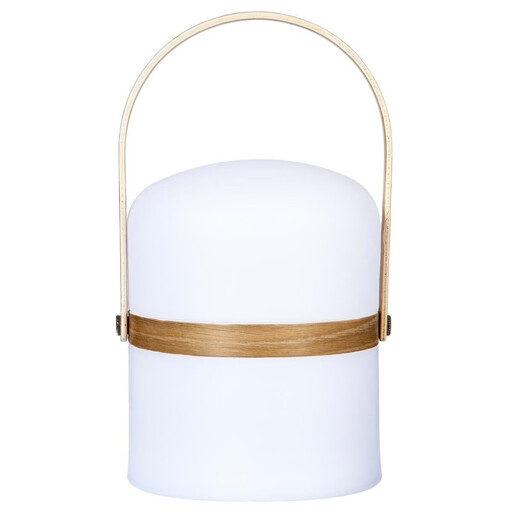
Why it suits this profile: This portable lamp is designed for anyone who wants to illuminate a balcony, table or sheltered terrace area without permanent installation. The wooden handle makes it easy to move.
The product specification states that it uses USB power, has an integrated lithium-ion battery and is rated IP44. You therefore aren’t entirely dependent on sunlight, but you must protect the lamp from direct rain.
270 lumens, warm white LED light, 26.5 cm high and, according to the product specification, up to 72 hours of battery life depending on the light setting.
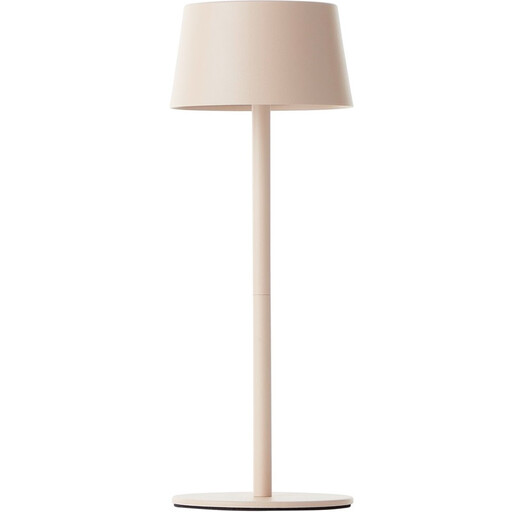
Why it suits this profile: The combination of solar and USB charging is ideal for anyone who wants to use a stylish table lamp without a permanent cable, while still having an alternative charging option in cloudy weather.
The description explicitly states that IP44 provides protection against splashing water, not a waterproof construction. Place the lamp on a stable, sheltered surface.
170 lumens, warm white light at 3000 K, integrated LED, three dimming settings and two possible mounting heights.

Why it suits this profile: This set is designed for garden paths, borders and plants. The ground spikes allow flexible positioning, while app control is useful for anyone who regularly adjusts the light colour and brightness.
The specification states that the cable is 8 metres long and that the lights are rated IP44. Keep the cable away from walkways and do not place the spotlights in standing water. Smart features require app installation and a network connection.
Set of three, 660 lumens, dimmable, CCT from 3000–6500 K, RGB colours and control via the Tuya Smart app according to the product description.
We’ve put together a complete, up-to-date list of products that fully meet these strict selection criteria and the applicable European safety regulations.
IP44 outdoor lights are suitable for outdoor use in locations where they are protected from splashing water. They are not designed for immersion, direct jets of water or prolonged exposure to heavy rain. Always check the manufacturer’s positioning instructions.
While in use, a solar outdoor light draws energy from its built-in battery, which is charged via the solar panel during the day. No permanent power connection is required. Charging performance depends on sunlight, shade, the season and the position of the panel. A model with USB charging can be useful when solar charging is insufficient.
The operating time per charge varies by model and light setting. Check the stated battery capacity, charging time and illumination time. With an integrated LED module, the light source is generally not intended to be replaced by the user. Store portable lights in a dry place when not in use and follow the manufacturer’s maintenance instructions.
