
Vandaag of morgen in huis

Kwaliteit gegarandeerd

Welkomstaanbiedingen ontgrendelen: GRATIS bezorging | Tot 80% korting | Gratis 30 dagen JoyPlus-proefperiode
Download de app
An outdoor lamp needs to withstand more than just a shower of rain on a sheltered balcony. Yet many shoppers focus mainly on design, brightness or a low price. As a result, they may end up with a lamp that provides too little light, develops faults quickly or is unsuitable for the place where it is installed.
As a Joybuy Product Recommendation Officer, I filter the most important product specifications from the marketing information. Below, you can read what to look for when choosing outdoor lighting and which popular options suit different situations in and around the home.
A designation such as IP44 outdoor lighting does not mean that the lamp is completely waterproof. The first digit refers to protection against solid particles, while the second refers to water. IP44 provides protection against splashing water from different directions, but not against immersion or powerful water jets.
IP44 may be suitable for a sheltered façade, veranda or balcony. For an open driveway or a location exposed to heavy rain and dirt, IP65 outdoor lighting is generally a better choice. Even with IP65, plugs, adapters and connections must be protected according to the instructions.
A high lumen count sounds appealing, but more light is not always practical. A bright lamp by the front door can cause glare, while a low wattage does not automatically guarantee soft or energy-efficient lighting. You should also consider:
A solar outdoor lamp does not need mains electricity, but its solar panel must receive enough direct light during the day. Under a balcony, next to a tall fence or on a north-facing wall, the battery may not charge as effectively. According to information provided by the brands, some models are designed for multiple lighting modes or longer operating times when fully charged. Actual performance, however, depends on the season, cloud cover, shade and the selected mode.
Use IP44 for general outdoor locations that are not constantly exposed to direct water jets. An outdoor wall lamp beneath an overhang or a decorative string light on a sheltered fence may fall into this category.
IP65 offers greater protection against dust and water jets. This makes the rating more suitable for an exposed façade, garage, garden wall or driveway. Still, check that the cable connection and adapter have the same level of protection. In practice, the lowest rating in the complete setup determines where you can safely use the lighting.
There are three common options:
For more choice, you can also browse the range of waterproof low-voltage lighting.
Measure the wall, balcony or edge of the patio before buying. For outdoor string lights, check the length of the illuminated section, the distance between hanging points and the length of the extension cable. With an outdoor wall lamp, also check the bulb fitting, maximum wattage and connection method.
A lamp with an integrated LED does not require a separate light source, but the LED usually cannot be replaced individually. A model with an E27 or GU10 fitting gives you more flexibility in terms of colour temperature and dimming, although the lamp is not always supplied with a light source.
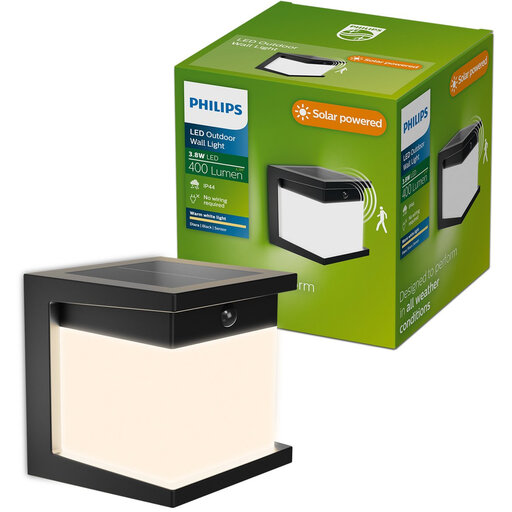
Why it suits this profile: This solar wall lamp works without fixed wiring and, according to the product specifications, has two lighting modes, a motion sensor, 400 lumens and warm 2700K light. That makes it suitable for a balcony, garden path or entrance where installation needs to be straightforward.
The IP44 rating makes it clear that this lamp is protected against splashing water, not immersion. Place it in a suitable outdoor location and ensure that the panel receives direct sunlight.
No mains connection required; integrated LED; 2700K warm white; two lighting modes.

Why it suits this profile: For a driveway, garage or large garden, a powerful lamp with a motion sensor is more practical than a decorative outdoor lamp. The product specifications state 4000 lumens, IP65, three adjustable light heads and an integrated solar power supply.
The higher IP65 rating can be checked in the product specifications and is better suited to a less sheltered installation location than IP44. The panel still needs to receive direct sunlight.
IP65; 4000 lumens; motion detection; adjustable light heads.

Why it suits this profile: For festive occasions, a façade or a large window, these outdoor Christmas lights provide a decorative solution. The system has 720 warm-white LEDs, 15 hanging points, a coverage area of 10 × 0.5 metres and a 9-watt adapter.
The length, number of hanging points and IP44 rating are clear from the outset. Do not use the lights as though they were completely waterproof, and protect the adapter and connections from direct water.
720 LEDs; 3000K warm light; memory function; 5-metre extension cable.
We have put together a complete, up-to-date list of products that fully meet these strict selection criteria and the applicable European safety regulations.
With a fixed outdoor wall lamp or outdoor wall light, you should switch off the electricity first. Follow the installation instructions and have a fixed connection carried out by a qualified electrician. Use suitable wall plugs for brick, concrete or another surface.
Installation is easier with a solar outdoor lamp, but you should pay attention to three points:
Outdoor string lights must be secured firmly without putting tension on the cables. Use a dry cloth for cleaning and never immerse an adapter or electrical connection in water.
IP44 is often suitable for a sheltered location, as this rating provides protection against splashing water. For a more exposed location, IP65 may be more appropriate. Always check the complete installation, including the adapter and connections.
A solar outdoor lamp does not use mains electricity during normal operation. According to the product specifications, there are therefore no regular electricity costs for the lighting itself. However, operating time and brightness depend on sunlight, battery capacity, the season and the settings.
Lifespan varies according to the model, operating conditions and heat dissipation. Some product descriptions state an estimated lifespan of 25,000 or 50,000 hours of operation. Treat these figures as the brand’s product specifications, not as a guarantee for every installation. Proper positioning, protection from moisture and regular maintenance help limit unnecessary wear.
