
Vandaag of morgen in huis

Kwaliteit gegarandeerd

Welkomstaanbiedingen ontgrendelen: GRATIS bezorging | Tot 80% korting | Gratis 30 dagen JoyPlus-proefperiode
Download de app
Good outdoor lighting makes an entrance more visible, creates a welcoming atmosphere on your patio and helps you continue using your garden after sunset. Yet many people choose a light based on an attractive photo or a high lumen figure. This can result in a light that is too bright, runs out of charge quickly or turns out not to be suitable for the place where you want to install it.
The main pitfalls:
The IP code indicates how well a product is protected against solid particles and moisture. For many Dutch gardens, balconies and covered patios, an IP44 outdoor light is a practical choice. According to the product specifications, this classification is intended to provide protection against splashing water.
For a façade directly exposed to rain, an open driveway or a location where there is a lot of dust and moisture, IP65 outdoor lighting may be the more logical choice. IP65 is generally described in product information as protection against dust and water jets. Always check the full product description and installation instructions; an IP rating does not automatically make a fitting suitable for immersion.
Lumens indicate the amount of visible light. As a practical guide, use:
Colour temperature is measured in kelvin. Around 2700K to 3000K generally produces warm white light for a relaxed atmosphere. Around 4000K appears more neutral. Higher values produce cooler light. It is therefore important to check the description alongside the technical specifications. For example, the UME light lists 7000K, while the product text describes it as “warm white”. If you are looking for warm light, this technical value is a reason to compare the details carefully before buying.
Solar outdoor lighting works with a solar panel and a rechargeable battery. Pay attention to:
An outdoor solar light does not require a fixed mains connection, but it may operate for less time or produce less light in winter. Clean the panel occasionally with a soft, damp cloth. With an electric LED outdoor light, wattage and lumens are more important than the word “LED” alone. An integrated LED is convenient, but the light source cannot be replaced on some models.
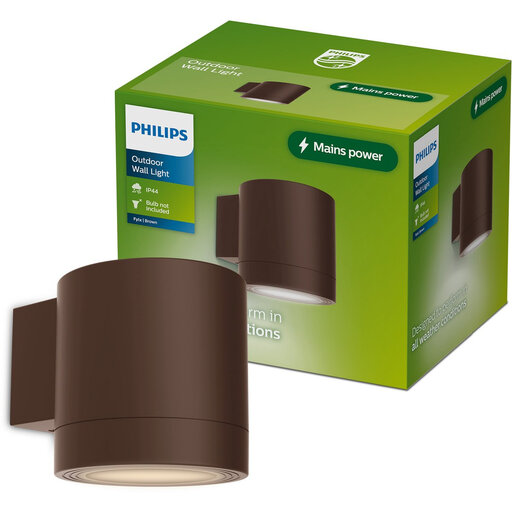
Why it suits this profile: This compact façade or wall light uses a GU10 fitting. You can therefore choose a suitable LED bulb and colour temperature for your entrance or patio.
The fitting and maximum power of 5W are clearly stated. The light is supplied without a GU10 light source, so you are not forced to accept an unwanted colour temperature by accident.
Aluminium housing, replaceable GU10 bulb and IP44 classification according to the product details.
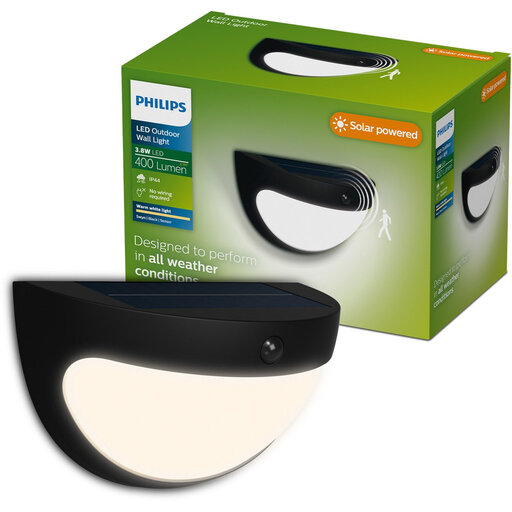
Why it suits this profile: This solar wall light is designed for a façade, shed, balcony or entrance where you do not want to run a cable. The two light modes and motion sensor offer flexibility.
The product information explicitly states the IP44 classification and recommends installation in direct sunlight. This makes it clear that the installation location affects performance.
400 lumens per light point, solar power, two modes and a built-in motion sensor according to the product specifications.

Why it suits this profile: This solar outdoor lighting is designed for larger areas such as a driveway, garage, back garden or grounds where broad illumination is desirable.
The three light modes allow you to adjust the powerful light output. However, check that 3,000 lumens is suitable for your space and your neighbours.
302 LEDs, a stated detection angle of 180°, three adjustable light heads and IP65 according to the product description.
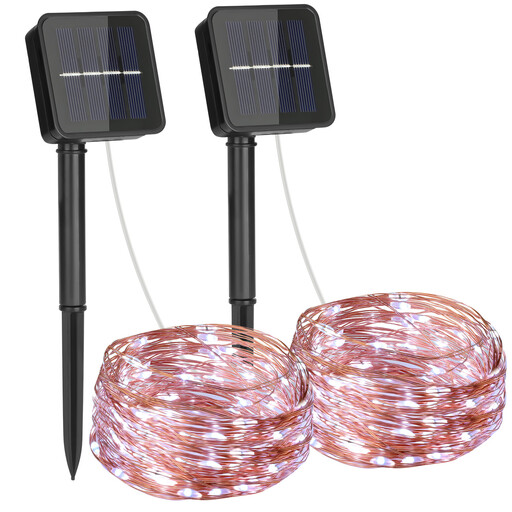
Why it suits this profile: This outdoor string light is suitable for fences, plants, balcony edges and patios where decorative lighting is more important than practical visibility.
The product details state a length of 8 metres, eight light modes and IP65. Nevertheless, check how much sunlight the location receives, as the stated operating time depends on the weather.
Two 8-metre strings, each with 80 LEDs, solar power and eight effects with memory function according to the product description.
We have put together a complete, up-to-date list of products that fully meet these strict selection criteria and the applicable European safety regulations.
For a driveway, targeted lighting with enough lumens is practical. An outdoor light with a motion sensor prevents the light from staying on continuously. For an open, unprotected location, preferably choose a model with a suitably higher IP rating, such as IP65, and position the light so that it does not shine directly into windows or the eyes of passers-by.
A solar light does not use mains electricity while operating. Running costs are therefore limited to the purchase price and, in the longer term, any battery replacement. Actual operating time depends on sunlight, temperature, battery capacity and the selected programme. Output may be lower in winter.
Lifespan varies depending on the product and operating conditions. Do not look only at the term LED, but also at the warranty, IP rating, whether the light source can be replaced and the maintenance instructions. With an integrated LED outdoor light, replacing the light source is often not possible. A fitting with a GU10 or E27 fitting offers greater flexibility, as you can replace the bulb later.
Position path lighting with enough space between each light so that the beams overlap slightly, without creating dark gaps. For patio lighting, several smaller light points often create a calmer effect than one powerful lamp. With solar products, take into account shade from trees, walls and parasols. This helps keep your chosen outdoor lighting better suited to the function of the space.
