
Vandaag of morgen in huis

Kwaliteit gegarandeerd

Welkomstaanbiedingen ontgrendelen: GRATIS bezorging | Tot 80% korting | Gratis 30 dagen JoyPlus-proefperiode
Download de app
Good outdoor lighting needs to suit the location, its purpose and the British weather. A light for a covered balcony has different requirements to a fitting along your driveway. If you only look at the number of lumens or an attractive product photo, you could easily end up with an unsuitable purchase.
A high lumen count doesn't automatically mean a lamp will provide pleasant or appropriate illumination. A bright beam of light can be uncomfortable on a patio, whereas a dark driveway actually needs more focused lighting. So pay attention to the light distribution, the colour temperature and whether the lamp can be adjusted.
For outdoor mood lighting, warm light around 2700 to 3000K is often a good choice. For a functional outdoor light near a garage or back door, a more neutral or cooler colour temperature can be more practical. Also check whether the stated light output refers to one lamp or the entire product.
A waterproof outdoor light IP44 is in practice mainly suitable for splashes and sheltered spots. IP44 means protection against solid objects larger than 1 millimetre and splashing water from any direction. Place such a lamp, for example, under a canopy or on a sheltered wall.
A waterproof outdoor light IP65 offers higher protection against dust and water jets. This makes it a more logical choice for a lamp that is more exposed to rain. However, IP65 does not mean the lamp can be submerged. Always check the installation instructions and the location where the lamp will go, alongside the IP rating.
With solar outdoor lighting, the position of the solar panel is crucial. A lamp under a balcony, next to a tall fence or on a north-facing wall may not receive enough direct sunlight. The stated burn time is usually based on a fully charged battery and favourable conditions.
So check:
Choose the IP rating based on exposure to rain. For a covered entrance, IP44 may be sufficient. For an open wall, garage or garden path, a product with IP65 is often more practical. Also pay attention to the mounting materials. A wall-mounted light must be securely fixed to brick, wood or another suitable surface.
For magnetic lights, you need a flat, clean and sufficiently strong surface. Also check that the weight can be safely supported. Loose installation can cause damage or injury.
An integrated LED outdoor light generally uses little energy and doesn't need a separate bulb. The downside is that the light source is often not replaceable. With an outdoor light that has a GU10 or E27 fitting, you can choose a suitable LED bulb yourself and replace it later.
Look out for these details:
A fitting lamp offers more flexibility, but a wired wall light usually needs to be connected to 230 volts by a qualified installer.
An outdoor light with a motion sensor is handy near a back door, driveway or shed. Don't just look at whether it has a sensor, but also at the detection range, detection angle and adjustable burn time. A sensor pointed directly at a busy street or moving branches can trigger unnecessarily often.
Multiple lighting modes can be useful. Some models stay on at a dim level and switch to brighter when movement is detected. Others only come on when they detect movement. Choose the mode that suits your needs for safety, privacy and the desired look.
The selection below is based on verifiable product specifications such as IP rating, light output, power supply, mounting and sensor features. Descriptions of performance are presented as product information from the manufacturer or seller, not as independently verified operation.
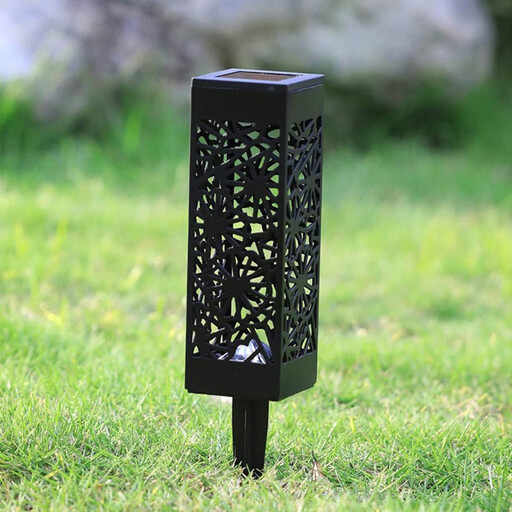
Why this fits the profile: Six ground spots offer a simple way to mark out a garden path, border or flower bed without any wiring or tools.
The specifications state an IP65 rating and recommend a sunny location. The expected burn time of 5–8 hours applies, according to the product information, after a full charge.
Set of six, warm white LEDs, automatic activation and direct placement into the ground.

Why this fits the profile: This solar outdoor wall light combines an integrated LED, motion sensor and two modes for a wall, patio or entrance.
The product information clearly states IP44, meaning the light should not be treated as fully waterproof. Placement on a suitable wall and regular cleaning of the panel are still necessary.
400 lumens per light point according to the product data, warm light at 2700K, solar powered and an integrated motion sensor.

Why this fits the profile: The three adjustable light heads are aimed at larger areas such as a driveway, garage, garden or backyard.
The stated IP65 rating, a detection distance of 60 feet and three modes make the intended use clear. However, place the panel in direct sunlight.
302 LEDs, a stated light output of 3000 lumens, three light heads and installation without any electrical wiring.

Why this fits the profile: The portable wall light runs on a rechargeable battery and uses a magnetic fixing, handy when you don't want to drill or wire anything.
The product specification states IP44 and warns that the light must not be submerged or exposed to powerful water jets.
300 lumens, 3000K, integrated motion sensor, USB-C charging and a magnetic mounting system.
We've put together a full, up-to-date list of products that fully meet these strict selection criteria and comply with current European safety regulations.
Place solar lights so that the panel receives as much direct daylight as possible. Clean the panel and sensor regularly with a soft, slightly damp cloth, unless the manual says otherwise. For ground spots, check that their placement doesn't create a trip hazard.
For wired wall lights with a GU10 or E27 fitting, the power must be switched off during installation. Have the connection to 230 volts carried out by a qualified installer. For IP44 lights, use a sheltered spot and avoid direct water jets.
That depends on the application. Path lighting and decorative lighting can get by with a lower light output. For an entrance, garage or driveway, more focused light is desirable. Look at the beam angle as well as lumens, so the light doesn't shine unnecessarily into neighbours' windows or your own.
The burn time depends on sunlight, season, shade, battery capacity and temperature. A stated burn time is usually based on a fully charged battery. In winter or after several cloudy days, the light may stay on for less time. Keep the panel clean and position it free from shade.
Solar lighting uses no mains power during operation. With LED lights on the mains, consumption is usually limited, but the exact cost depends on wattage and hours of use. A motion sensor can help ensure a light only comes on when it's needed.
