
Vandaag of morgen in huis

Kwaliteit gegarandeerd

Welkomstaanbiedingen ontgrendelen: GRATIS bezorging | Tot 80% korting | Gratis 30 dagen JoyPlus-proefperiode
Download de app
Good outdoor lighting makes an entrance easier to see, creates atmosphere on the patio and helps keep dark paths clear. However, an attractive product photo does not guarantee that an outdoor light will suit your situation. Three common pitfalls regularly lead to disappointing purchases: insufficient IP protection, no light source included and an unsuitable power supply.
With this practical guide, you can focus on the specifications that really matter in a Dutch garden, on a balcony or beside a driveway.
An IP44 outdoor light is protected against solid particles larger than 1 millimetre and splashing water from different directions. This makes IP44 suitable for many sheltered applications, such as a façade, balcony, patio or covered area. The classification does not mean that the light can be submerged or withstand a powerful jet of water.
Therefore, do not install an outdoor wall light where rainwater can collect. Also check that the seals, glass and mounting have been fitted correctly.
With an E27 outdoor light or GU10 outdoor light, the fitting is not the same as the light source. Some fittings are supplied without an LED bulb. This gives you the freedom to choose the colour temperature and brightness yourself, but it also means you need to buy a suitable bulb separately.
Check the following before buying:
A black outdoor light, classic lantern or modern outdoor ground spotlight must also be suitable for its installation location. Consider the dimensions, cable direction, mounting method and available connection. For example, a plug-in spotlight is practical for an existing earthed outdoor socket, while a fixed wall light will often need to be connected by an installer.
The power must be switched off during electrical installation. If you are unsure about the wiring or earthing, it is advisable to call in a qualified electrician.
For many applications around the home, IP44 is a useful minimum when the light is installed in a sheltered position. Think of a wall light beside the back door or a light beneath a covered area. For very exposed locations or places where a lot of water can reach the light, a higher level of protection may be more suitable. Always check the full product description and installation instructions.
Wattage mainly indicates energy consumption. To determine the amount of light, look at lumens. A lower light output is suitable for creating a relaxed atmosphere on a balcony, while a driveway or access path may require more directed light.
The colour temperature determines the appearance:
A solar outdoor light works without a fixed mains connection, but its performance depends on the amount of daylight available. Therefore, do not position the solar panel permanently beneath a roof edge or in deep shade. A model with USB charging can be useful during dark or overcast periods.
Aluminium and glass or plastic can be suitable for outdoor use, depending on the finish and construction. A coating can help protect against dirt, scratches and corrosion, but regular cleaning remains important. Use a soft, dry or slightly damp cloth, following the manufacturer’s instructions. Do not use aggressive cleaning products and do not direct a pressure washer at the light.
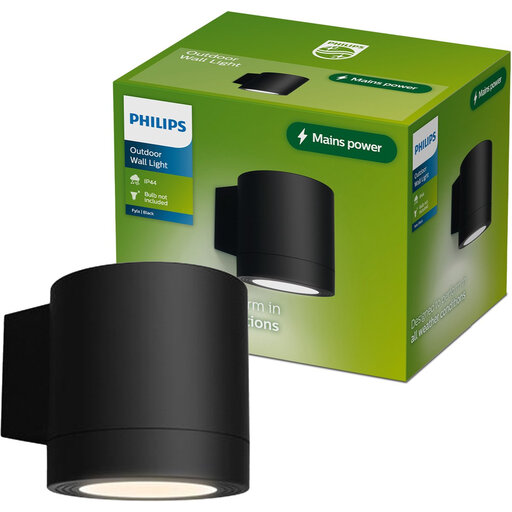
Why it suits this profile: This compact fitting for a façade, balcony or garden is supplied without a GU10 spotlight. You can therefore choose your preferred LED bulb and colour temperature.
The fitting and IP44 rating are clearly stated. Bear in mind that you will need to purchase a GU10 light source separately.
Black aluminium, 8.9 × 11.6 × 9 cm, replaceable GU10 light source and suitable for outdoor use, gardens and balconies.
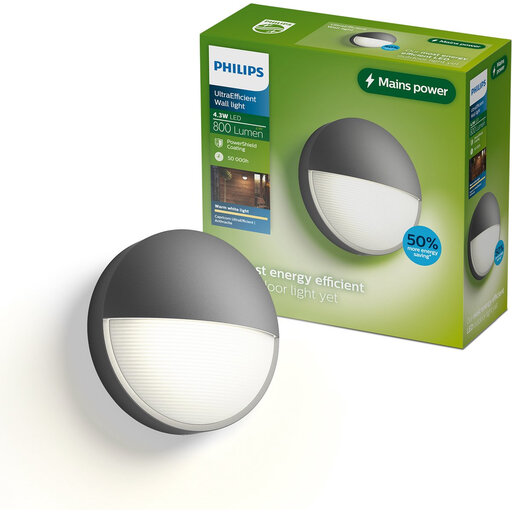
Why it suits this profile: This modern outdoor light features integrated LED lighting, 800 lumens and warm white light at 2700 K for a permanent lighting solution beside a façade or balcony.
The light output, colour temperature and IP44 protection are clearly specified. The LED is integrated and cannot be replaced.
800 lumens, 4.3 W, aluminium and plastic construction, anthracite colour and a stated lifespan of up to 50,000 operating hours.
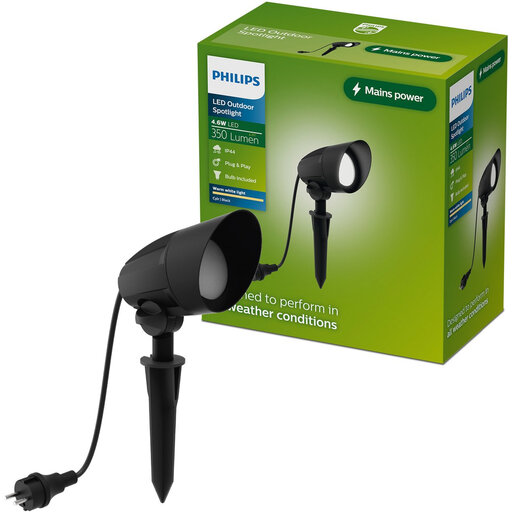
Why it suits this profile: This portable ground spotlight is designed for driveways, gates and lawns, and for highlighting trees or shrubs.
The spotlight is supplied with a GU10 LED and has a 150 cm cable. Position it securely and use a suitable outdoor socket.
350 lumens, 2700 K, 4.6 W, IP44, adjustable positioning and a stated lifespan of 15,000 hours.
An outdoor light with a sensor is practical beside a front door, shed or garden path. A motion sensor prevents the light from staying on continuously, but pay attention to its positioning: branches, traffic or pets can trigger the sensor unintentionally. A dusk-to-dawn and motion sensor, as found on some solar outdoor lights, combines automatic activation with operation when it gets dark.
Direct daylight is important for a solar-powered light. For a model with a fixed 230V connection, check the cable length and the position of the outdoor socket beforehand. A ground spotlight must also not create a trip hazard.
We have put together a complete, up-to-date list of products that fully meet these strict selection criteria and the applicable European safety regulations.
For a sheltered façade, balcony or patio, IP44 may be suitable. This rating protects against splashing water, but not against submersion or powerful jets of water. For a completely open and heavily exposed location, a higher IP rating may be the wiser choice.
Lifespan varies from product to product. Some models, for example, specify 15,000 or 50,000 operating hours. This is a product specification, not a guarantee of a fixed service life in every situation. Installation, temperature, moisture and proper maintenance all affect performance.
A sensor can reduce the number of hours the light is on by activating it only when movement is detected or when it is dark. Actual consumption depends on the wattage, the set operating time and how often the sensor is activated. With a solar outdoor light, the energy comes from the solar panel, but performance depends on the sunlight available.
