
Vandaag of morgen in huis

Kwaliteit gegarandeerd

Welkomstaanbiedingen ontgrendelen: GRATIS bezorging | Tot 80% korting | Gratis 30 dagen JoyPlus-proefperiode
Download de app
Buying an outdoor lamp seems simple, until you discover after a few weeks that the light is not bright enough, the battery runs out quickly or the housing cannot withstand Dutch rain. When choosing outdoor lighting, costly mistakes often stem from three recurring pitfalls:
The right choice depends on the location, purpose and technical specifications. Below, we explain what to look for when choosing garden lighting, patio lighting, an outdoor lamp with a motion sensor or decorative Christmas lights for outdoor use.
Before you look at the design or brand, decide what the lamp needs to do.
Also consider the light colour. 2700 K creates a warmer, softer effect than 5000 or 7000 K. A cooler colour may be practical on a driveway, but less pleasant around a seating area.
The IP code consists of two digits. The first digit refers to protection against solid particles; the second refers to water.
Also check the installation instructions. A weather-resistant outdoor lamp may still require a stable surface, suitable wall plugs or professional connection. For example, the Philips Capricorn has a fixed mains connection and, according to the product information, must be installed by a qualified installer.
Solar outdoor lighting works without a connection to the mains, but it needs direct sunlight for the solar panel. Do not place the panel beneath an overhang or behind dense vegetation. Clean the panel regularly with a soft cloth.
A rechargeable outdoor lamp offers greater flexibility when sunlight is limited. The Brilliant Xaana table lamp uses an integrated 18650 lithium-ion battery, charges via USB and, according to the product information, has a run time of up to 14 hours. The lamp is suitable for a stable table on a covered patio or balcony, but its IP44 rating means it is not suitable for immersion or direct water jets.
With a fixed LED lamp, check whether the light source can be replaced. Integrated LEDs are compact, but once the light source reaches the stated lifespan, some models require the entire fitting to be replaced. A GU10 bulb, as used in the Philips Fylx, gives you the option of choosing a suitable light source yourself and replacing it later.
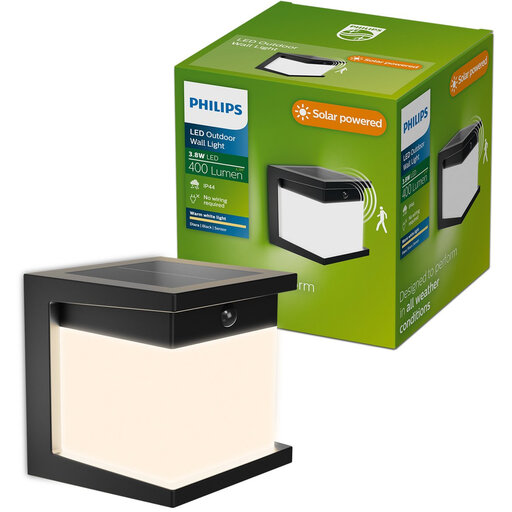
Why it suits this profile: This solar wall light is designed for a balcony, garden path or small entrance where there is no power outlet. It does not require permanent wiring.
The specifications clearly state IP44, a motion sensor and the need for sufficient sunlight. Do not install the lamp on a permanently dark exterior wall.
400 lumens, 2700 K warm white light, two lighting modes and a stated IP44 rating.
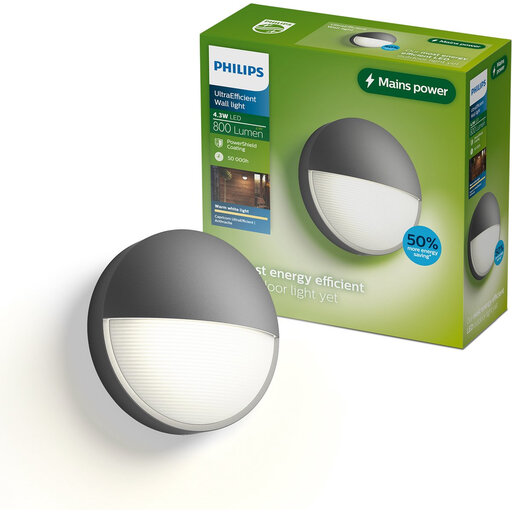
Why it suits this profile: Suitable for anyone looking for a fixed LED outdoor lamp for an exterior wall or balcony and able to arrange professional installation.
The fixed mains connection and IP44 rating are clearly stated. This means it is clear from the outset that this is neither a wireless nor a fully waterproof lamp.
800 lumens, 2700 K warm white light, aluminium housing and integrated LED.

Why it suits this profile: This solar security light is ideal for a driveway, garage or large property where a wide, powerful beam is needed.
The specifications list IP65, an adjustable light head and a motion sensor. However, make sure the powerful light output is suitable for the surroundings.
4000 lumens, IP65, two lighting modes and a stated detection range of up to 16 metres when approached from the side.
We have put together a complete, up-to-date list of products that fully meet these strict selection criteria and the applicable European safety regulations.
Yes, IP44 is suitable for many sheltered outdoor applications, such as a covered balcony, patio or exterior wall. The rating protects against splashing water, but not against immersion or powerful water jets. For a completely open and exposed location, IP65 outdoor lighting may be a more suitable choice.
The operating time per night depends on the battery, the amount of sunlight, the lighting mode and the weather. Manufacturers may also state the LED lifespan or a number of operating hours. This figure does not automatically indicate how long the battery will last. Keep the solar panel clean and position the lamp where it receives direct sunlight during the day.
Usage depends on the wattage and the number of hours it is switched on. A 4-watt lamp that is on for 5 hours a day uses approximately 0.02 kWh per day. A solar outdoor lamp does not use mains electricity, but the battery and panel still require maintenance and depend on the lighting conditions. Therefore, do not compare energy consumption alone; also consider the light output and the operating time you need.
