
Vandaag of morgen in huis

Kwaliteit gegarandeerd

Welkomstaanbiedingen ontgrendelen: GRATIS bezorging | Tot 80% korting | Gratis 30 dagen JoyPlus-proefperiode
Download de app
A dark driveway, poorly lit entrance or atmosphere-free patio calls for a practical solution. Yet choosing outdoor lighting is not always straightforward. Product pages often emphasise high lumen output, a high IP rating or “energy-efficient” operation, while important details receive less attention.
Three common pitfalls:
Focusing too much on lumens
A high lumen count does not automatically mean that a light produces a pleasant illumination. For a pathway, 550 lumens may be sufficient, while a wide driveway requires broader coverage. Also consider the beam angle, colour temperature and positioning.
Confusing IP44 with complete waterproofing
An IP44 outdoor light is protected against solid objects and water splashes. This makes it suitable for many sheltered outdoor locations, but not for submersion or direct water jets. For an exposed wall or garden, IP65 outdoor lighting is often the more logical choice, provided the other product specifications are suitable as well.
Installing solar lighting without enough sunlight
A solar outdoor light does not operate at the same level at all times. Its performance depends on direct sunlight, the season, shade and battery capacity. A light installed beneath a canopy or on the north-facing side of a home may therefore stay on for less time than expected.
The IP code consists of two digits. The first indicates protection against solid particles, while the second refers to water protection.
An IP rating does not tell you everything about mounting, cable connections or the quality of the wall fixture. Always follow the installation instructions.
Lumens (lm) indicate the amount of visible light. For creating ambience on a balcony, a lower light output is often sufficient. For an entrance, garage or driveway, more light can be practical.
Colour temperature is expressed in kelvin (K):
Watch out for conflicting product descriptions. The UME solar outdoor light, for example, is listed with 3000 lumens and 7000 K, while the description also refers to “warm white”. Always check the technical specifications and product images before ordering.
A solar wall light or solar garden light does not require a connection to the mains electricity supply. This is convenient for a rented property, balcony or location without existing cabling. However, the solar panel must receive direct daylight. Clean the panel regularly and check that the light is securely mounted.
A wired outdoor wall light provides a constant power supply but requires connection to 230 volts. Products such as the Brilliant Jelani GU10 outdoor light and the Philips Capricorn are intended for permanent installation according to their product information. Have this work carried out by a qualified installer.
A light with a motion sensor can save energy by switching on only when movement is detected. Check the detection range, response time and preferred lighting mode. A sensor is particularly practical by a front door, garage or driveway, but less suitable if you want continuous illumination.
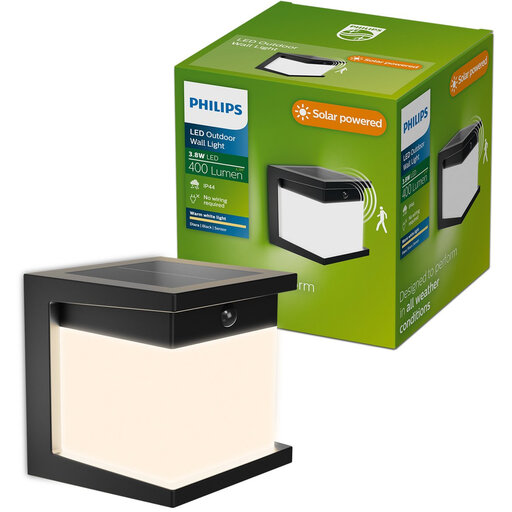
Why it fits: A practical choice for a balcony, garden wall or entrance without an available power connection. According to the product information, this light runs on solar power and features a motion sensor.
The product information lists 400 lumens, 2700 K and IP44. Install the light in a sheltered location and make sure the solar panel receives direct light.
Integrated LED, two lighting modes, a motion sensor and no permanent wiring required.
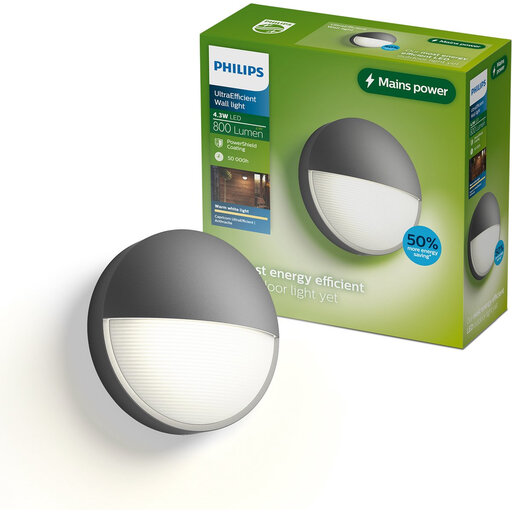
Why it fits: For homeowners looking for a permanent outdoor wall light with an aluminium housing and integrated LED for a façade, patio or entrance.
The light has an IP44 rating and is not designed for submersion. According to the product information, it must be permanently connected to the mains electricity supply.
800 lumens, 2700 K, an aluminium construction and a stated power rating of 4.3 watts.

Why it fits: For users looking for broad light coverage and an outdoor light with a motion sensor for a garage, driveway, patio or back garden.
The light uses solar power, so its performance depends on sunlight. The stated 7000 K differs from the “warm white” description, making it important to verify the light colour.
The product information lists 302 LEDs, 3000 lumens, three modes, a 180-degree detection angle and IP65.
For a pathway, low-level pathway lighting with downward-facing illumination is often more practical than a powerful floodlight. According to the specifications, the vidaXL LED outdoor light provides 550 lumens, 9 watts, a height of 80 centimetres and IP54. View the product via the vidaXL LED outdoor light.
For decorative lighting, you can use a set of solar garden lights. The Huacan set contains six lights with warm white illumination, a stated charging time of four to six hours and IP65. The operating time is listed in the product information as five to eight hours after a full charge; the actual duration may vary depending on the season and location.
An outdoor LED string light works differently from solar lighting. The VIVREAL G40 set is 30 metres long, has 50 plus 2 LEDs, operates via a plug and, according to the product information, features replaceable bulbs, dimming and multiple modes. During installation, make sure that the connections are not placed in standing water.
Browse a current selection of outdoor lighting and compare the light source, IP rating, power supply and installation requirements for each product.
A solar outdoor light does not use mains electricity while operating. According to product descriptions from various brands, this can help reduce electricity consumption. However, the light contains an integrated battery whose capacity may decline over time. Total costs therefore also depend on the purchase price, battery lifespan and replacement requirements.
IP44 may be suitable for a sheltered wall or balcony. For a location with greater exposure to rain, dust and water jets, IP65 is generally the more appropriate choice. Also check the installation instructions: a higher IP rating does not replace correct installation.
Lifespan varies by product and operating conditions. With integrated LEDs, the light source is often not replaceable. Some product pages state an expected lifespan, but this is not a guarantee for every situation. Also consider the statutory warranty, whether a GU10 or E27 bulb can be replaced and how easily spare parts can be accessed.
