
Vandaag of morgen in huis

Kwaliteit gegarandeerd

Welkomstaanbiedingen ontgrendelen: GRATIS bezorging | Tot 80% korting | Gratis 30 dagen JoyPlus-proefperiode
Download de app
Good outdoor lighting needs to do more than look attractive. A light for your driveway should provide enough visibility, an outdoor wall light needs to withstand rain, and garden lighting shouldn’t prove awkward to use after just a few weeks. Yet people often make the wrong choice because of three common pitfalls.
For example, a high lumen output doesn’t automatically mean the light will be spread comfortably. And “waterproof” in a product description doesn’t always mean a light can be submerged. Solar outdoor lighting also only works well if its panel gets enough direct sunlight each day. So look beyond the design and special offer price.
The IP code indicates how well a product is protected against dust and water. The second digit is the most important for outdoor use:
So an outdoor light described as waterproof isn’t automatically suitable for every situation. Always check the full product description and installation instructions.
Lumens indicate the total amount of light. For atmospheric garden lighting, a lower light output can be more pleasant than a bright beam. A path, entrance or garage, on the other hand, needs focused lighting. So also consider:
An outdoor LED light is generally economical to run, but its energy consumption depends on its wattage and how long it’s switched on.
Solar outdoor lighting doesn’t need a permanent mains connection, but the panel does need enough direct sunlight. Don’t place it under a covered area, close to a tall fence or in a north-facing spot with lots of shade. In winter and during overcast weather, the operating time may be shorter.
For an outdoor light with a motion sensor, the detection direction also matters. A sensor that mainly detects movement straight ahead works differently from one with a wide detection angle. Also check whether the light stays on dimly or only switches on when it detects movement.
A modest light output is often enough to create atmosphere on a balcony or patio. A brighter model is more practical for a driveway or rear entrance. Look at the combination of lumens and wattage. A light with an integrated LED usually lists both values. With an outdoor light that takes a GU10 or E27 bulb, you choose the light source yourself, so check the maximum wattage.
To compare energy use, you can view the figures side by side in our overview of outdoor lighting with wattage information.
A mains-powered wall light needs to be permanently installed and connected by a qualified electrician. This applies, for example, to the Brilliant Jelani, Keola and Newport models with GU10 or E27 fittings. A solar outdoor light can usually be installed without wiring. A rechargeable light with a USB connection is flexible, but it does need to be charged regularly.
For garden post lights, a stable base is important. Check that the post can be secured firmly and that cables won’t create a trip hazard.
Aluminium and plastic are commonly used for outdoor lights. A coating can help protect against the elements, but the IP rating and correct installation are still key. Ideally, place IP44 lights in a sheltered spot. Don’t use cleaning products or stiff brushes on solar panels, sensors or light diffusers. A soft, slightly damp cloth is usually enough, if the product manual allows it.
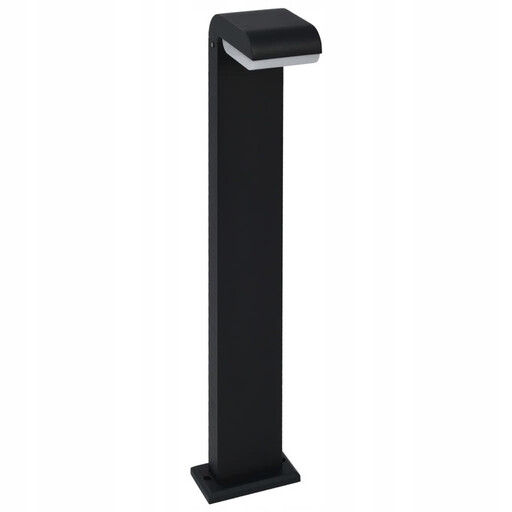
Why it suits this use: This black outdoor light is a straightforward choice for a garden path or flower bed. Its integrated LED and downward-facing light mean you don’t need to choose a separate bulb.
The specifications state 9 W, 550 lm and IP54. This means you can assess the light output and protection in advance, rather than judging by appearance alone.
Cast aluminium, 800 mm high, an integrated LED and an opal diffuser.

Why it suits this use: This garden post light is ideal for a permanent route along a driveway, flower bed or patio where a neat, permanent installation is preferred.
The listing states 800 lm, 4.3 W, 2700 K and IP44. So you can see in advance that it gives off warm light and is protected against splashing water, but isn’t suitable for submersion.
Aluminium housing, 96 cm high and an integrated LED with a stated lifespan of 50,000 hours.

Why it suits this use: This model is designed for a driveway, garage, garden or large patio where wide detection and bright lighting matter more than subtle mood lighting.
The stated IP65 rating and motion detection up to 60 ft across a 180° angle give you more useful information than the term “security light” alone.
302 LEDs, a stated output of 3000 lm, three lighting modes and three adjustable light heads.

Why it suits this use: This set is for anyone who wants to adjust their garden lighting using an app or voice assistant, for example around a flower bed, planting area or patio.
The product information states IP44 and includes an 800 cm cable. This makes it clear that the set is splash-resistant and needs a mains connection.
Three ground spotlights, a dimming function, adjustable CCT from 3000–6500 K, RGB and control via Tuya Smart.
We’ve put together a complete, up-to-date list of products that meet these strict selection criteria and the applicable European safety regulations.
IP44 may be suitable for a sheltered wall or patio. For a more exposed spot where the light is more likely to get rained on or hit by water jets, IP65 is a better choice. Neither rating means the light can be submerged.
That depends on the wattage, how long it’s switched on and your electricity tariff. A 10 W light that’s on for four hours a day uses around 14.6 kWh a year. Solar outdoor lighting doesn’t use mains electricity, but its performance depends on sunlight, battery capacity and temperature.
Point the sensor towards the area where you expect movement, such as a path, gate or driveway. Don’t place it right next to a busy road or branches that move in the wind. Check the detection angle, range and whether the light only activates when it’s dark. This helps prevent unnecessary activation and keeps energy use down.
