
Vandaag of morgen in huis

Kwaliteit gegarandeerd

Welkomstaanbiedingen ontgrendelen: GRATIS bezorging | Tot 80% korting | Gratis 30 dagen JoyPlus-proefperiode
Download de app
The right outdoor lighting does more than brighten a dark spot. The right outdoor light helps you find your keys, makes a driveway easier to navigate and creates a welcoming glow on your balcony or patio. Yet it’s easy to make the wrong choice because of three common pitfalls: a high lumen output that isn’t suited to the intended use, an IP rating that’s misunderstood, and solar outdoor lighting that doesn’t get enough sun.
Use the checks below to compare an outdoor wall light, solar wall light, LED outdoor light or exterior wall lighting based on practical features, rather than just appearance or marketing claims.
A light with a high lumen output illuminates a larger area, but can feel uncomfortably bright by a front door or on a small balcony. A lower output may be enough for atmospheric garden or patio lighting. For a driveway, garage or large garden, a wider spread of light is more important.
As well as lumens, consider:
An IP44 outdoor light is protected against solid objects larger than 1 mm and splashing water from different directions. This makes IP44 suitable for many sheltered exterior walls, balconies and entrances, but not for immersion or powerful direct jets of water.
An IP65 outdoor light offers greater protection against dust and water jets. This can be more practical in an open garden, on a driveway or in a spot where the light is more exposed to rain. However, the IP rating doesn’t automatically tell you anything about light quality, battery life or installation quality.
Solar outdoor lighting doesn’t need a mains connection, but its panel needs enough daylight. A light under a canopy, next to a tall fence or on a north-facing wall may not charge as well. Runtime can also decrease during the darker months.
So check:
Lumens indicate how much visible light a lamp produces. A model with 180 to 500 lumens is often suitable for an entrance, balcony or small garden area. For safety-focused lighting on a driveway or large patio, a model with 1,000 lumens or more may be a better choice.
Colour temperature is measured in kelvins. 2700 K typically gives a warmer glow, while 3000 K looks slightly brighter and more neutral. A rating of 7000 K indicates very cool light. Always check the product details: a description that lists both “warm white” and 7000 K is worth looking at more closely.
An outdoor light with a motion sensor can save energy by switching on only when it detects movement. Don’t just check whether it has a sensor; look at its detection range and angle too.
A sensor with a 180-degree range is useful for a wide driveway. In a narrow passage, a smaller detection angle may help prevent the light switching on unnecessarily. Position the light so it doesn’t constantly pick up passing traffic, moving branches or pets.
Aluminium, plastic and glass are commonly used for outdoor lights. Check that the light is suitable for your chosen wall, and that the wall plugs and screws are appropriate for brick, concrete or wood. Wired models, such as some exterior wall lights with a GU10 or E27 fitting, should be installed by a qualified electrician.
An integrated LED module can’t always be replaced by the user. With a light that has a GU10 or E27 fitting, you can usually choose the bulb yourself and replace it later. Clean solar panels and sensor windows with a soft, slightly damp cloth, unless the product instructions say otherwise.
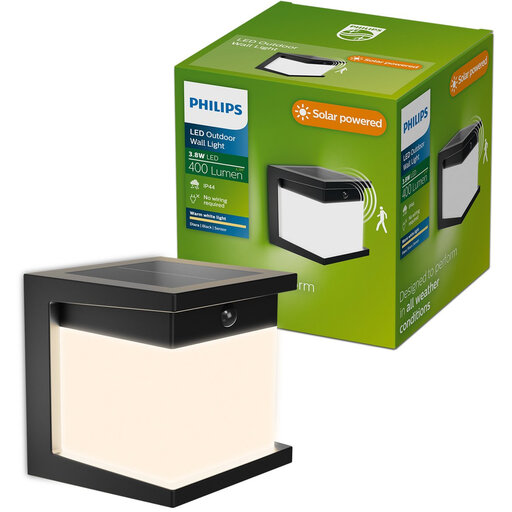
Why it suits this need: This solar wall light works without wiring and provides 400 lumens at a colour temperature of 2700 K. It’s a good fit for an entrance, balcony or smaller garden area.
The IP44 rating is clearly stated. The light is splashproof, but isn’t designed for immersion or direct water jets.
Solar-powered, with a motion sensor, two lighting modes and an integrated 400-lumen LED.

Why it suits this need: With 1,000 lumens, 3000 K and a motion sensor, this model is designed to brighten an entrance, exterior wall or driveway without the need for fixed wiring.
The light output and colour temperature are clearly specified. This makes it easier to choose the model for practical lighting, rather than judging it by appearance alone.
1,000 lumens, 3000 K, two lighting modes, solar power and built-in dusk and motion sensors.

Why it suits this need: For a large garden, garage area or driveway, this model offers three adjustable heads and wide light coverage.
The listing specifies IP65, a 180-degree detection angle and a range of 60 feet. Before installation, check that these distances are suitable for your property.
302 LEDs, a stated light output of 3000 lumens, three lighting modes and three adjustable light heads.
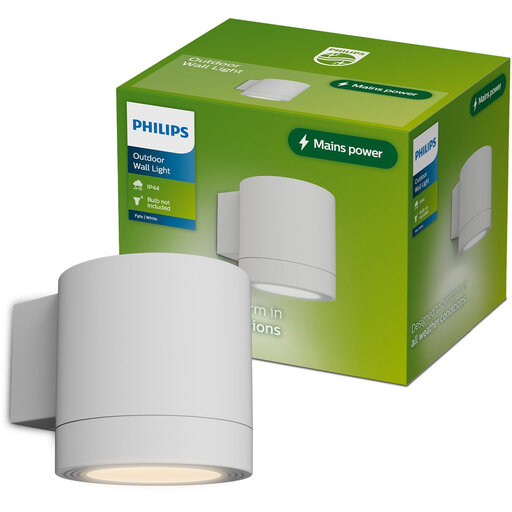
Why it suits this need: This compact white outdoor wall light has a GU10 fitting, so you can choose an LED bulb for warm, bright or smart lighting.
The light is supplied without a GU10 bulb. This is clearly shown in the product specifications, so you can factor in the extra cost of a suitable bulb.
GU10 fitting, aluminium housing, downward-facing light and an IP44 rating for sheltered outdoor locations.
We’ve put together a complete, up-to-date list of products that meet these strict selection criteria and current European safety regulations.
IP44 is often suitable for a sheltered exterior wall, balcony or entrance. For an open area exposed to more rain and dust, IP65 may be a better choice. Check the installation instructions too, and make sure an IP44 light isn’t directly exposed to a water jet.
Runtime each night depends on sunlight, battery capacity, lighting mode and temperature. In winter or after several cloudy days, the light may not stay on as long. Clean the solar panel regularly and choose a spot without shade for more consistent charging.
A solar outdoor light doesn’t use mains electricity. A wired LED outdoor light with a motion sensor switches on only when it detects movement, but its energy use depends on its wattage and how long it stays on. Before choosing, check the wattage, lumens and adjustable lighting duration.
