
Vandaag of morgen in huis

Kwaliteit gegarandeerd

Welkomstaanbiedingen ontgrendelen: GRATIS bezorging | Tot 80% korting | Gratis 30 dagen JoyPlus-proefperiode
Download de app
Good outdoor lighting makes an entrance easier to see, creates a welcoming atmosphere on the patio and helps illuminate dark areas of the garden. However, an attractive product photo does not guarantee that an outdoor light will suit your situation. For example, a solar wall light that receives little direct sunlight may not stay lit for as long. A light with a motion sensor can also respond inconveniently if the sensor faces a busy pavement or road.
In this buying guide, you’ll learn what to look for in an outdoor light, outdoor wall light, solar garden light or decorative outdoor lighting.
IP44 outdoor lighting is resistant to splashing water and solid objects larger than 1 millimetre. This does not mean that the light is waterproof or suitable for direct jets of water. It is therefore best to install an IP44 outdoor light under a canopy, on a sheltered façade or somewhere rain will not fall directly on the housing for prolonged periods.
IP65 outdoor lighting provides greater protection against dust and jets of water. Even then, you should follow the installation instructions: the IP rating applies to the complete, correctly installed housing and not automatically to every connection or cable joint.
More lumens mean more light, but not always a more pleasant result. A 1,000-lumen light may be suitable for a driveway or back door, while 180 to 400 lumens is often enough for a balcony, garden path or atmospheric façade lighting. Also pay attention to the light colour:
Solar outdoor lighting works without a fixed power connection, but the solar panel does need enough daylight. In a Dutch garden, shade from a façade, tree or fence can affect charging performance. With a fixed LED outdoor light, you should check whether wiring is already in place. A wired light with a GU10 or E27 fitting can offer flexibility, but the light source is sometimes not included.
An integrated LED outdoor light is compact and ready to use straight away. The LED module cannot be replaced on some models; at the end of its service life, the entire light generally needs to be replaced. A light with a GU10 or E27 fitting gives you more freedom to choose your own LED bulb. Check the maximum wattage and whether dimming is supported.
For a garden path, even light distribution and downward illumination are important. For façade or entrance lighting, a motion sensor can be particularly useful. A sensor prevents the light from staying on continuously, but the detection angle, range and activation time determine how useful it is in practice.
Don’t just rely on the words “for outdoor use”. Check the IP code, the material and the recommended installation location. Aluminium can provide a sturdy housing, while plastic is often lighter and can be practical for a solar wall light or portable outdoor light. A light with an IP44 rating is splash-resistant, but is not designed for immersion or direct jets of water.
A fixed 230-volt outdoor wall light must be connected by a qualified installer in accordance with the product information. Switch off the power before carrying out maintenance and use fixings suitable for the wall. Portable models with USB-rechargeable batteries are easier to position, but need to be recharged regularly.
Clean solar panels and sensors with a soft cloth. Some models specifically advise against using water or liquid cleaner. Also check that magnetic fixings are attached to a flat, clean and sufficiently strong surface.

Why it suits this profile: This portable LED outdoor light runs on an integrated battery and, according to the product information, requires no fixed wiring. That makes it suitable for a balcony, veranda or rented property where you do not want to have a permanent connection installed.
The specifications state 300 lumens, 3,000 K, IP44 and a motion sensor. This allows you to check the light output and splash protection against the installation location in advance.
Magnetic mounting, USB charging, an integrated 4 W LED and warm white light. Make sure the mounting plate is securely attached and check the battery charge regularly.
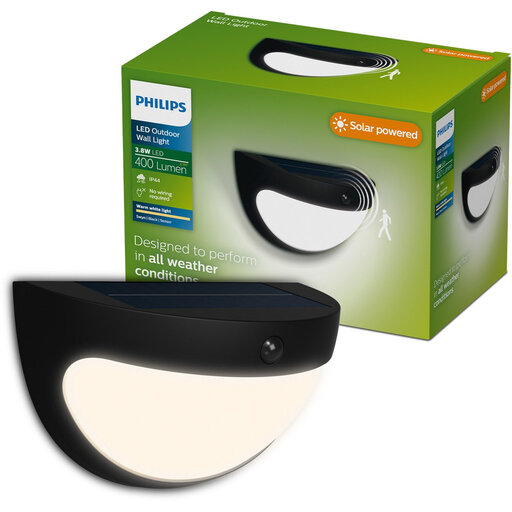
Why it suits this profile: This solar wall light is designed for users who do not want to run cables and are looking for a permanent wall-mounted solution for a garden, balcony or patio.
The product details list two light modes, a daylight sensor, a motion sensor and IP44 protection. This means you can see in advance which automatic functions are available.
According to the product description, the light provides 400 lumens per light point and warm white light. Direct sunlight on the panel remains important for charging.

Why it suits this profile: The three adjustable light heads and wide light distribution are well suited to a driveway, garage, back garden or larger commercial site where targeted lighting is needed.
The stated IP65 rating is suitable where greater protection is needed than IP44. Before installation, however, check the full manual and position the solar panel where it will receive as little shade as possible.
The product specifications list 302 LEDs, three light modes, a motion sensor and a stated light output of 3,000 lumens.
Start by choosing the purpose: orientation, ambience, entrance lighting or illuminating a large area. Then measure the installation location and check where the beam will fall. If you want to limit unnecessary activation, don’t point an outdoor light with a sensor directly at a public pavement.
For solar outdoor lighting, position the panel where it will receive as much direct daylight as possible. With an outdoor LED string light, check that the power supply and connections are suitable for outdoor use. A plug-in string light is practical for a patio, but keep the plug and connections away from standing water.
We’ve compiled a complete, up-to-date list of products that fully meet these strict selection criteria and the applicable European safety regulations.
A modest light output is often enough for a garden path or decorative garden lighting. More light is useful for an entrance or driveway. Always compare the lumens with the installation height, beam angle and purpose of the light.
IP44 is suitable for many sheltered outdoor applications and protects against splashing water. The light is not designed for immersion or direct jets of water. For an exposed location with greater exposure to rain, a higher IP rating may be more suitable, provided the rest of the installation is suitable too.
A solar outdoor light does not use electricity from the mains while it is lit. Its practical performance does depend on sunlight, the season, shade and the condition of the battery. So don’t just check the stated operating time; also consider the positioning options around your home.
