
Vandaag of morgen in huis

Kwaliteit gegarandeerd

Welkomstaanbiedingen ontgrendelen: GRATIS bezorging | Tot 80% korting | Gratis 30 dagen JoyPlus-proefperiode
Download de app
An outdoor lamp needs to do more than look attractive. On a balcony, patio, façade or garden path, lighting has to cope with rain, cold, dust and changing temperatures. Yet many buyers focus mainly on design or a low price. As a result, a lamp may turn out to be too weak, difficult to install or less suitable for the chosen location.
The most common pitfalls when choosing outdoor lighting are:
The IP code indicates how well a product is protected against solid particles and moisture. An IP44 outdoor lamp is protected against splashing water from various directions. This is usually suitable for a sheltered façade, balcony, patio or location beneath an eaves.
For a completely exposed position, a higher level of protection, such as IP65, may be more practical. According to the product specifications, the Philips UltraEfficient Zyren has IP65. This means the lamp is designed for use where greater protection against dust and water is required. Always check the installation instructions too, and install the fitting according to the relevant guidelines.
Choose the power supply based on the installation location:
For atmospheric garden lighting, warm white light of around 2700 to 3000 K is often pleasant. For an entrance or security lighting, a higher light output may be more practical. According to the product information, the Philips Fyns produces 1000 lumens and has a colour temperature of 3000 K.
An outdoor lamp with a motion sensor switches on only when movement is detected. Therefore, check the detection range and the direction in which the lamp will be installed. A lamp with an integrated LED is ready to use straight away, while a fitting with an E27 outdoor lamp or GU10 outdoor lamp gives you more freedom to choose the colour and brightness of the light.
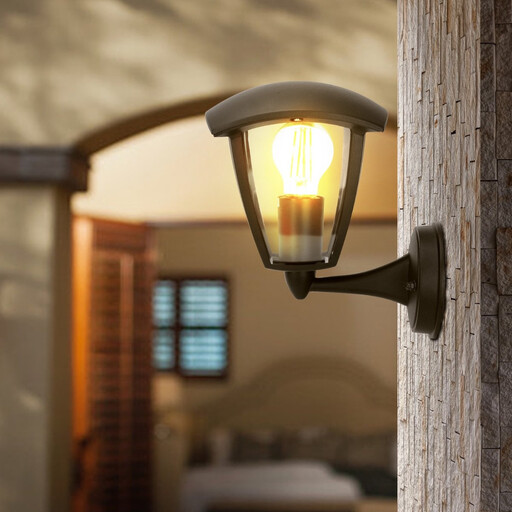
Why it suits this profile: This black wall light has an E27 fitting and is supplied without a light source. You can therefore choose an LED bulb with the colour temperature and brightness you want for a balcony, canopy or entrance.
The product information clearly states that the lamp is supplied without a light source. The IP44 rating is also specified, allowing you to weigh its splash protection against the intended location.
E27 fitting, aluminium and PMMA, IP44 and a maximum power of 60 W.

Why it suits this profile: This solar wall light is designed for anyone looking for plenty of light and a wider detection range near a driveway, back door or façade.
The specifications mention both IP65 and motion detection of up to 8 metres for an approach from directly in front, and 16 metres for a lateral approach. According to the product information, direct sunlight is needed for optimum charging.
4000 lumens, integrated LED, 5000 K, IP65 and an adjustable lamp head.

Why it suits this profile: This solar outdoor lamp is suitable for an entrance, shed or driveway where bright automatic lighting is needed without permanent wiring.
The lamp combines a motion sensor with a dusk sensor and has an IP44 rating. Make sure you position the solar panel where it receives direct light; the manufacturer states this is a requirement for use.
1000 lumens, 3000 K, two light modes, integrated LED and solar power.

Why it suits this profile: This set is designed for garden paths, borders and patios where colour, dimming and app control are desirable.
The set has an IP44 rating and an 8-metre cable. Bear cables in mind as a potential trip hazard, as well as the app, account registration and connection required for the smart functions.
3 pieces, integrated LED, 660 lumens, RGB/CCT, dimming function and Tuya Smart compatibility.
We have put together a complete, up-to-date list of products that fully meet these strict selection criteria and the applicable European safety regulations.
That depends on the intended use. A few hundred lumens are often enough for decorative garden lighting. For an entrance, driveway or security function, a higher light output may be preferable. As well as lumens, consider the beam direction and installation height.
Solar outdoor lighting can work well when the panel receives enough direct light during the day. In winter, in cloudy conditions or in a shady location, the battery may not charge fully. In such cases, consider mains-powered lighting or a rechargeable model instead.
LED lamps generally use less wattage than traditional light sources while providing a similar amount of light. Actual consumption depends on the wattage, the number of hours the lamp is switched on and how it is operated. A motion sensor or dusk sensor can reduce the operating time.
