
Vandaag of morgen in huis

Kwaliteit gegarandeerd

Welkomstaanbiedingen ontgrendelen: GRATIS bezorging | Tot 80% korting | Gratis 30 dagen JoyPlus-proefperiode
Download de app
Good outdoor lighting needs to do more than look attractive. An outdoor lamp by the front door must withstand rain, a solar outdoor lamp needs sufficient daylight and a garden light must suit the place where you want to use it. Yet important details are often overshadowed by terms such as “powerful”, “energy-efficient” or “waterproof”.
So pay particular attention to these three common pitfalls:
With the right specifications, you can make an informed choice between an outdoor wall light, LED outdoor lighting, solar garden lighting or an outdoor lamp with a motion sensor.
The IP code indicates how well a product is protected against solid particles and water. The first digit refers to solid particles, while the second refers to moisture.
An IP44 lamp is therefore not automatically waterproof. Also check the installation instructions and do not place a lamp where water can collect.
Lumens indicate how much light a lamp produces. A few hundred lumens may be sufficient for atmospheric patio lighting. A driveway or large garden requires more light. Also consider the colour temperature:
Also consider the direction of the light beam. A swivelling lamp with multiple light heads illuminates a wider area than a compact outdoor wall light that mainly shines downwards.
A solar outdoor lamp works without a fixed connection, but it needs to be installed somewhere where the solar panel receives enough direct daylight. A tree, canopy or tall fence can reduce charging performance. Clean the panel regularly with a soft cloth.
A fixed outdoor lamp with an E27 or GU10 fitting gives you more freedom when choosing the light source and colour temperature. However, installation on the mains must be carried out by a qualified installer. Also check whether the lamp is supplied without a light source.
The recommendations below are based on verifiable product details, such as IP rating, light output, energy source and installation type. Brand descriptions relating to efficiency, service life or performance are presented as product information from the brand and not as independently established results.
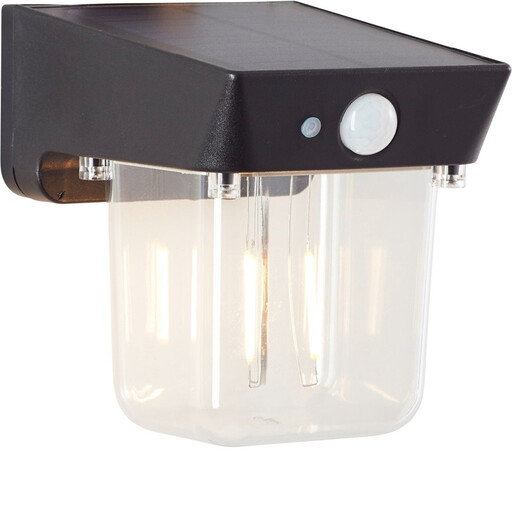
Why it suits this profile: This compact lamp runs on solar power and does not require a fixed electricity connection. That makes it practical for an entrance, balcony or small garden wall.
The specifications clearly state that it has an integrated LED, motion sensor, solar operation and an IP44 rating. Expect protection against splashing water, not direct water jets.
180 lumens, 2700K warm white light, two lighting modes and installation without wiring.
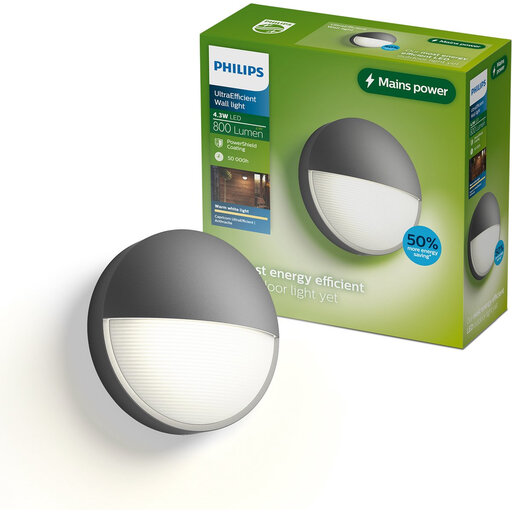
Why it suits this profile: This fixed LED outdoor light is ideal if you are looking for a sleek design, consistent light output and an aluminium housing for a façade or balcony.
The product information lists 800 lumens, 2700K, 4.3W and IP44. This allows you to compare the lamp based on clear specifications rather than relying solely on design claims.
Integrated LED, aluminium and plastic construction, 800 lumens and a stated service life of up to 50,000 hours according to Philips.

Why it suits this profile: For an open driveway, large garden or wide façade, high light output and robust moisture protection may be more important than a compact design.
The combination of 4,000 lumens, IP65 and an adjustable light head makes the intended application clearer. Do not install this lamp in a small area where its brightness could be unnecessarily intrusive.
Solar operation, motion sensor, 5000K light, IP65 and, according to Philips, up to four nights of illumination after a full battery charge.
We have put together a complete, up-to-date list of products that fully meet these strict selection criteria and the applicable European safety regulations.
That depends on the space. For atmospheric lighting on a balcony or patio, 180 to 400 lumens may be sufficient. An entrance, garden path or driveway will often benefit from more light. If you choose a lamp with a motion sensor, it is also worth considering the light beam and installation height.
An IP44 outdoor lamp is designed to withstand splashing water, but not direct water jets or immersion. Preferably use this rating in a sheltered location and follow the installation instructions. For a completely exposed external wall, an IP65 outdoor lamp may be more suitable.
The operating time per night depends on sunlight, battery capacity, temperature and the selected lighting mode. In winter, solar panels generally charge less effectively because of shorter days and cloudy weather. Keep the panel free from shade and the surface clean. When buying, check the battery specifications rather than focusing only on the term “energy-efficient”.
