
Vandaag of morgen in huis

Kwaliteit gegarandeerd

Welkomstaanbiedingen ontgrendelen: GRATIS bezorging | Tot 80% korting | Gratis 30 dagen JoyPlus-proefperiode
Download de app
Good outdoor lighting needs to do more than look attractive in a product photo. A light for your garden, exterior wall or driveway has to cope with rain, limited sunlight, temperature changes and sometimes an unsuitable installation location. If you only look at the number of LEDs or a low price, you can quickly end up buying a light that disappoints in practice.
The main pitfalls are usually:
The IP rating consists of two digits. The first digit concerns protection against solid particles, while the second refers to water.
A higher IP rating does not mean that every component is completely resistant to moisture. Also check the installation instructions, cable connections and the position of the solar panel.
For LED garden lighting and ambient garden lighting, values of around 2700 to 3000 K are generally considered warm white. This creates a softer effect on a patio, balcony or entrance. A higher colour temperature, such as 6500 K or 7000 K, looks much whiter and is more suitable for functional lighting along a path or across a large area.
Lumens indicate how much light a lamp emits according to the product specification. As a guide:
Also consider the light distribution. A lamp with several adjustable heads can cover a larger area than a compact wall light with the same light source.
An outdoor light with a motion sensor only switches on when movement is detected. This is practical by a front door, garage or garden path. Check the detection angle and range, as these determine whether the light will actually come on when someone walks past.
A solar-powered garden light or solar garden light does not need a fixed power connection, but its performance depends on sunlight, the season and battery capacity. During prolonged cloudy weather, the light may run for less time. A wireless outdoor light with a USB-rechargeable battery offers greater flexibility, but it does need to be recharged regularly.
For string lights, check the number of settings, the length and the position of the solar panel. An outdoor string light is primarily decorative; do not use it as a replacement for bright security lighting.

Why it suits this type of user: This solar garden light with ground spike is easy to install along a path or in a border, without a connection to the mains electricity supply.
The product specification lists a polycrystalline solar panel, a charging time of 4–6 hours and an IP44 rating. Make sure you install the light in a sunny location.
Stainless steel construction, a height of 55 cm, a colour temperature of 6500 K and a stated operating time of 8–12 hours.

Why it suits this type of user: This solar wall light is designed for an entrance, patio or exterior wall where automatic lighting and a clear light output are important.
The product specification mentions two light settings, a dusk and motion sensor, and IP44. The light therefore does not rely on manual operation, although it still needs a suitable installation location.
1000 lumens, 3000 K warm white light, integrated LEDs and installation without fixed wiring.

Why it suits this type of user: This model is designed for a driveway, garage, patio or another larger area where broad, powerful lighting is needed.
The stated IP65 rating and three light settings provide more information than a simple marketing claim about “water resistance”. Check the exact positioning and installation instructions.
302 LEDs, a stated light output of 3000 lumens, three adjustable heads, a detection angle of 180 degrees and a 1800 mAh solar battery.
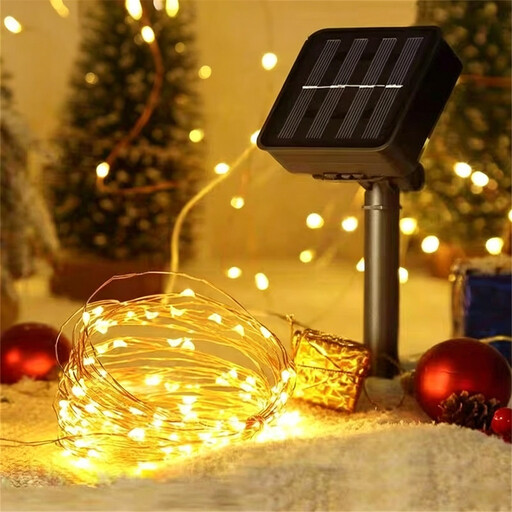
Why it suits this type of user: The two string lights are suitable for a balcony, pergola, tree or patio where decorative lighting is more important than a powerful beam.
The specification clearly states the length, number of LEDs, eight light settings and charging time. The solar panel needs direct daylight; the string lights must not be immersed.
Two 49 ft strings with 75 warm white LEDs each, eight settings and a stated operating time of 8–14 hours depending on the conditions.
We have put together a complete, up-to-date list of products that fully meet these strict selection criteria and the applicable European safety regulations.
The operating time per night depends on sunlight, the season, temperature, battery and selected light setting. Manufacturers sometimes state an expected operating time, but this is not a fixed guarantee for every UK garden. Clean the solar panel regularly and position it as openly as possible.
According to the classification, an IP44 outdoor light is protected against splashing water. This makes it suitable for many sheltered outdoor locations, such as an exterior wall or covered patio. IP44 does not mean that the light is waterproof against immersion or direct water jets.
A solar garden light does not use electricity from the mains during normal operation. Its battery is charged via the solar panel. However, bear in mind that operating time can vary in cloudy weather and during periods of limited winter sunlight. For a mains-powered light, you can estimate consumption more accurately based on the wattage and number of operating hours.
