
Vandaag of morgen in huis

Kwaliteit gegarandeerd

Welkomstaanbiedingen ontgrendelen: GRATIS bezorging | Tot 80% korting | Gratis 30 dagen JoyPlus-proefperiode
Download de app
Good outdoor lighting should suit the location, the weather and how you plan to use it. A light for a sheltered balcony has different requirements from lighting along a driveway or by a garage. Yet many buyers focus mainly on lumens, design or a low price. This can lead to problems: the light may not be bright enough, the battery may run out quickly or the housing may be less suitable for rain than expected.
This buying guide helps you compare a solar outdoor light, an outdoor light with a motion sensor, an LED outdoor light, an outdoor wall light and smart garden lighting, among other options, using verifiable features.
A high lumen count doesn’t automatically mean a light will work well in the right place. A wide-beam floodlight may suit a driveway, but could be too bright next to a seating area. For atmospheric garden lighting, colour temperature, beam angle and dimming are often more important than the maximum lumen count alone.
Pay attention to the colour temperature too:
An IP44 outdoor light is protected against splashing water, but isn’t designed for direct jets of water or submersion. Ideally, install one in a sheltered spot under an overhang or somewhere rain won’t fall directly onto the housing.
An IP65 outdoor light offers greater protection against dust and water jets. Even so, correct installation, sealing and maintenance are important. An IP rating doesn’t automatically make a product suitable for every location.
A solar outdoor light needs enough daylight to charge its battery. In a north-facing garden, under a balcony or among tall trees, it may not stay on for as long. Check whether the solar panel gets direct sunlight and whether the light has a separate panel.
With a rechargeable outdoor light, check how it charges, how often it needs charging and whether the battery can be replaced. With integrated LED lighting, the light source may not be replaceable by the user.
Start by deciding what you need the light for:
Check whether the stated lumen value applies to the whole light or just the light source. An LED light with an integrated light source doesn’t need a separate bulb, while a GU10 or E27 bulb gives you more flexibility over colour temperature and brightness.
An outdoor light with a motion sensor is handy by an entrance, shed or driveway. Check the:
A wide detection range isn’t always desirable. For example, a light beside a public pavement could switch on unnecessarily. Also check whether branches, pets or passers-by could trigger the sensor.
A light without fixed wiring is easy to install, but is usually limited by battery life or brightness. A wired wall light generally provides a stable power supply, but a 230 V connection must be carried out by a qualified installer, in accordance with the product information.
Clean solar panels and sensor windows regularly with a soft, slightly damp cloth. For products that should only be cleaned with a dry cloth, don’t use water or liquid cleaners.
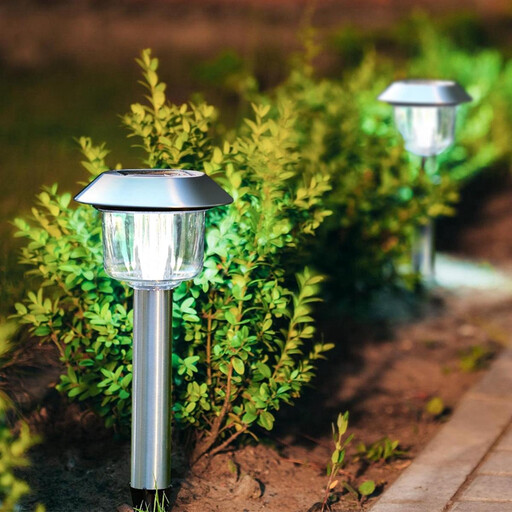
Why it suits this profile: This solar garden light works without fixed wiring and is designed for gardens or patios. Its compact design makes it easy to position along borders or a path.
The light is solar-powered, so there’s no need for an electrician or power cable. However, positioning it in direct daylight is still important for charging performance.
Solar-powered, made from stainless steel and 36.6 cm high. The product information lists a colour temperature of 6500 K and a power rating of 0.08 W.
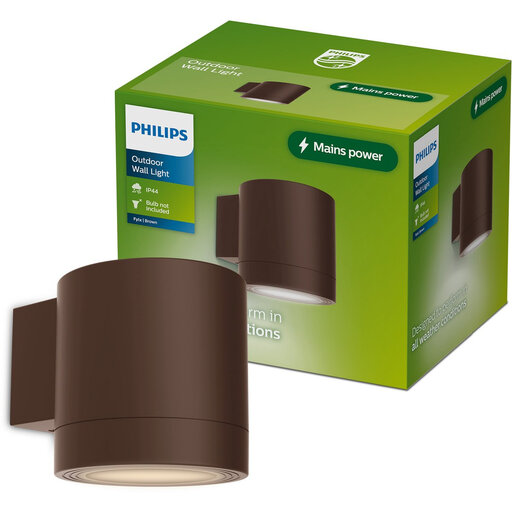
Why it suits this profile: This outdoor wall light is a good choice if you want to choose your own GU10 light source. This lets you tailor the colour temperature, dimming and brightness to suit your exterior wall or entrance.
The GU10 fitting means you aren’t tied to one fixed colour temperature. Please note: the light source isn’t included, and IP44 protects against splashing water, not direct water jets.
Aluminium housing, GU10 fitting, one light point and an IP44 rating. The light has a compact size of approximately 8.9 × 11.6 × 9 cm.

Why it suits this profile: This solar outdoor light is designed for larger areas such as a garage, driveway, garden or patio. Its three light heads and motion sensor are useful when you need broad, practical lighting.
The stated IP65 rating is better suited to an exposed outdoor location than IP44. The light has three settings, so you don’t always need to use the brightest one.
The product information lists 302 LEDs, 3000 lumens, three adjustable heads, a 180° detection angle and a detection range of approximately 18 metres.
We’ve put together a full, up-to-date list of products that meet these strict selection criteria and the applicable European safety regulations.
IP44 may be suitable for a sheltered spot, as long as the light isn’t exposed to direct water jets. For an exposed exterior wall, driveway or garden, IP65 is often more practical. Always check the installation instructions and exact product information.
A solar outdoor light doesn’t use mains electricity while charging. Its actual performance depends on the amount of daylight, battery capacity, the season and the battery’s age. For consistent lighting throughout the night, wired LED garden lighting may be more predictable.
Lifespan varies by model and conditions of use. Check whether the LED is integrated, whether the light source can be replaced, and what manufacturer’s or statutory guarantee applies. With a light that has a replaceable GU10 or E27 fitting, you can change the light source later without replacing the whole fitting.
