
Vandaag of morgen in huis

Kwaliteit gegarandeerd

Welkomstaanbiedingen ontgrendelen: GRATIS bezorging | Tot 80% korting | Gratis 30 dagen JoyPlus-proefperiode
Download de app
Good outdoor lighting should suit the location, purpose and British weather. A light for a garden path has different requirements from a security light by the driveway. Yet many models are mainly promoted with terms such as “extra bright”, “waterproof” or “energy-efficient”, without making it clear what these claims mean in practice.
So watch out for these three common pitfalls:
Below, you’ll find out which specifications matter and which types of outdoor lights suit different situations.
Lumens indicate how much light a lamp produces according to its product specifications. However, that figure does not tell you everything. For pathway lighting, an even, soft light distribution is often more practical than an extremely high light output. By a driveway or back door, an outdoor light with a motion sensor and a wide beam may be more useful.
Use this guide:
The overall effect also depends on the mounting height, the angle of the lamp and the colour temperature. A lamp rated at 2700K to 3000K produces warm white light, which is often pleasant around a patio or garden path. 4000K to 6500K looks whiter and can be more practical by a garage or work area.
The IP code consists of two digits. The first relates to protection against solid particles, while the second refers to water.
A higher IP rating does not automatically make a product suitable for every situation. Also check the fixings, cable entry and installation instructions. With solar wall lights, the position of the panel is also more important than the IP code alone.
Solar outdoor lighting is useful when you do not want to run cables. The lamp charges during the day and usually switches on automatically when it gets dark. The stated operating time depends on hours of sunlight, panel position, temperature and battery condition. So place the solar panel where it will receive as much direct daylight as possible and clean it regularly.
Mains-powered LED outdoor lighting generally offers consistent availability, but it does require a socket or permanent connection. A plug-in set, such as some LED garden spotlights, is a middle ground: you do not need to install permanent wiring, but you are dependent on a power point and suitable cable routing.
Check the following for every product:
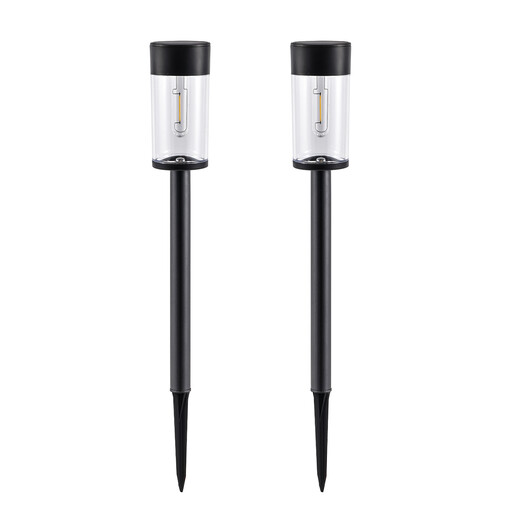
Why it suits this profile: This set is designed for anyone who wants to mark out a garden path, border or driveway without installing wiring. It is installed using ground stakes.
The product information states 10 lumens per lamp and an IP65 rating. This makes it clear that these are accent and pathway lights, not powerful lights for a large driveway.
3000K warm white light, automatic switching on and off, and a stated operating time of 8 to 12 hours.
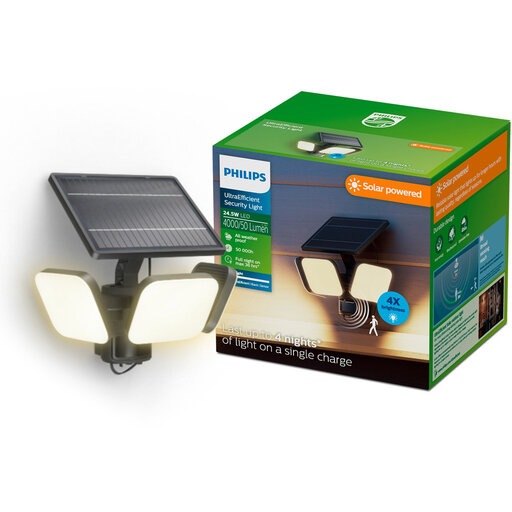
Why it suits this profile: This solar wall light is designed for a wall, entrance or driveway where a wide beam and motion detection are desirable.
The specifications list IP65, an adjustable lamp head and two light settings. This helps you direct the light more accurately towards the desired area.
According to the product information, 4000 lumens, 3000K light, a detection range of 8 metres when approached directly and 16 metres when approached from the side.

Why it suits this profile: This lamp is designed for larger areas around a garage, garden, patio or driveway where automatic lighting when movement is detected is desirable.
The three heads and adjustable lighting direction make it possible to illuminate a wider area than a single fixed beam.
According to the product specifications, 302 LEDs, 3000 lumens, IP65 and three light settings with a sensor range of 60 feet and a detection angle of 180 degrees.

Why it suits this profile: Ideal for garden enthusiasts who want to position LED garden spotlights along borders, plants or a patio and adjust the lighting via an app.
The product information states IP44 and an 8-metre cable. So position the set in a suitable, sheltered location and keep cables away from paths.
Dimmable, RGB and CCT settings from 3000K to 6500K, with control via Tuya Smart, Alexa or Google Assistant according to the product description.
We’ve put together a complete, up-to-date list of products that fully meet these strict selection criteria and the applicable European safety regulations.
Yes, but positioning makes a big difference. A panel needs direct light during the day to charge the battery sufficiently. In autumn and winter, shorter days, cloudy weather and low light levels can limit the operating time. Choose a lamp with clear battery and charging specifications, and position the panel as openly as possible.
A motion sensor switches the lamp on when movement is detected. A dusk sensor responds to the ambient light and switches the lamp on as soon as it gets dark. Some models combine both functions. This can be useful by an entrance or driveway, while a dusk sensor without motion detection is better suited to constant ambient lighting.
Consumption depends on the wattage and the number of hours the light is on. According to the product specifications, an integrated 4-watt LED lamp uses 4 kWh per 1,000 operating hours. Solar lamps do not use electricity from a socket, but battery capacity and available sunlight determine how long they work. So always check both the wattage and operating time, rather than focusing only on the term energy-efficient.
