
Vandaag of morgen in huis

Kwaliteit gegarandeerd

Welkomstaanbiedingen ontgrendelen: GRATIS bezorging | Tot 80% korting | Gratis 30 dagen JoyPlus-proefperiode
Download de app
Good outdoor lighting should suit the location, how it is used and the British weather. A lamp for creating ambience on a balcony has different requirements from outdoor security lighting for a driveway. Yet many shoppers focus mainly on appearance, the number of LEDs or a high lumen rating. As a result, a lamp may end up in your basket that no longer performs comfortably after a few months.
A high lumen count may sound appealing, but more light is not always more practical. A 4,000-lumen outdoor LED lamp may be suitable for a large driveway, but too bright next to a seating area. Consider the intended use:
Marketing copy sometimes uses terms such as weather-resistant or waterproof without clearly explaining the full protection rating. Always check the IP rating. The first digit indicates protection against solid particles and the second against water.
Solar outdoor lighting only works well when the panel receives enough direct daylight. Shade from a canopy, tree or tall façade limits charging. A solar-powered outdoor lamp is therefore not the most logical choice for every north-facing wall.
A fixed 230-volt wall light will usually need to be connected by a qualified electrician. Also check whether the light source is included. Some models have a GU10 or E27 fitting but are supplied without a bulb. This gives you more choice, but also means extra costs and a separate purchase.
The colour temperature determines the overall look. Warm white light from 2,700 to 3,000 kelvin works well for decorative outdoor lighting, a patio or an entrance. Cooler light can be more practical for a driveway or work area, but looks less soft.
Also consider the direction of the beam. A wall light that shines downwards mainly illuminates the floor and the wall beneath it. A model with adjustable heads can cover a larger area. For garden lighting along a path, several low-level lights are often calmer and less harsh than one bright lamp.
An outdoor lamp with a motion sensor can switch on automatically when someone walks past. Check:
A motion sensor is useful by an entrance, garage or rear path. For a patio where you sit for longer periods, a fixed switch or continuous-on mode is often more practical.
Aluminium, plastic and glass are all commonly used. Do not look only at the material; check the IP rating, mounting system and maintenance instructions too. A solar wall light will generally need its panel cleaned regularly. With battery-powered models, you need to allow for charging or replacement.
With integrated LED lighting, the light source is not always replaceable. A GU10 or E27 fitting offers greater flexibility, as you can adapt or replace the bulb. Always check the maximum wattage and dimensions before ordering.
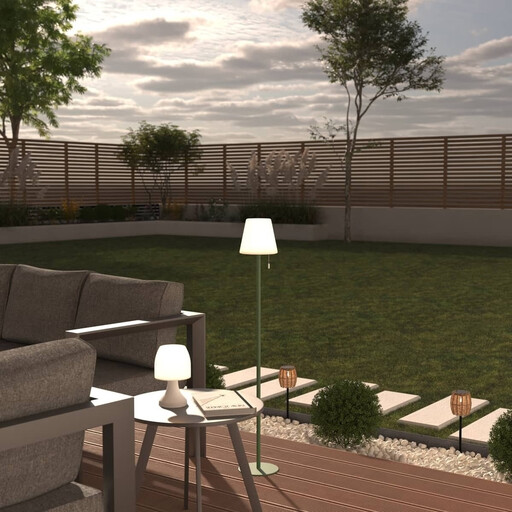
Why it suits this profile: This portable floor lamp runs on batteries and does not need to be connected to the mains. You can therefore move it between your balcony, patio and garden.
The specifications state three light modes, a runtime of up to ten hours and IP44. You can therefore see in advance that this is mainly an ambient lamp, not a bright security light.
108 cm tall, removable light source, steel base and a choice of multicolour, flame effect and white light.
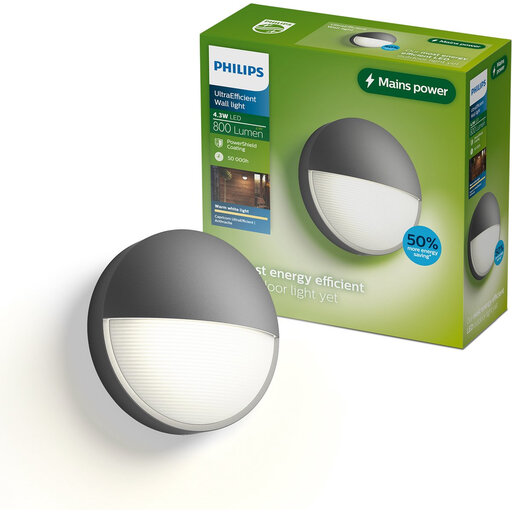
Why it suits this profile: For a fixed wall or balcony light, this fitting offers integrated LED lighting with warm white light and an aluminium housing.
The product information specifies 800 lumens, 2,700 kelvin, 4.3 watts and IP44. This means you are not relying solely on a general durability claim.
Aluminium and plastic, integrated LED and a stated lifespan of up to 50,000 hours. Fixed installation by an electrician is required.

Why it suits this profile: This solar outdoor light is designed for large driveways, garages and gardens where broad, powerful lighting and automatic detection are desirable.
The product details specify IP65, 4,000 lumens, two light modes and a motion-detection range that varies depending on the approach. Direct sunlight is still essential for installation.
Solar power without fixed cabling, adjustable lamp head, integrated LED and a battery that, according to the product description, can support up to four nights.
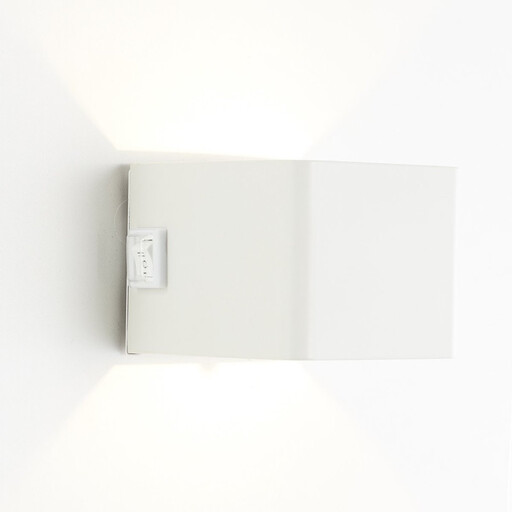
Why it suits this profile: This cordless lamp runs on batteries and has a magnetic mount, making it suitable for places where drilling or wiring is difficult.
The lamp offers 300 lumens, 3,000 kelvin and IP44. This makes it clear that the model is intended for close-range lighting and splash protection, not large exposed areas.
Integrated LED, USB charging, motion sensor and magnetic mounting. Check that the surface is flat, clean and magnetic enough.
We have put together a complete, up-to-date list of products that fully meet these strict selection criteria and the applicable European safety regulations.
For a sheltered façade, balcony or patio, an IP44 outdoor lamp may be suitable. For a location more frequently exposed to rain and water jets, IP65 is the more obvious choice. Always check the installation instructions, and do not place an IP44 fitting somewhere it will be directly hit by powerful water jets.
Solar lighting may run for less time or produce less light in winter because of shorter days, cloudy weather and lower levels of direct sunlight. Position the panel as far from shade as possible and keep it clean. A model with a larger battery capacity or multiple light settings offers greater flexibility, but the actual runtime will still depend on the charging conditions.
An outdoor LED lamp generally uses less energy than traditional light sources for a similar light output. Consumption depends on the wattage and the number of hours it is switched on. A lamp with a motion sensor can limit the operating time. Solar outdoor lighting does not use electricity from the mains, but it does need sufficient sunlight to charge the battery.
