
Vandaag of morgen in huis

Kwaliteit gegarandeerd

Welkomstaanbiedingen ontgrendelen: GRATIS bezorging | Tot 80% korting | Gratis 30 dagen JoyPlus-proefperiode
Download de app
Buying a new light for your façade, garden or driveway seems straightforward. Yet many purchases fail to live up to expectations. A light may be dimmer than expected, the sensor may respond too slowly or the housing may not be suitable for the place where you want to install it. By checking a few key product specifications, you can avoid unnecessary costs.
The number of lumens indicates how much light a lamp produces. The light distribution then determines where that light falls. A powerful lamp with a narrow beam is suitable for highlighting a tree or architectural feature, but less useful for illuminating a wide driveway.
Also consider the colour temperature:
Warm-coloured outdoor lighting is often a good choice for an entrance or patio. You can also browse the range of warm-coloured LED outdoor lighting if you are mainly looking for a calm lighting atmosphere.
The IP code is more important than a general marketing term. An IP44 outdoor light is protected against solid particles from 1 millimetre in size and splashing water from different directions. This does not mean that the light can withstand immersion or a powerful jet of water.
IP44 may be sufficient for areas beneath a canopy. On a completely exposed façade, near a sprinkler or in a low-lying area of the garden, a higher level of protection may be more practical. Also check whether the cable, plug and mounting materials are suitable for outdoor use.
Solar outdoor lighting does not need a permanent power connection, but the solar panel must receive enough daylight. A north-facing wall, a position beneath a balcony or a shady garden can limit charging time. In the darker winter months, the operating time may also be shorter.
A motion sensor helps to reduce energy consumption, but pay attention to its settings. A sensor aimed at a busy footpath may switch on unnecessarily often. Also check whether the light offers an automatic mode, a permanent-on setting or both.
Lumens are the practical measure of the amount of light. Less light is often sufficient for atmospheric lighting along a path than for a driveway or back door. Wattage mainly indicates electricity consumption and does not directly tell you how much light you will get. Energy-efficient LED lighting can still provide useful light output with a low wattage.
For replaceable spotlights, check the fitting. A GU10 LED spotlight only works in a fitting with a GU10 connection and the correct mains voltage. The Philips GU10 spotlights listed in the product details are described as intended for indoor use and have an IP20 rating. Do not use them in an outdoor fitting without checking first.
Look at the complete IP rating, not just the words “for outdoor use”. Aluminium can feel sturdy, while plastic is lighter and is often practical for solar products. When mounting a light on a façade, check that the surface, screws and wall plugs are compatible with one another.
An integrated LED is compact and generally requires little maintenance. However, the light source cannot be replaced in some fittings. When it reaches the end of its service life, the entire light must then be replaced. A fitting with a separate bulb offers greater flexibility, provided the fitting and wattage are compatible.
A fixed outdoor wall light running at 230 V must be connected safely. The product information for the Philips Capricorn specifies professional installation by a qualified electrician. Switch off the power at the consumer unit before working on a fixed connection.
A solar wall light or rechargeable LED outdoor light is easier to install, but it must be secured firmly. A magnetic light requires a flat, clean and sufficiently strong surface. After installation, check that the light cannot fall or obstruct a walkway.
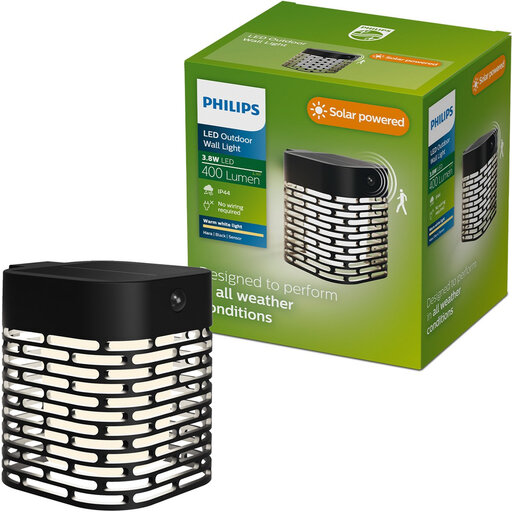
Why it suits this profile: This solar wall light works without fixed wiring and, according to the product specifications, has two lighting modes, 400 lumens and an IP44 rating. This makes it practical for a balcony, shed or entrance with enough direct daylight.
The IP44 specification clearly indicates its protection against splashing water. Position the light so that the solar panel receives direct light; IP44 does not mean waterproof.
No mains connection required; warm white light at 2700 K and a built-in dusk and motion sensor.
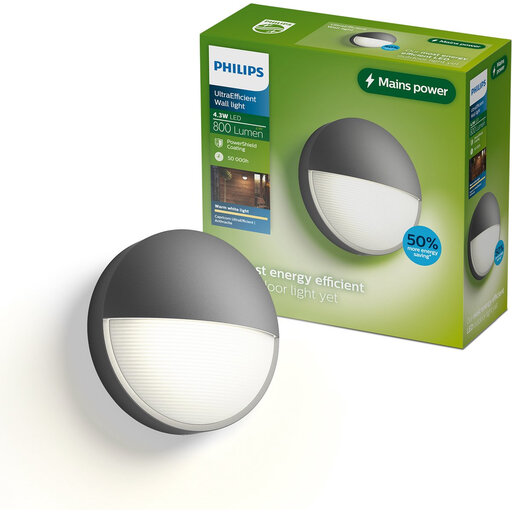
Why it suits this profile: A fixed outdoor wall light with an integrated LED is a good choice for anyone looking for a permanent lighting solution for a façade, patio or balcony. The specifications state 800 lumens, 2700 K and 4.3 W.
The product information explicitly mentions IP44 and an aluminium housing. Bear in mind that professional installation is required for 230 V.
Aluminium and integrated LED; 800 lumens and warm white light for general outdoor lighting.

Why it suits this profile: For a driveway, large garden wall or entrance where plenty of light is needed, the product description states 4000 lumens, a motion sensor and IP65 protection.
The higher IP65 rating is more specific than a general claim of weather resistance. Position the sensor carefully to limit unwanted activation.
4000 lumens; solar-powered; motion and dusk sensor according to the stated product specifications.
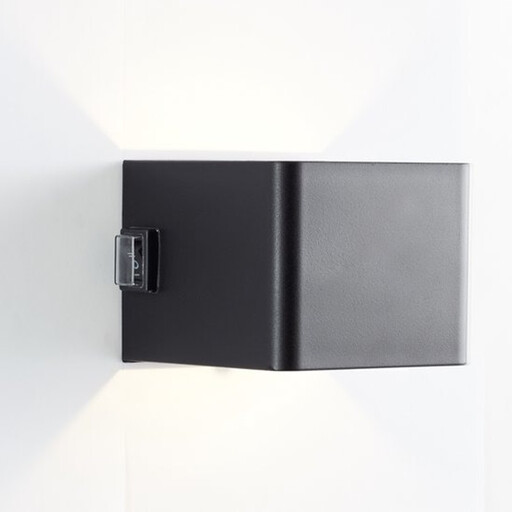
Why it suits this profile: This rechargeable LED outdoor light has a magnetic mount, USB-C charging, 300 lumens and a motion sensor. This means it can be moved without fixed wiring.
The IP44 rating is clearly stated. Secure the magnetic plate firmly and treat the light as splash-resistant, not completely waterproof.
Wireless positioning; rechargeable battery; 3000 K and motion sensor.
We have put together a complete, up-to-date list of products that fully meet these strict selection criteria and the applicable European safety regulations.
That depends on the application. A lower light output may be sufficient for atmospheric lighting along a garden path. A driveway, shed or entrance benefits from more light. Always compare lumens with the beam angle and check whether a sensor only switches the light on when needed.
An IP44 light is designed to protect against splashing water and solid particles. It may be suitable for general outdoor use, but not for immersion or direct water pressure. Positioning it beneath a canopy can provide additional protection. Always follow the product’s installation and safety instructions.
Solar lighting does not use mains electricity during normal operation. Actual performance depends on sunlight, panel direction, battery capacity and temperature. Keep the panel clean and do not leave the light in the shade for extended periods. With fixed LED outdoor lighting, you can estimate consumption using the wattage, operating hours and your electricity tariff.
