
Vandaag of morgen in huis

Kwaliteit gegarandeerd

Welkomstaanbiedingen ontgrendelen: GRATIS bezorging | Tot 80% korting | Gratis 30 dagen JoyPlus-proefperiode
Download de app
An outdoor light needs to do more than look good in a product photo. In the Netherlands, lighting has to cope with rain, wind, moisture and limited hours of sunshine. However, not every model is suitable for every location. If you focus only on design or a low price, you could end up with a light that provides too little illumination, is difficult to install or becomes outdated sooner than expected.
The most common pitfalls when choosing outdoor lighting are:
For a sheltered entrance, balcony or covered patio, IP44 outdoor lighting may be suitable. The housing is protected against splashing water, but not against a pressure washer or prolonged standing water. Install the light according to the instructions and make sure all connections are properly sealed.
For an outdoor ground spotlight or garden lighting along a low-lying path, drainage is particularly important. An IP44 rating does not make a fitting suitable for a location where water collects. Also check that the cable, plug and socket are suitable for outdoor use.
An outdoor wall light with an E27 fitting gives you plenty of flexibility. You can choose your own LED bulb with warm, neutral or cool light, and replace the bulb later. GU10 is particularly practical for directional lighting, for example on a façade or beside a front door.
A colour temperature of around 2700 to 3000 K produces warm white light. This suits a patio, balcony or entrance where atmosphere is important. For a more modern look or clearer visibility, cooler white light may be more suitable. Also check the number of lumens. A model with 400 lumens has different uses from an outdoor light with 800 or 1000 lumens.
A fixed LED outdoor light or mains-powered outdoor wall light requires a safe electrical connection. If you are unsure about the wiring, installation by a qualified electrician is advisable. An integrated LED is ready to use, but on some models the light source cannot be replaced.
An outdoor light with a motion sensor switches on automatically when movement is detected. This is practical for an entrance, garage or pathway. However, check that the sensor settings are suitable for the location. With solar lighting, the solar panel must be kept clear of leaves and dirt. Manufacturers generally recommend regular cleaning; this is maintenance, not a guarantee of a fixed operating time.
The recommendations below are based on verifiable product specifications, such as fitting, light output, dimensions, IP rating and power method.
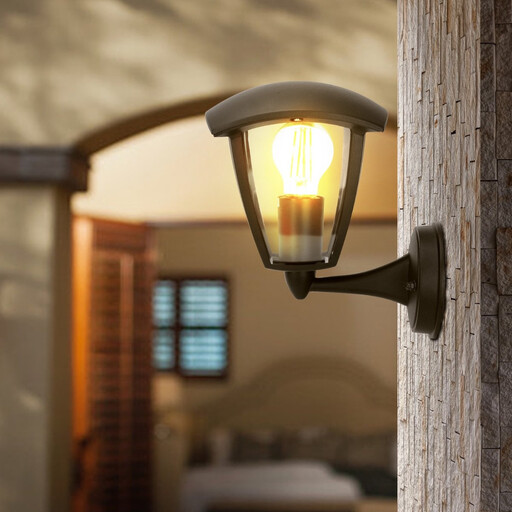
Why it suits this profile: This black outdoor light has an E27 fitting and is supplied without a light source. You can choose a suitable LED bulb yourself and replace it later.
The fitting is clearly stated and the IP44 rating makes the usage limits easy to understand. Bear in mind that it should be installed in a sheltered location.
E27 fitting, maximum 60 W according to the product specification, and dimensions of 215 × 170 × 235 mm.
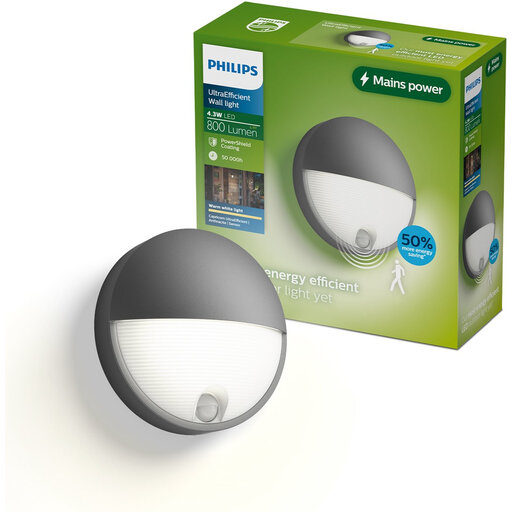
Why it suits this profile: A fixed wall light with an integrated LED and sensor is ideal for anyone looking for a neat, permanent solution for a façade, entrance or balcony.
The light output, colour temperature and IP rating are specified: 800 lumens, 2700 K and IP44. The integrated LED is not designed to be replaced.
Integrated 4.3 W LED, motion and dusk sensor, and an aluminium housing.

Why it suits this profile: This garden post light is designed for paths, patios and borders where continuous, fixed illumination is wanted.
The intended use and installation limits are clear: it can be placed in the garden, beside a path or on a patio, but not in water or under direct high-pressure jets.
800 lumens, 2700 K, integrated 4.3 W LED and a height of 96 cm.

Why it suits this profile: This solar outdoor light is suitable for a garden, shed or entrance without an available power connection, provided the panel receives direct sunlight.
The power method, two lighting modes and motion sensor are clearly stated in advance. Direct sunlight is still essential for charging.
1000 lumens, 3000 K, integrated LED, IP44 and no fixed wiring required.
We have put together a complete, up-to-date list of products that fully meet these strict selection criteria and the applicable European safety regulations.
Yes, IP44 outdoor lighting is designed to protect against splashing water and solid objects larger than 1 mm. The light must not be submerged and is not suitable for direct water jets. The installation location and properly sealed connections remain important.
A solar-powered outdoor light does not use electricity from the mains during normal operation. However, the light must receive enough sunlight to charge the battery. In winter or in a shady location, the operating time may be shorter. A light with USB charging may be more practical in these circumstances.
Lifespan varies depending on the product and operating conditions. Check the stated value in hours of operation. According to the product specification, Philips states up to 50,000 operating hours for certain Splay models and 25,000 hours for some solar products. These are manufacturer product specifications, not a guarantee of an exact number of years. With an integrated LED, the entire fitting will generally need to be replaced when the light source reaches the end of its lifespan.
