
Vandaag of morgen in huis

Kwaliteit gegarandeerd

Welkomstaanbiedingen ontgrendelen: GRATIS bezorging | Tot 80% korting | Gratis 30 dagen JoyPlus-proefperiode
Download de app
A light that only switches on when someone approaches your driveway, front door or garden path: outdoor lighting with a motion sensor is practical and can help make dark areas around your home easier to navigate. However, not every outdoor light with a motion sensor is right for every situation.
Many disappointing purchases come down to three common pitfalls:
Misinterpreting a high IP rating
IP44 outdoor lighting is protected against splashing water, but not powerful water jets or prolonged exposure to driving rain. For an exposed garden path or a spot with heavy rainfall, IP65 outdoor lighting may be a better choice.
Looking only at the lumen count
A high lumen count doesn’t automatically mean the light will be comfortable or well directed. For an entrance, 300 to 1,000 lumens may be enough, while a large outdoor area needs a wider spread of light. Positioning, beam angle and colour temperature also affect the result.
Installing solar outdoor lighting without enough sunlight
A solar-powered outdoor light needs direct daylight to charge its battery. Under a covered area, on a north-facing wall or among tall trees, it may stay lit for less time than you expect. So always check where the solar panel will go, not just the sensor range.
A motion sensor switches the light on when it detects movement. A dusk sensor stops the light from switching on unnecessarily during the day. Check:
A compact range is often enough for a front door or balcony. A wide detection angle is more practical for a driveway or back garden. A sensor is not a complete security solution, either: the light provides illumination, but it won’t prevent unauthorised access on its own.
The IP code consists of two digits. The first indicates protection against solid particles; the second indicates protection against water.
No IP rating means a light can be submerged in water. Always follow the installation instructions and make sure connections are properly sealed.
An integrated LED outdoor light generally uses little power and doesn’t need a separate bulb. As well as wattage, check the lumen count:
Warm white outdoor lighting at around 2700K to 3000K looks softer and suits a patio, balcony or classic outdoor wall light. A higher colour temperature can look brighter and cooler. With solar lighting, the actual time it stays lit depends on sunlight hours, the season, battery capacity and the selected sensor programme.

Why it suits this type of buyer: This compact solar-powered outdoor wall light is suitable for an entrance, balcony or small exterior wall where there’s no wiring. Its stated brightness is 180 lumens and its colour temperature is 2700K.
Solar power means you don’t need to install cables. Bear in mind, though, that IP44 protects against splashing water and the light needs direct sunlight to charge.
Integrated LED, solar power, motion sensor and dimming function, according to the product information.
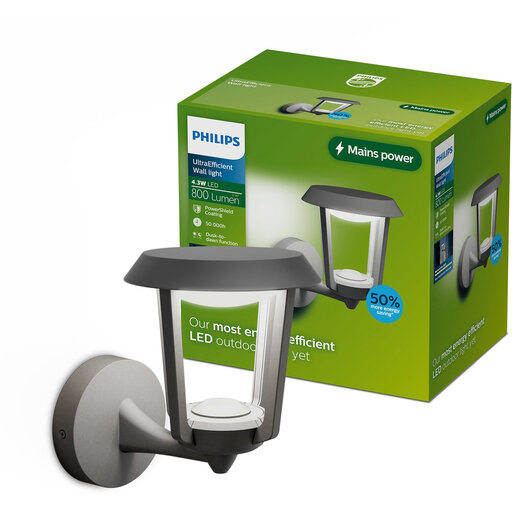
Why it suits this type of buyer: This aluminium outdoor wall light is a good fit for a fixed exterior wall, entrance or patio. The integrated LED is rated at 800 lumens and 2700K, with an IP44 rating.
The product information specifies an integrated dusk sensor and a fixed 230V connection. That means you don’t have to rely on limited sunlight.
Aluminium housing, integrated LED and a stated lifespan of 50,000 lighting hours, according to the product description.

Why it suits this type of buyer: This solar-powered outdoor security light is designed for driveways, garages, gardens and larger areas. The product information lists 3,000 lumens, three lighting modes and three adjustable heads.
Its stated IP65 rating makes it more suitable than IP44 for an exposed installation. Still, check that the solar panel gets enough direct sunlight each day.
IP65, a 180° detection angle according to the product information, and three lighting modes for different uses.

Why it suits this type of buyer: The magnetic mounting and USB-C charging are handy for a balcony, patio or rented home where permanent wiring isn’t wanted. According to the specifications, the light has 300 lumens, 3000K and IP44.
You’re not tied to a fixed connection. However, the battery needs regular charging, and IP44 is for splashing water, not direct water jets.
Magnetic fixing, integrated LED, human presence sensor and rechargeable lithium-ion battery.
We’ve put together a complete, up-to-date list of products that meet these strict selection criteria and the applicable European safety regulations.
Lifespan depends on the type of light. Integrated LEDs sometimes come with an estimated lifespan, but the actual lifespan also depends on use, temperature and moisture. The battery is an important wear part in solar lights. So check whether it’s replaceable and what warranty terms apply.
A solar-powered outdoor light uses solar energy during the day to charge an internal battery. It doesn’t need to be connected to the mains. How long it stays lit is affected by sunlight, the season, battery capacity and how often the motion sensor is triggered.
IP44 may be suitable for a sheltered entrance, balcony or wall where splashing water is likely. For an exposed spot affected by rain and dust, IP65 outdoor lighting is generally a better choice. Always check the installation instructions too, as the IP rating doesn’t automatically protect against immersion or incorrectly fitted connections.
