
Vandaag of morgen in huis

Kwaliteit gegarandeerd

Welkomstaanbiedingen ontgrendelen: GRATIS bezorging | Tot 80% korting | Gratis 30 dagen JoyPlus-proefperiode
Download de app
An outdoor light that switches on automatically sounds simple. Yet in practice, things can sometimes be disappointing. The light responds too late, the battery runs flat after a few cloudy days or the housing turns out to be less suitable for the chosen location. If you are looking for outdoor lighting with a motion sensor, it therefore pays to look beyond just the number of LEDs or the claim that it is “waterproof”.
This guide will help you compare the key specifications and choose a suitable solar light for outdoors, solar wall light or fixed LED outdoor lighting.
More lumens means a higher total light output, but not necessarily better illumination for your drive or garden path. The light distribution, the angle of the lamp and the position of the sensor determine where the light reaches. A compact 400-lumen wall light may be suitable by a front door, while a wide driveway may benefit more from several light points or a lamp with adjustable heads.
Also pay attention to the colour temperature. 2700K to 3000K produces warm white light, which is often pleasant on a patio or by an entrance. 5000K to 7000K looks cooler and can be useful when you want to illuminate a larger area brightly.
The IP rating is a verifiable indication of protection against dust and water:
An IP44 outdoor light is therefore not the same as a completely waterproof outdoor light.
An outdoor solar light needs sufficient daylight to charge its internal battery. Positioning it beneath an overhang, next to a tall fence or on a north-facing wall can reduce its operating time. In winter and during several consecutive dark days, the available solar energy is also lower.
Before buying, therefore check:
A sensor with a long range is not always suitable for a small balcony. For a front door, a range of a few metres may be sufficient. For a driveway or large garden, a wider angle is more practical. The UME Solar Outdoor Lights, for example, state a detection distance of 60 feet, equivalent to approximately 18 metres, with a detection angle of 180 degrees. According to the product description, the three adjustable light heads provide 270-degree coverage.
Philips Zyren states a PIR detection range of 8 metres when approached directly and 16 metres when approached from the side. Treat such distances as product specifications measured under certain conditions. Mounting height, direction of movement, temperature and obstacles can affect performance.
Use lumens as a starting point, not as your only selection criterion:
A lamp with a high light output may be unnecessarily bright in a narrow passage. Also consider whether you can adjust the light head or select a lower sensor setting.
A solar security light works without a permanent power connection. This makes installation easier, but performance depends on sunlight and battery capacity. A fixed 230V wall light provides a more stable power supply, but installation must be carried out by a qualified electrician in accordance with the product information.
Pay attention to the difference between a motion sensor and a dusk sensor:
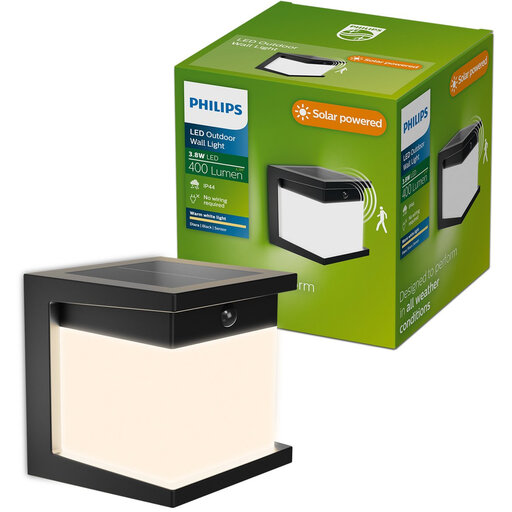
Why it suits this profile: This compact solar wall light is designed for a garden, balcony or entrance where simple installation and modest light output are sufficient. The lamp is specified as providing 400 lumens, warm white light at 2700K and two light modes.
The product information specifies IP44 and installation without wiring. Position the lamp so that the solar panel receives sufficient direct daylight.
400 lumens, 2700K, integrated LED, motion sensor and two light modes according to the product specifications.
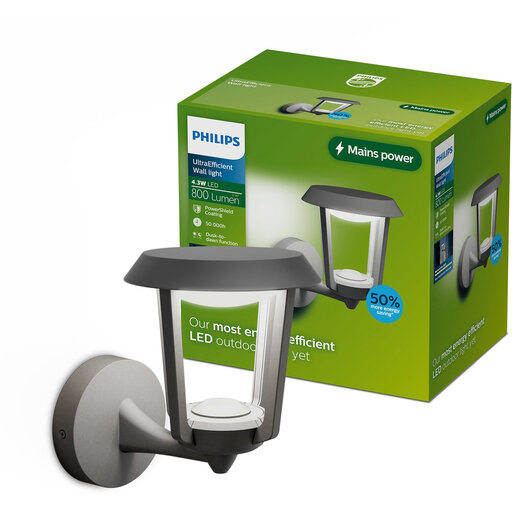
Why it suits this profile: For those who want to combine fixed LED outdoor lighting by a façade or entrance with a classic fixture design. The lamp operates at 230V and features integrated LED lighting.
The specifications list 800 lumens, 4.3W, 2700K and IP44. This allows you to check the light output, energy consumption and splash protection in advance.
Integrated LED, 800 lumens, warm white light and a stated lifespan of 50,000 operating hours according to the product description.

Why it suits this profile: This model is designed to provide broad illumination for a driveway, garage, patio or large garden. The product description lists 302 LEDs, 3000 lumens, three light heads and three modes.
The IP65 rating is specified for protection against dust and water jets. The three light heads help spread the light across a wider area.
A detection distance of approximately 18 metres, a detection angle of 180 degrees, 3000 lumens and three adjustable modes according to the stated product specifications.
Mount a solar wall light on a sturdy, flat surface and check that the supplied fixings are suitable for the wall. Point the sensor towards the route people take, rather than at a busy road or moving branches. This helps limit unwanted activation.
Clean the solar panel and sensor window regularly with a soft, slightly damp cloth. Do not use abrasive products. With a fixed outdoor light with a sensor, the power must be switched off before maintenance. Have 230V installations carried out by a qualified electrician.
We have put together a complete, up-to-date list of products that fully meet these strict selection criteria and the applicable European safety regulations.
A solar-powered outdoor light does not use mains electricity during normal operation. However, the purchase price, battery capacity and performance in low sunlight must also be taken into account. A fixed LED light generally uses little electricity, but depends on a 230V connection.
The lifespan depends on the LED, battery, electronics, installation and exposure to the weather. Product descriptions may state an expected lifespan, but this does not guarantee the same operating life in every Dutch garden. With solar lighting, the battery is often an important consideration. Check whether it can be replaced and follow the manufacturer’s safety instructions.
Choose a location with an unobstructed view of the route people take and sufficient light for the solar panel. By a front door, a wall beside or above the entrance is practical. For a driveway, a higher installation with a wide detection angle often works better. With IP44, check that the lamp is sufficiently sheltered; for an exposed location, consider choosing a model with IP65 protection.
