
Vandaag of morgen in huis

Kwaliteit gegarandeerd

Welkomstaanbiedingen ontgrendelen: GRATIS bezorging | Tot 80% korting | Gratis 30 dagen JoyPlus-proefperiode
Download de app
A light that switches on automatically by the front door, driveway or shed sounds simple. Yet many people buy an outdoor light with a sensor that is not actually suitable in practice. The sensor responds too slowly, the light does not receive enough sunlight or the housing turns out to be less suitable for the UK weather than expected.
With this buying guide, you can compare outdoor lighting with a motion sensor based on verifiable features. This makes it easier to choose between a solar outdoor light, wireless outdoor lighting, a fixed LED outdoor light or a rechargeable outdoor light.
A high lumen count sounds appealing, but it does not tell you how the light is distributed. A 300-lumen light may be sufficient for a balcony or entrance, while a driveway or large garden needs more light and a wider beam angle. As well as the lumen count, pay attention to:
A waterproof outdoor light IP44 is not the same as a light rated IP65. IP44 provides protection against splashing water and solid objects of a certain size. This type of light is often suitable for a sheltered wall, balcony or covered patio, but it must not be immersed or exposed to powerful water jets.
According to the IP classification, IP65 protects against dust and water jets. Always check the official product information and the recommended installation location. An IP rating does not replace correct installation.
A solar outdoor light depends on the amount of direct sunlight it receives. In a shady garden or during dark, overcast periods, the operating time may be reduced. A rechargeable outdoor light, on the other hand, requires a USB connection and regular charging. With both types, check whether the battery is included, which type of battery is used and how you can charge the light safely.
Check whether the light detects movement only when it is dark or whether it can also switch on during the day. Some models combine a day/night sensor with a motion sensor. If a product specifies a detection distance, also consider the installation height and direction the sensor faces. A sensor aimed towards a busy road may activate more often than you would like.
A manual switch or multiple lighting modes are useful when you want to temporarily disable the automatic function. For a fixed wall light, it should also be clear whether professional installation is required.
An integrated LED is compact and does not require a separate bulb. However, the light source cannot be replaced on many models. A wall light with an E27 or GU10 fitting gives you more choice of colour temperature and brightness, but the light source is sometimes not included.
IP44 may be suitable for a covered terrace or balcony. For an exposed wall, garden shed or location with greater exposure to rain, a higher level of protection may be more appropriate. Also check whether the mounting plate, screws and surface are suitable.
Magnetic installation requires a clean, flat surface with sufficient magnetic strength. Do not place a magnetic light above a passageway if it could cause injury or damage should it fall. Clean the sensor, solar panel and housing according to the product instructions, and do not use harsh cleaning products.
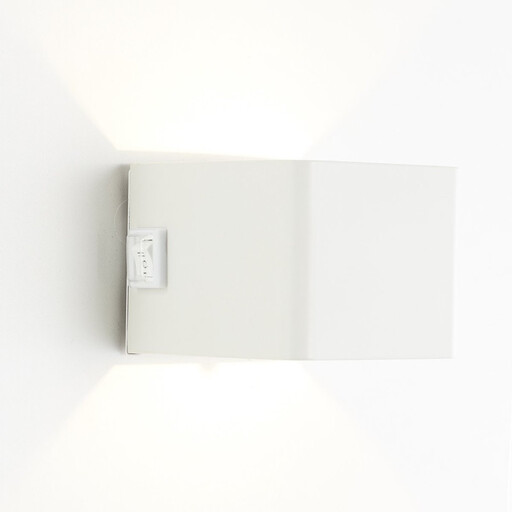
Why it suits this profile: This compact white wall light works wirelessly, has an integrated 4 W LED and is suitable for an entrance, balcony or sheltered patio.
The specifications state 300 lumens, a motion sensor and IP44. This makes it clear that it offers splash protection rather than protection against immersion.
Magnetic attachment, two 18650 lithium-ion batteries and warm white light at 3000 K. Charging is via USB.

Why it suits this profile: For anyone looking for a fixed solar wall light for outdoor use, with higher light output and automatic operation by an entrance, garage or driveway.
The product information explicitly states 1000 lumens, two lighting modes, a dusk sensor and IP44. Make sure you position the panel somewhere with direct sunlight.
Integrated LED, 1000 lumens, 3000 K and wireless installation without a mains connection.

Why it suits this profile: This model is designed for larger areas such as a driveway, garage or spacious garden where broad illumination is needed.
The listing states IP65, three adjustable light heads and wide coverage. According to the product description, these are the stated product specifications; check the current packaging and manual before purchase.
302 LEDs, stated light output of 3000 lumens, three lighting modes and an integrated 1800mAh lithium-ion battery.
We have compiled a complete, up-to-date list of products that fully meet these strict selection criteria and the applicable European safety regulations.
Point the sensor towards the area where movement is expected, such as a pathway or front door. Avoid positioning it close to trees, ventilation openings and busy roads. Install the light on a stable surface and follow the instructions for installation height, detection angle and power supply.
The operating time per night depends on sunlight, battery capacity, brightness and the mode selected. A light that stays brightly lit all night uses more energy than one that only switches on when movement is detected. Clean the solar panel regularly and allow for lower output on darker days.
An LED outdoor light generally uses little power compared with traditional light sources. Actual consumption depends on the wattage and the number of hours the light is on. With a sensor light, automatic activation can limit the number of hours it operates. With solar and battery-powered models, the energy use mainly translates into charging sessions or battery replacement.
