
Vandaag of morgen in huis

Kwaliteit gegarandeerd

Welkomstaanbiedingen ontgrendelen: GRATIS bezorging | Tot 80% korting | Gratis 30 dagen JoyPlus-proefperiode
Download de app
A light that only comes on when someone approaches the driveway, garden or entrance is practical and can help reduce unnecessary use. However, outdoor lighting with a motion sensor is not automatically suitable for every situation. A sensor may be too sensitive to passing cats, a solar outdoor light may run for less time in winter, and a high IP rating does not mean that a fitting is waterproof in all conditions.
Joybuy Product Recommendation Officer selects products based on verifiable specifications. This makes it easier to see which outdoor LED light, solar wall light or fixed outdoor wall light suits your home and how you intend to use it.
A high lumen figure sounds appealing, but more light is not always more practical. For a balcony or front door, 300 to 800 lumens may be sufficient. For a wide driveway or large garden, a more powerful outdoor security light is a more logical choice. Also consider the beam angle and adjustability: a light with several heads can illuminate a larger area than a single fixed light source.
IP44 outdoor lighting is protected against solid objects from 1 millimetre in size and splashing water from various directions. This makes IP44 suitable for a sheltered façade, entrance or patio, but not for prolonged exposure to direct jets of water.
An IP65 outdoor light offers a higher level of protection against dust and water jets. IP65 does not mean that the light may be immersed in water. Always check the installation location and fit the light according to the manufacturer’s instructions.
An outdoor solar light does not require mains power or wiring, but the solar panel must receive enough direct light during the day. Shade from an eave, tree or another building can reduce charging capacity. In winter and during several overcast days, the operating time may also be shorter.
An outdoor light without wiring is useful for rented homes, garden paths and locations without an available power point. Solar lighting works independently, but depends on the position of the panel and the charging conditions.
A portable light with a rechargeable battery offers greater flexibility. Check how the light is charged, whether the battery can be replaced and how long charging takes.
A fixed outdoor wall light running on 230 volts generally provides a constant power supply. A qualified electrician may be needed for installation and connection to the mains. This applies, for example, to fittings with an E27 or GU10 socket that are connected directly to the home’s electrical system.
Lumens indicate how much light a fitting produces according to its product specifications. Use this indication alongside the intended application:
The colour temperature determines the overall appearance. 2700K to 3000K produces warm white light for an entrance or patio. 4000K looks more neutral. 5000K to 7000K produces bright, cooler light, often chosen for functional lighting and visibility on a driveway.
Look at the detection distance and viewing angle. A sensor with a wide angle is practical for a corner façade or driveway. Position the light so that the sensor can detect the direction of movement clearly. If you point the sensor directly towards a busy road, passing traffic may activate the light.
Also consider the available settings. Some models offer different light modes, a dusk sensor or manual switching. Check whether mounting hardware is included and whether the wall is strong enough.
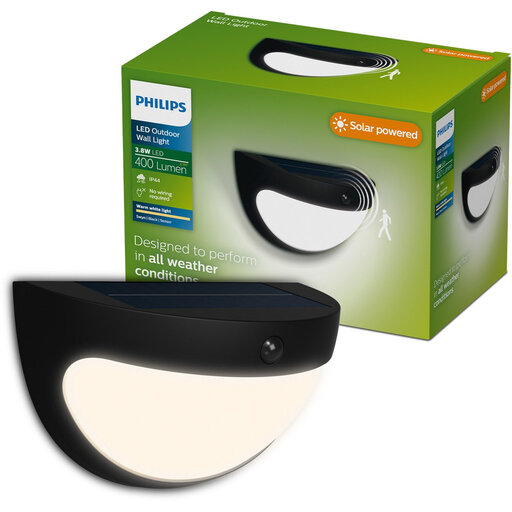
Why it suits this profile: This solar outdoor wall light is suitable for a front door, balcony or small patio where wiring is not available. According to the product information, the light produces 400 lumens and has two light modes, a motion sensor and an IP44 rating.
The product specifications clearly state the light output, IP rating and power supply. This makes it clear that the model is intended for general outdoor lighting rather than locations exposed to heavy water spray.
Solar power without a connection cable, 400 lumens, two modes and an integrated motion sensor.
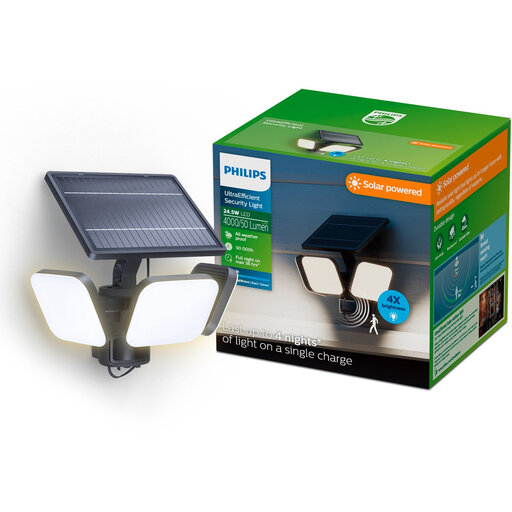
Why it suits this profile: This model is designed for larger areas such as a driveway, garage or spacious garden. According to Philips, it delivers 4000 lumens and has an IP65 rating, a motion sensor and two light modes.
The higher IP65 rating can be verified in the product specifications. This makes it more suitable for a less sheltered installation location than an IP44 fitting, without suggesting that it can be submerged.
4000 lumens, IP65, solar power and a stated detection range of 8 metres for direct approach and 16 metres for side approach.

Why it suits this profile: The three adjustable heads and wide coverage are designed for a garage, driveway, large garden or patio. According to the product description, this model has 302 LEDs, 3000 lumens, a detection distance of approximately 18 metres and a detection angle of 180 degrees.
The wide light distribution prevents you from illuminating only a small spot. The IP65 rating also makes it clear that the fitting is protected against dust and water jets, but is not designed to be submerged.
Three adjustable light heads, 270-degree adjustable coverage, three light modes and installation without mains wiring.
We have put together a complete, up-to-date list of products that fully meet these strict selection criteria and the applicable European safety regulations.
Yes, but performance depends on the amount of daylight, positioning and battery capacity. Shorter days and overcast weather can reduce charging time and operating time. Position the panel as far from shade as possible and keep its surface clean.
Lifespan varies from product to product. Integrated LED models sometimes list an expected lifespan, such as 20,000 or 25,000 hours of operation. This is a product specification, not a guarantee of an exact number of years of use. Batteries, sensors, weather conditions and frequency of use also have an impact.
A solar outdoor light does not use mains electricity. With a fixed outdoor LED light, consumption depends on the wattage and operating time. A motion sensor can switch the light on only when movement is detected, but actual consumption still depends on the set run-on time and the number of activations.
