
Vandaag of morgen in huis

Kwaliteit gegarandeerd

Welkomstaanbiedingen ontgrendelen: GRATIS bezorging | Tot 80% korting | Gratis 30 dagen JoyPlus-proefperiode
Download de app
A light that only comes on when someone walks past sounds simple. Yet many purchases fail to live up to expectations. The light may be too dim, the sensor may not respond where you need it to, or the battery may barely charge during winter. With this guide, you’ll discover what to look for in outdoor lighting with a motion sensor, whether you’re lighting a balcony, driveway or garage.
A high lumen count does not automatically mean that a garden or façade will be well lit. The beam angle, mounting height and adjustability also determine where the light falls. A compact solar wall light with 180 or 400 lumens may be sufficient by a front door, while a driveway or large back garden requires more light.
Also consider the colour temperature. 2700K to 3000K generally produces a warm white light for an entrance, patio or balcony. 4000K to 5000K looks cooler and can be more practical for a garage, shed or driveway.
An IP44 outdoor light is protected against solid objects and splashing water. This makes such a model suitable for many sheltered façades, balconies and entrances, but not for immersion or direct water jets. An IP65 outdoor light offers a higher level of protection against dust and water jets according to the IP rating.
Therefore, check the intended mounting location. IP44 may be suitable beneath an overhang. On an exposed façade or an unprotected driveway, IP65 may be the more logical choice. A light without an IP rating should never be placed underwater.
A solar outdoor light works without fixed wiring, but it still needs sufficient daylight. A north-facing wall, a position beneath a balcony or shade from trees can limit charging performance. In winter, the days are shorter and sunlight is often less intense. Before buying, check where the panel will receive direct or prolonged daylight.
Compare the number of lumens with the intended use:
The detection range of an outdoor light with a motion sensor is often specified differently for someone approaching directly and for movement from the side. Also check the detection angle and adjust the light so that pets, passers-by or traffic do not trigger it unnecessarily.
With solar-powered outdoor lighting, the panel, battery and selected lighting mode are more important than the wattage alone. For example, a light may combine a constant low-light setting with brighter illumination when motion is detected. This can reduce energy consumption, but the actual operating time depends on sunlight, temperature and usage.
A light with a USB-rechargeable battery is an alternative for locations where solar charging is difficult. In that case, check how often it needs charging and whether the light can easily be removed from the wall.
Solar models are generally suitable for installation without a mains cable. For 230-volt models, such as certain Philips outdoor lights, installation by a qualified electrician may be required. Always check the included mounting materials, the weight and the type of surface.
Clean the solar panel regularly with a soft cloth. Dirt, leaves and bird droppings reduce the amount of light captured by the panel. Also check occasionally that the housing, sensor and wall mount are still secure and undamaged.
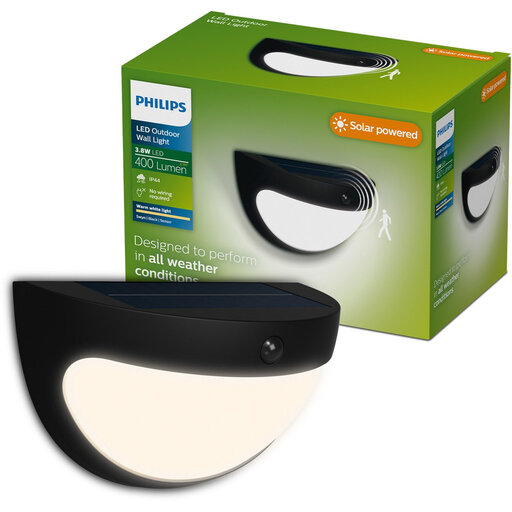
Why it suits this profile: This solar wall light works without wiring and has two lighting modes. With 400 lumens and warm white 2700K light, it is suitable for a small entrance, balcony or sheltered garden wall.
The light output and IP44 rating are clearly stated. However, install the light in a sheltered position and check that the panel receives sufficient daylight.
Solar power, motion sensor, two modes and a stated light output of 400 lumens.
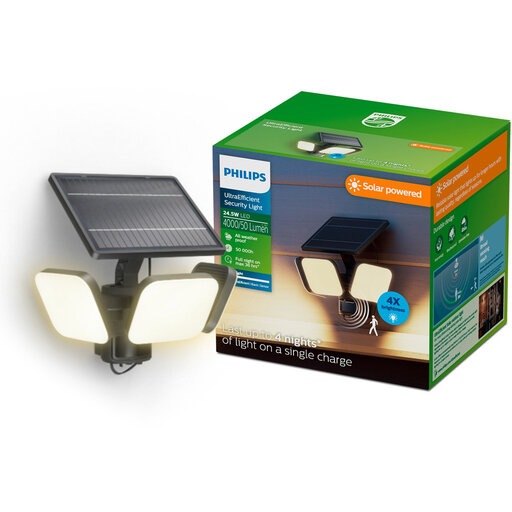
Why it suits this profile: According to the product information, this solar security light delivers 4000 lumens, has IP65 protection and features an adjustable light head. This makes it suitable for a large driveway, garage area or exposed façade.
The product details specify both the light output and IP65 protection, as well as a detection range of 8 metres for direct approach and 16 metres from the side. Check the installation location for shade.
4000 lumens, IP65, adjustable head, solar power and two lighting modes according to the stated product specifications.

Why it suits this profile: The three adjustable heads, stated 180-degree detection angle and three lighting modes are designed for larger areas such as a garden, garage, patio or driveway.
The light specifies IP65 protection, three lighting modes and broad light distribution. Before installation, check that 3000 lumens will not be too bright for neighbours or nearby homes.
302 LEDs, 3000 lumens according to the product listing, three heads, three modes and an IP65 rating.
We’ve put together a complete, up-to-date list of products that fully meet these strict selection criteria and the applicable European safety regulations.
Choose a sturdy wall or post that receives sufficient daylight. Point the sensor towards the route people take and avoid direct light from another lamp. After installation, test the detection range and angle. With a solar wall light, keep the panel clear of branches, leaves and other sources of shade.
The operating time per night varies by model and depends on sunlight, battery capacity, temperature and the number of movements detected. Manufacturers may state a particular operating time or lifespan; treat this as a product specification under certain conditions, not a guarantee for every British winter. Keeping the panel clean and choosing an appropriate lighting mode will help maintain performance.
During normal use, a solar outdoor light does not draw electricity from the mains. Its battery is charged via the solar panel. A 230-volt LED outdoor light does use mains electricity, so check the wattage and how long the light is on each day. With a motion sensor, the light is often on for less time than a model that stays lit continuously throughout the evening.
