
Vandaag of morgen in huis

Kwaliteit gegarandeerd

Welkomstaanbiedingen ontgrendelen: GRATIS bezorging | Tot 80% korting | Gratis 30 dagen JoyPlus-proefperiode
Download de app
An outdoor light that switches on automatically may seem easy to choose. Yet many households end up with a model that disappoints in practice. The light receives too little sunlight, the sensor reacts to passing cats, or the housing proves unsuitable for an exposed wall.
So don’t focus only on lumens, design or a low purchase price. With outdoor lighting with a motion sensor, the installation location, IP rating, sensor settings and power supply are the main factors determining whether the light suits your needs.
A motion sensor switches the light on when movement is detected. A dusk sensor responds to ambient light and can automatically switch a light on when it gets dark. Some products combine both functions, while others have only one of the two.
A motion sensor is practical for a driveway or entrance: the light only comes on when someone approaches. For a garden path, permanent, gentle lighting with a dusk sensor may make more sense. So check whether the product description mentions “motion sensor”, “human sensor”, “dusk sensor” or only “auto on/off”.
A high lumen count mainly means more light. It does not automatically say anything about the detection angle, battery life, light distribution or glare. A powerful outdoor security light can be useful on a wide driveway, but unnecessarily bright on a small balcony.
For atmospheric garden lighting, warm white outdoor lighting of around 2700K to 3000K with a modest light output is often more pleasant. More light may be desirable for a large property or dark rear elevation. As well as lumens, look at the colour temperature and whether the light head can be adjusted.
An IP44 outdoor light is protected against splashing water and is suitable for many sheltered outdoor locations. This does not mean that the light can withstand a direct jet of water or immersion. An IP65 waterproof outdoor light offers a higher level of protection against dust and water jets according to the IP rating.
The right choice depends on the installation location. IP44 may be sufficient beneath a canopy. On an exposed wall, beside a fence or in a location subject to heavy rain and dirt, IP65 is a more sensible specification to consider. Also check the installation instructions; an IP rating does not make a product suitable for every situation.
An outdoor solar light with a motion sensor works without a fixed power connection. This makes installation appealing for tenants, balconies, garden paths and places where there is no cable. However, performance depends on direct sunlight, the angle of the panel and battery capacity. In winter or on a north-facing wall, the operating time may be shorter.
A 230-volt light provides a constant power supply, but requires permanent installation and, for some models, installation by a qualified electrician. Wireless outdoor lighting powered via USB or a battery sits somewhere in between: it can be positioned flexibly, but still needs regular charging.
Check whether the range in metres and the detection angle are specified. A wide angle is useful for a driveway or garden path, while a shorter range can help prevent unwanted activation. An adjustable light threshold helps determine whether the light only responds in darkness. An adjustable on-time prevents the light from staying on for longer than necessary.
For a separate sensor, such as the Aigostar PIR-360, the specifications include an adjustable light sensitivity of 10 to 2000 lux and a delay of 10 seconds to 7 minutes. This is not an outdoor light in itself, but a switching component for suitable lighting. Have the 230-volt connection installed in accordance with the instructions and applicable safety regulations.
An LED outdoor light with 2700K or 3000K produces warm white light. This usually suits an entrance, patio or wall where ambience is important. A higher colour temperature looks whiter and may be better suited to functional security lighting.
Also consider the dimensions, mounting hardware and surface. A magnetic light should be mounted on a flat, sturdy surface. With ground spotlights and solar-powered path lighting, the ground spike must be firmly secured in the soil. Keep the solar panel free from leaves and clean it regularly.
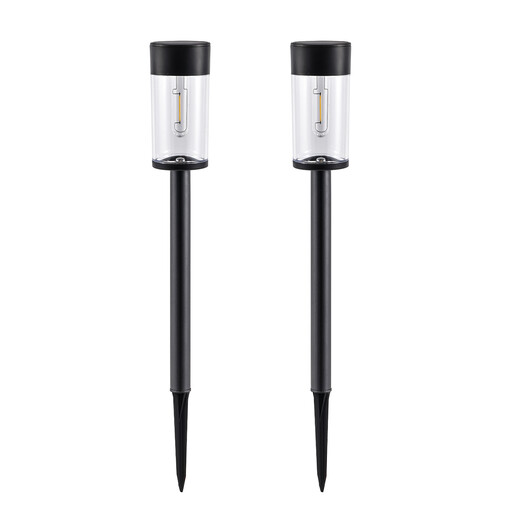
Why it suits this profile: For anyone who wants to mark out a garden path, border or driveway without wiring. This model uses a light sensor to switch on automatically at dusk, so it is not a motion sensor.
The specifications clearly state a dusk function, IP65 and 3000K. This makes the distinction from a motion sensor clear before you place your order.
Two lights per pack, 3000K warm white light, ground installation and a stated IP65 rating.

Why it suits this profile: For a wall, balcony, patio or entrance where automatic lighting without cables is preferred. The product information lists both a daylight sensor and a motion sensor.
The combination of two light modes, motion detection and IP44 makes the intended use clearer than a general claim about automatic lighting alone.
400 lumens, integrated LED, 2700K warm white light, no fixed wiring and stated IP44 protection.

Why it suits this profile: For large driveways, back gardens and walls where a broad, powerful beam is needed. The product details list a motion sensor, dusk sensor and adjustable light head.
The IP65 rating, stated sensor range and adjustable head provide greater confidence for an exposed, intensively used installation location.
4000 lumens, IP65, two light modes and a range stated in the product description of 8 metres for a direct approach and 16 metres for a sideways approach.
We have put together a complete, up-to-date list of products that fully meet these strict selection criteria and the applicable European safety regulations.
Choose a location with as much direct sunlight as possible, preferably without shade from trees, roof edges or walls. Point the sensor towards the area where movement is expected, rather than directly at a busy road. After installation, check that the light charges during the day and test the detection in the dark.
The operating time varies from model to model and depends on the number of hours of sunlight, battery capacity, temperature and sensor usage. Manufacturers may state a particular service life for the LED or battery, but this does not guarantee the same performance in all Dutch weather conditions. Keep the panel clean and check the fixings regularly.
A solar outdoor light does not use mains electricity, but depends on sunlight and an internal battery. A fixed LED outdoor light generally only uses electricity when the sensor detects movement, depending on the set operating time. So don’t just compare wattage; also consider how often the light switches on and how long it stays lit.
