
Vandaag of morgen in huis

Kwaliteit gegarandeerd

Welkomstaanbiedingen ontgrendelen: GRATIS bezorging | Tot 80% korting | Gratis 30 dagen JoyPlus-proefperiode
Download de app
A light that only comes on when someone approaches your driveway, garden or front door can make everyday life more convenient. However, outdoor lighting with a motion sensor varies considerably in brightness, installation, sensor range and protection from rain. A low price or a high lumen count doesn’t tell the whole story.
Look out for these three common pitfalls:
Check the stated range and viewing angle. A sensor that detects movement mainly straight ahead works differently from one with a wide angle. According to the product information, the Philips Zyren has a detection range of 8 metres when approached directly and 16 metres for lateral movement. The manufacturer states that the UME light has a range of around 18 metres and a 180-degree angle.
Don’t position the light directly opposite a busy road, moving branches or a heat source, as these can trigger it unnecessarily. Point the sensor towards the path, gate or door you want to illuminate.
Lumens indicate the total amount of light. Around 300 to 800 lumens may be enough for an entrance or balcony, depending on the ambience you want and the installation height. A more powerful model may be better for a wide driveway or large garden.
Also consider the colour temperature:
A light with adjustable heads or multiple light panels can distribute the light more effectively. Just check that the beam doesn’t point towards windows or the public road.
An IP44 outdoor light is protected against splashing water and is suitable, for example, under an overhang or on a sheltered wall. An IP65 outdoor light generally offers greater protection against dust and water jets. Even with IP65, immersion isn’t permitted; always follow the product’s safety information.
A solar-powered outdoor light doesn’t need a mains connection, but it does need a spot with enough direct sunlight. Shade from a roof edge, tree or fence will reduce its ability to charge. Clean the panel occasionally with a soft cloth. A wired light works independently of sunlight, but a 230-volt installation must be carried out by a qualified electrician.
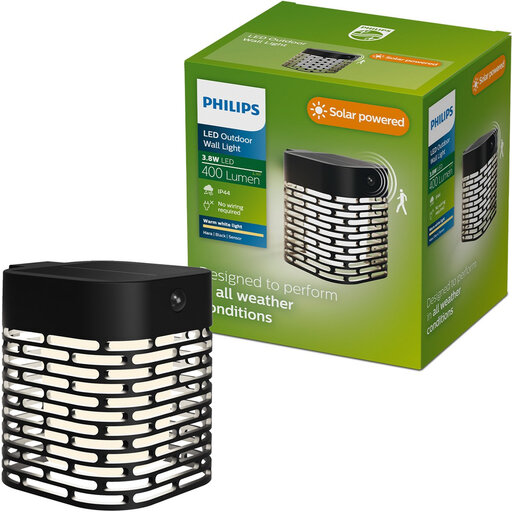
Why it suits this profile: This solar wall light is suitable for an entrance, balcony or small patio without existing wiring. According to the product information, it has two light settings, 400 lumens, warm white light at 2700K and IP44 protection.
The specifications make it clear that this is an IP44 light, protected against splashing water, and not suitable for immersion or direct water jets. This helps you assess the installation location more realistically.
Solar-powered, with no fixed mains connection needed, and offers two settings with integrated LED lighting.
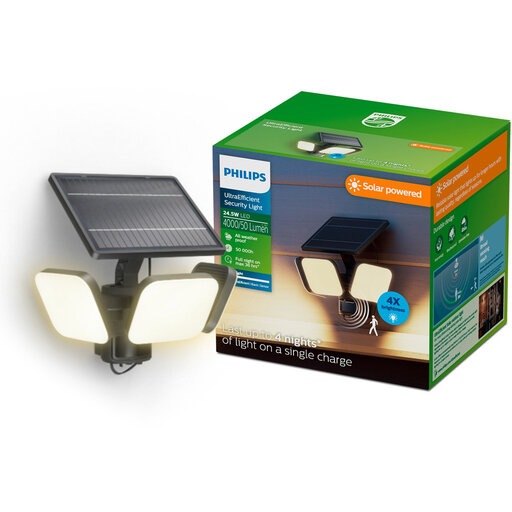
Why it suits this profile: According to the product information, this solar security light is designed for larger areas such as a driveway, back garden or garage. The model is listed as offering 4000 lumens, IP65 protection, an adjustable light head and two light settings.
The higher IP rating and stated sensor range give you more information than a marketing term such as “security light” alone. It still needs to be placed in direct sunlight.
IP65 rating, adjustable head, 4000 lumens according to the product information, and detection of direct and lateral movement.

Why it suits this profile: For a large garden, driveway or garage, the combination of three light heads, a stated 270-degree coverage and three settings could be appealing. The product information lists 302 LEDs, 3000 lumens and IP65 protection.
The adjustable heads and different settings let you adapt the spread of light. Check in advance that the high light output is suitable for its surroundings.
Three light heads, three modes, solar power and IP65 protection, as stated in the product information.
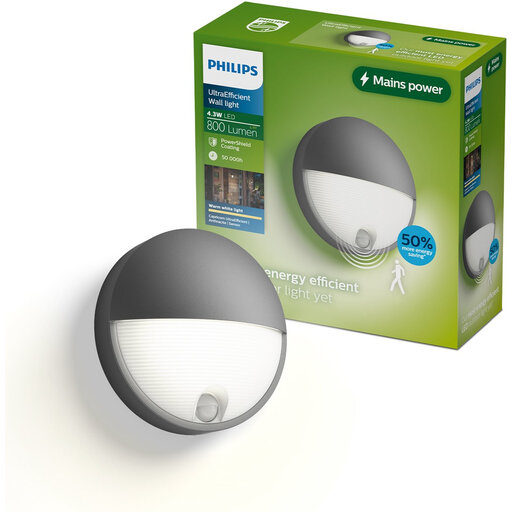
Why it suits this profile: This wired wall light is designed for a wall, garden or balcony with a fixed mains connection. According to the product information, the model combines a motion and dusk sensor with 800 lumens, 2700K and IP44 protection.
The fixed connection means it doesn’t depend on sunlight. However, IP44 is clearly not a rating for direct water jets, so choose a sheltered installation location.
Integrated LED, warm white light and a combined motion and dusk sensor. Installation on 230 volts requires a qualified electrician.
We’ve put together a complete, up-to-date list of products that meet these strict selection criteria and the applicable European safety regulations.
Choose a sturdy surface that’s suitable for the supplied fixings. A solar outdoor light’s panel should receive as much direct sunlight as possible. Once installed, test the sensor in the evening and walk past the light from different directions.
With wired models, switch off the power before installation or cleaning. Have the connection installed in accordance with local regulations. Clean an outdoor LED light with a soft, dry or slightly damp cloth, depending on the instructions. Don’t use abrasive products or try to open an integrated lithium battery yourself.
A solar outdoor light doesn’t use mains electricity while operating, but it does depend on sunlight and the capacity of its internal battery. A wired LED light mainly uses electricity when it’s on. A short on-time and a dusk sensor can help reduce consumption. Check the stated wattage, as lumens and watts measure different things.
How long it operates each night depends on the hours of sunlight, battery capacity, temperature, light setting and how often the sensor detects movement. Manufacturer claims about operating hours or multiple nights come from the manufacturer and may apply under specific conditions. Keep the solar panel clean and replace the light or battery according to the maintenance instructions.
Install the light where the sensor can detect the area you want to cover, without being constantly triggered by traffic or moving plants. A directional wall light is often enough for a front door or path. For a driveway or large garden, a model with a wide detection angle, adjustable light head or multiple light panels may be more practical.
