
Vandaag of morgen in huis

Kwaliteit gegarandeerd

Welkomstaanbiedingen ontgrendelen: GRATIS bezorging | Tot 80% korting | Gratis 30 dagen JoyPlus-proefperiode
Download de app
A motion-sensor light might seem simple to choose. Yet many people buy a model that doesn’t provide enough light in practice, is installed in the wrong place or can’t withstand the British weather. With an outdoor solar light in particular, positioning and the amount of sunlight it receives are key to how well it works.
The three most common pitfalls:
Looking only at the lumen count
A high lumen figure doesn’t tell the whole story. The spread of the light, the mounting height and the direction of the lamp all affect how well a driveway or entrance is lit.
Assuming IP44 means fully waterproof
An IP44 outdoor light is protected against solid particles and splashing water. This makes it suitable for many sheltered walls, balconies and patios, but not automatically for a spot exposed to direct jets of water. An IP65 outdoor light offers greater protection against dust and water.
Installing a solar panel in a shady spot
A solar-powered outdoor light needs enough daylight to charge its battery. Under an overhang, beside a tall fence or on a north-facing wall, it may not stay lit for as long as you expect.
Don’t just check whether a light has a sensor. Find out how far and how wide the sensor can detect movement. A shorter range is often enough for a front door. For a driveway, garden path or garage, a wide detection angle can be more practical.
Also consider the direction in which you mount it. A sensor facing directly towards someone’s path may register movement differently from one positioned so they walk across its field of view. Manufacturers may quote the range under specific conditions; actual detection also depends on temperature, obstacles and mounting height.
Lumens indicate the total amount of light. Around 180 to 400 lumens is often suitable for atmospheric wall lighting or a balcony. A higher lumen count may be useful for a driveway or a larger area of the garden.
Colour temperature is measured in Kelvin:
Look for adjustable heads or lights that shine in two directions, too. These let you direct the light towards a path, wall or doorway and reduce distracting glare.
An IP rating consists of two numbers. The first relates, among other things, to protection against dust; the second indicates protection against water. An IP44 light is suitable for splashing water and many typical outdoor uses. An IP65 light is better suited to a more exposed location, such as an open driveway or garden wall.
Then choose between:
For a fixed electrical connection, switch off the power and, if in doubt, have the installation carried out in accordance with the relevant UK regulations.
The selection below is matched to different uses. Product specifications are based on the available product information. Any claims about performance or lifespan are presented as stated by the manufacturer or seller.

Why it suits this shopper: A compact solar wall light for an entrance, balcony, patio or small garden path, with no wiring required.
The stated specifications clearly list 180 lumens, IP44 and an integrated battery. This makes the light best suited to smaller areas, rather than a large driveway.
Solar power, motion sensor, dimmable function and IP44 protection. The stated colour temperature is 2700 K.

Why it suits this shopper: A good fit for a front door or wall where a smart appearance, warm light and automatic activation are important.
The product information lists both a motion sensor and a dusk sensor, as well as two modes. Its IP44 rating makes clear that it should be kept away from direct jets of water.
1000 lumens, 3000 K, integrated LED and wire-free installation. The manufacturer states a minimum statutory guarantee of two years.
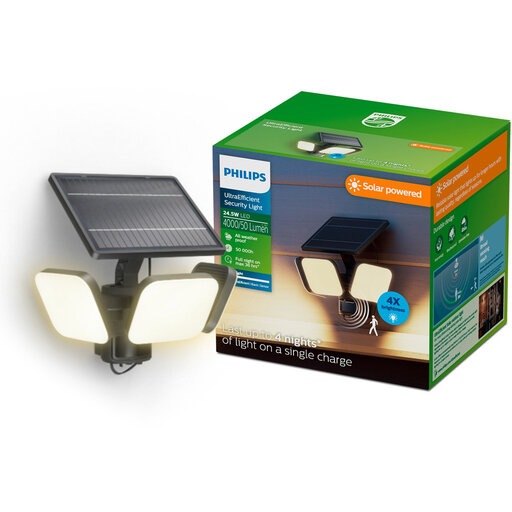
Why it suits this shopper: Designed for larger areas such as a driveway, garage or spacious garden, where wide detection and high stated light output are desirable.
The stated detection range is 8 metres when approached head-on and 16 metres for movement across the sensor’s field of view. That gives you a clearer idea of its range than models with no sensor information.
4000 lumens, IP65 and an adjustable light head. The stated colour temperature is 3000 K. Philips says the light is designed to run for several nights after a full charge; actual runtime depends on sunlight and settings.
We’ve put together a full, up-to-date list of products that meet these strict selection criteria and the applicable European safety regulations.
Yes, but solar lights may not charge as fully in winter because of shorter days, cloudy weather and the lower position of the sun. Position the panel in as open a spot as possible and keep it clean. A mains-powered model doesn’t have this particular charging issue.
Runtime per night depends on the battery, the number of times the light switches on, the brightness setting and the amount of sunlight. The stated lifespan of an LED light source isn’t the same as the battery runtime. Check whether the battery is replaceable and what warranty is offered.
A solar wall light doesn’t use mains electricity, but relies on stored solar energy. An electric LED outdoor light mainly uses electricity while it’s on. A motion sensor can limit how long the light stays on, but remember to check the wattage and the set switch-off delay.
