
Vandaag of morgen in huis

Kwaliteit gegarandeerd

Welkomstaanbiedingen ontgrendelen: GRATIS bezorging | Tot 80% korting | Gratis 30 dagen JoyPlus-proefperiode
Download de app
A new outdoor light often seems easy to pick. Yet problems usually show up after a few weeks: the light isn’t bright enough, the battery drains quickly or the housing turns out to be unsuitable for where you’ve mounted it. Especially with outdoor lighting, attractive product photos and phrases like “waterproof”, “extra bright” and “energy-efficient” aren’t enough to make a good choice.
So before you buy, watch out for three common pitfalls:
The IP rating indicates how well a product is protected against solid particles and moisture. The first digit relates to dust and contact; the second to water.
The IP rating is a product specification, not a blanket guarantee that every outdoor light performs the same under all weather conditions.
Lumens indicate the total light output. A compact outdoor wall light with around 180 to 400 lumens can be sufficient for an entrance or mood lighting. For a wide driveway or large garden zone, you’ll need more light.
The colour temperature, expressed in kelvin, affects the look and feel:
Light distribution also matters. A light with multiple adjustable heads illuminates a larger area. A GU10 outdoor light with a single spot directs the beam more precisely onto a wall, plant or path.
A solar outdoor light doesn’t need a fixed power connection, but depends on sunlight and battery capacity. Ideally, place the panel where it gets direct light and keep the surface free from dirt and leaves.
With a hardwired outdoor wall light, check whether:
An outdoor light with a motion sensor can be handy by a back door or garage. Pay attention to the detection range, detection angle and whether the sensor can be properly adjusted. A sensor that reacts to the street, moving branches or pets can switch on unnecessarily.

Why this fits the profile: This solar outdoor light runs without fixed wiring and, according to the product description, has two light modes, a daylight sensor and a motion sensor. That makes it practical for an entrance, balcony or sheltered wall.
The IP44 rating isn’t presented as fully waterproof. Place the light somewhere it won’t be exposed to direct water jets.
Runs on solar power, has an integrated LED light source and specifies 400 lumens per light point.
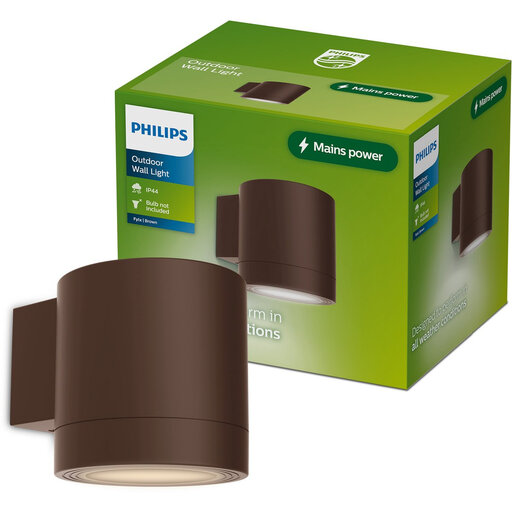
Why this fits the profile: If you want to choose the bulb and colour temperature yourself, this outdoor wall light provides a swappable GU10 fitting. The aluminium housing and compact round design suit a variety of façades.
The light is supplied without a GU10 spotlight. That’s clearly stated, so you can factor in the cost and specifications of the light source in advance.
GU10 fitting, replaceable light source and IP44 protection for outdoor use in a sheltered location.

Why this fits the profile: For a driveway, garage or larger garden zone, wide light spread matters more than a compact design alone. This solar security light has three heads and a manufacturer-stated detection distance of 60 feet, about 18 metres.
The specifications mention both the light output and the IP65 rating. According to the manufacturer, 302 LEDs deliver 3000 lumens; when installing, check that this powerful lighting suits the surroundings.
IP65 protection, three lighting modes, three adjustable heads and an 1800 mAh lithium-ion battery according to the product information.

Why this fits the profile: These garden lights are designed for paths, borders and plants. According to the product description, you can set brightness, RGB colours and colour temperature via the Tuya app. You’ll need the app, an account and a suitable connection.
The cable is included and the lights run from a plug, but leads can be a trip hazard. Don’t lay them loosely across a walkway.
Three integrated LED lights, dimming, adjustable CCT and RGB colours, and IP44 protection.
We’ve put together a complete, up-to-date list of products that fully meet these strict selection criteria and comply with current European safety regulations.
That depends on the mounting location. For a sheltered wall or balcony, an IP44 outdoor light may be sufficient. For an exposed façade, driveway or shed, IP65 outdoor lighting is more practical when the light is exposed to more rain and water jets. Also consider the desired light output, sensor settings and method of installation.
The runtime per night depends on sunlight, battery capacity, temperature, light mode and how clean the panel is. In winter, output can be lower due to shorter days and cloud cover. Clean the solar panel regularly and don’t place it under an eaves or close to tall vegetation.
An LED outdoor light generally uses less electricity than a comparable traditional light source, but actual consumption depends on wattage and operating time. A motion sensor or timer can limit how long the light stays on. With solar outdoor lighting, the energy comes from the battery; the light still depends on sufficient charging during the day.
According to the product information, a light with a fixed mains connection must be installed by a qualified electrician. Wireless solar lighting or a light with a plug is often simpler to fit, but always check the supplied instructions, the stability of the mounting surface and the safety of the cables.
