
Vandaag of morgen in huis

Kwaliteit gegarandeerd

Welkomstaanbiedingen ontgrendelen: GRATIS bezorging | Tot 80% korting | Gratis 30 dagen JoyPlus-proefperiode
Download de app
A dark driveway, poorly lit garden path or bare exterior wall calls for a practical lighting solution. However, outdoor lighting is not automatically suitable for every Dutch garden. A lamp may look sturdy but provide very little light. A solar lamp may work wirelessly but fail to charge sufficiently in a shady spot. And an IP rating only indicates protection against dust and water, not the product’s overall lifespan.
As a Joybuy Product Recommendation Officer, I filter the most important product specifications out of the marketing language. This helps you see which outdoor lighting is right for your garden, patio, balcony, exterior wall, driveway or walkway.
The number of LEDs tells you very little without the light output in lumens. For example, a lamp with 302 LEDs may deliver 3000 lumens, while a decorative garden lamp with just a few LEDs is mainly intended to create ambience. Soft lighting is often enough for a garden path; for a driveway or entrance, you will usually want broader, clearer illumination.
So pay attention to:
An IP65 waterproof outdoor lamp is dust-tight and protected against water jets. This does not mean that the lamp can be submerged or withstand every pressure washer. IP44 outdoor lighting is protected against splashing water from various directions, but is less suitable for locations directly exposed to heavy rain or water jets.
So consider the location:
Solar outdoor lighting does not need a cable, but the solar panel must receive enough direct light every day. Shade from a fence, tree or canopy reduces charging time. During the darker winter months, the operating time may also be shorter than in summer.
Check the following before buying:
Solar garden lighting is suitable when you want to illuminate a garden path, border or exterior wall without installing wiring. Solar path lights are easy to position using a ground stake and usually switch on automatically at dusk. Their light output is generally intended for guidance and ambience.
An electric lamp, such as a GU10 outdoor lamp or ground spotlight, gives you more control over the light source. You can connect the lamp to a suitable outdoor circuit and, on some models, adjust the colour or brightness using a replaceable GU10 LED bulb. Bear cables, fixing and safe installation in mind.
For decorative garden lighting, a few lumens per light point may be enough. According to the product specification, the UME solar path lights deliver 10 lumens per lamp, making them suitable for soft lighting along a path, lawn edge or border.
Functional driveway lighting requires more light. The UME solar lamp with motion sensor states 3000 lumens, three adjustable light heads and a detection range of 60 feet with a sensor angle of 180 degrees. With such a high light output, check that the lamp does not shine towards windows or the public highway.
Aluminium can be a suitable choice for a fixed wall or ground spotlight. Plastic is often lighter and practical for solar products. More important than the material alone are the installation method, stability and protection of the connections.
For an outdoor lamp with a motion sensor, the sensor must have an unobstructed view. Do not position it directly behind a wide roof edge or next to a heat source that could trigger unwanted detections. For an outdoor ground spotlight, you should also consider the risk of tripping and make sure it is installed on a firm surface.
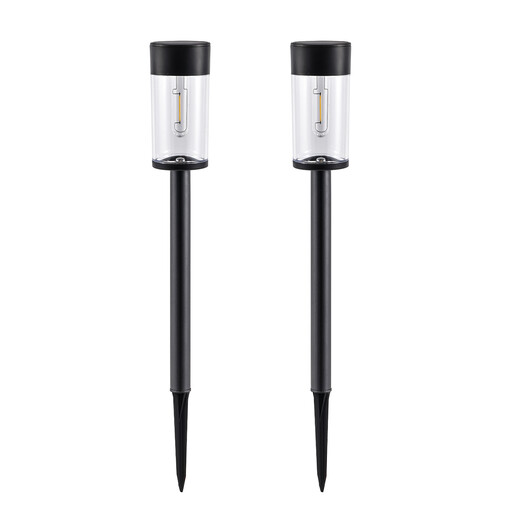
Why it suits this profile: This set is designed for anyone who wants to mark out a garden path, border or driveway edge without cables. It is installed using ground stakes.
The product specification states 10 lumens per lamp and 3000K. This makes it clear that the lights are intended for soft path and ambient lighting, rather than as a powerful floodlight.
Solar power, automatic dusk sensor, IP65 rating and a stated operating time of 8 to 12 hours under suitable charging conditions.
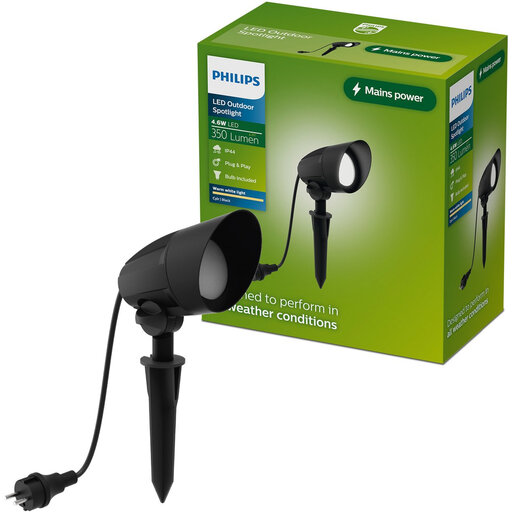
Why it suits this profile: Suitable for anyone wanting to use a fixed electric ground spotlight to highlight a tree, shrub, driveway or architectural feature on an exterior wall.
The specifications state 350 lumens, 2700K and IP44. This means you can get a better idea in advance of the ambience and splash-water protection to expect.
Aluminium housing, adjustable positioning, GU10 LED bulb included, 230V connection and a 150 cm cable.

Why it suits this profile: This solar floodlight is a good match for large gardens, garages, patios and driveways where broad lighting and automatic detection are required.
The product specification states not only the number of LEDs, but also 3000 lumens, three light modes, 270-degree coverage and a sensor range of 60 feet.
IP65 rating, three adjustable light heads, motion sensor and installation without electrical wiring.

Why it suits this profile: A compact option for a balcony, entrance or small patio where you do not want to install a cable and mainly need light when movement is detected.
The description states 180 lumens and IP44. This makes it clear that the model is intended for functional accent lighting and splash-water protection, rather than a large exposed area.
Compact size, integrated LED, solar power, motion sensor and a stated light output of 180 lumens.
We have put together a complete, up-to-date list of products that fully meet these strict selection criteria and the applicable European safety regulations.
Solar lamps do not use mains electricity during normal operation. Actual performance depends on sunlight, battery capacity, temperature and the selected light mode. In winter or in a shady location, the operating time may be reduced.
This varies by model, operating conditions and battery. Some product specifications state a lifespan for the light source, but this is not a guarantee of the lifespan of the complete lamp. With an integrated LED, replacing the light source is often not intended; with a GU10 outdoor lamp, you can generally replace the light source separately.
IP44 outdoor lighting is protected against splashing water and may be suitable for a sheltered exterior wall, balcony or patio. Do not place an IP44 lamp in water, under a direct water jet or in a location where water remains for long periods. For a fully exposed installation location, a higher IP rating may be more suitable.
