
Vandaag of morgen in huis

Kwaliteit gegarandeerd

Welkomstaanbiedingen ontgrendelen: GRATIS bezorging | Tot 80% korting | Gratis 30 dagen JoyPlus-proefperiode
Download de app
Good outdoor lighting needs to do more than look attractive. It should suit its location, offer enough protection against moisture and be easy to install. Yet many shoppers choose a light based on an appealing photo or a claim such as “waterproof”, without checking the technical details.
Three common pitfalls are:
A few checks before you buy can help ensure your path lights, outdoor wall light or patio lighting live up to expectations.
An IP code consists of two digits. The first indicates protection against solid particles, while the second relates to water.
Always check the full product description. A product page might say “waterproof”, for example, while the IP rating and safety instructions give a more nuanced picture.
Solar garden lights work without a fixed mains connection, but need direct sunlight. So avoid placing solar lights for the garden under dense foliage or next to a tall fence. Check the stated charging time and run time, too.
Electric LED outdoor lights generally provide consistent operation, but may need a fixed connection or an outdoor socket. A 230-volt outdoor wall light must be installed by a qualified electrician. A portable or USB-rechargeable light is more flexible, but will need regular charging.
Colour temperature is measured in kelvins:
For a path, lumens and beam spread matter more than wattage alone. An outdoor ground spotlight is suitable for highlighting a tree, wall or other feature. For a driveway or back door, an outdoor light with a motion sensor may be more practical than a light that stays on all evening.

Why it suits this type of user: This solar garden light is easy to push into the ground and does not need a fixed connection. It has a stainless steel housing, 6500K light and an IP44 rating.
The specifications clearly state a charging time of 4 to 6 hours and a run time of 8 to 12 hours. It still needs to be placed in full sun.
Solar-powered, with a ground stake, stainless steel construction and a compact height of 55 cm.
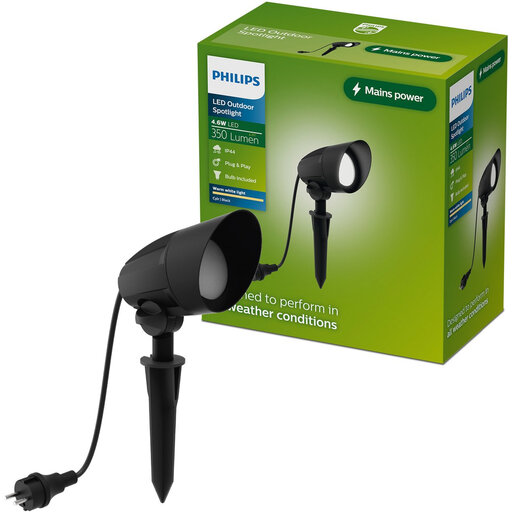
Why it suits this type of user: This electric ground spotlight is designed for anyone who wants a focused beam by a driveway, gate, lawn or tree. The GU10 LED bulb is included.
The product details specify 350 lumens, 2700K and IP44. This makes it clear from the outset that it provides warm accent lighting rather than broad area lighting.
Adjustable spotlight, GU10 LED bulb included, 150 cm cable and an aluminium-and-glass construction.

Why it suits this type of user: This solar outdoor light is designed for driveways, garages, patios and larger areas where automatic lighting is useful.
The light has an IP65 rating, three lighting modes and a sensor range of 60 feet, according to the product information. Check the intended mounting location and how much sunlight it gets before installation.
302 LEDs, three adjustable light heads, motion detection and a stated brightness of 3000 lumens.
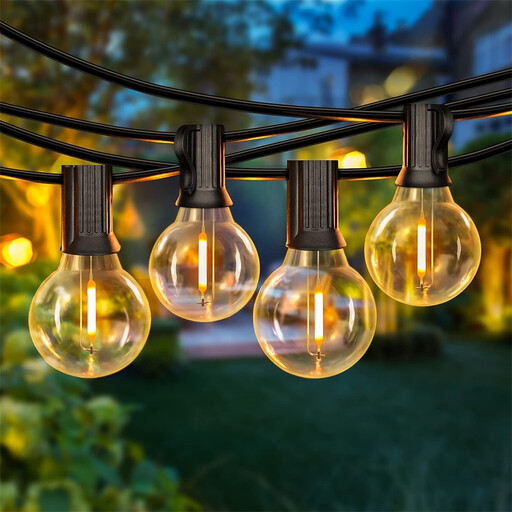
Why it suits this type of user: This outdoor string light is ideal for a patio, balcony, pergola or party setting where a continuous mains connection is available.
The lights run on mains power rather than a small battery. The product information also states that the bulbs are replaceable and that up to 500 lights can be connected.
30-metre length, dimming function, timer, multiple lighting modes and replaceable G40 LED bulbs.
We’ve put together a complete, up-to-date list of products that meet these strict selection criteria and the applicable European safety regulations.
Choose a spot that gets several hours of direct sunlight and switch the light on before using it for the first time. Keep the solar panel clean and make sure shrubs, walls or parasols do not shade it. In winter, the lights may stay on for less time because there is less sunlight.
IP44 protects against splashes and is best suited to sheltered outdoor areas. IP65 offers greater protection against dust and jets of water. Neither rating means the light can be submerged or exposed to a strong jet of water for a long time.
Energy use depends on the wattage, how long the light is on and how many lights you have. A 4,6-watt light left on for five hours each evening uses less energy than a traditional light with a higher wattage. A timer, motion sensor or solar power can help reduce the time spent using mains electricity.
