
Vandaag of morgen in huis

Kwaliteit gegarandeerd

Welkomstaanbiedingen ontgrendelen: GRATIS bezorging | Tot 80% korting | Gratis 30 dagen JoyPlus-proefperiode
Download de app
An outdoor light can make an entrance feel safer, create a more inviting patio or highlight a tree in the garden. But choosing one isn’t always straightforward. Product photos often show a beautifully lit garden, while important details about installation, light output and protection from moisture are less prominent.
So, watch out for these three common pitfalls:
A few checks beforehand can help you avoid buying outdoor lighting that isn’t suitable for the location, power supply or way you want to use it.
The IP code shows how well a product is protected against solid objects and moisture. The first digit relates to dust and contact; the second relates to water.
No rating automatically means that a light is suitable for immersion. Also, don’t place an IP44 light where rainwater can collect around it.
Lumens indicate the amount of light produced. A low lumen output may be enough for ambient lighting, while a driveway or large garden may need more light. Kelvin describes the colour of the light:
With LED outdoor lighting, wattage isn’t the only thing that matters. Check the lumen output, expected operating life and whether the light source can be replaced. A GU10 outdoor light gives you the flexibility to choose a suitable GU10 LED bulb yourself. Just check the fitting’s maximum wattage.
A solar outdoor light doesn’t need a permanent power connection, but its solar panel needs enough direct daylight. Shade from a wall, tree or balcony can affect charging performance. Clean the panel from time to time.
A plug-in outdoor light is easier to install, but only use a suitable outdoor socket. A fixed outdoor wall light running on 220-240V will generally need to be connected by a qualified electrician. Also consider the cable length, mounting height and risk of tripping.
An outdoor light with a motion sensor is handy by an entrance, garage or driveway. Check the detection angle, range and available lighting modes. If the sensor is positioned where it’s too sensitive, the light may switch on unnecessarily often.
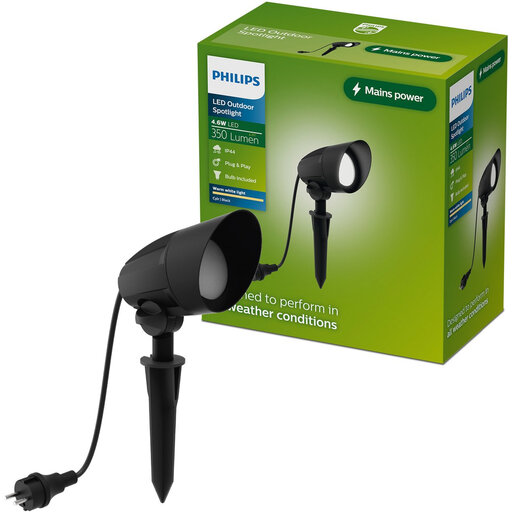
Why it suits this profile: This compact ground spotlight is easy to position along a path, lawn or driveway, and comes with a GU10 LED bulb and plug.
The product specifications state 350 lumens, 2700K and IP44. This makes it clear that it’s intended mainly for accent and ambient lighting, not as a powerful floodlight for a large area.
Adjustable spotlight, 4,6W power, 150 cm cable and a GU10 LED bulb included.

Why it suits this profile: This solar wall light is designed for anyone looking for plenty of light and sensor control without running a permanent power cable to the façade.
The product specifications list IP65, 4000 lumens and an integrated LED module. Just make sure the chosen mounting position gets enough sunlight.
PIR sensor, two lighting modes, 5000K colour temperature and, according to the product information, a range of up to 8 metres when approached directly.

Why it suits this profile: The three adjustable light heads are a practical choice for a wide driveway, garage area, back garden or larger patio.
The product description lists IP65, three lighting modes and a 180-degree motion detection angle. Keep the panel out of the shade to help it charge more effectively.
Solar-powered, 302 LEDs, three light heads and a stated light output of 3000 lumens according to the product specifications.
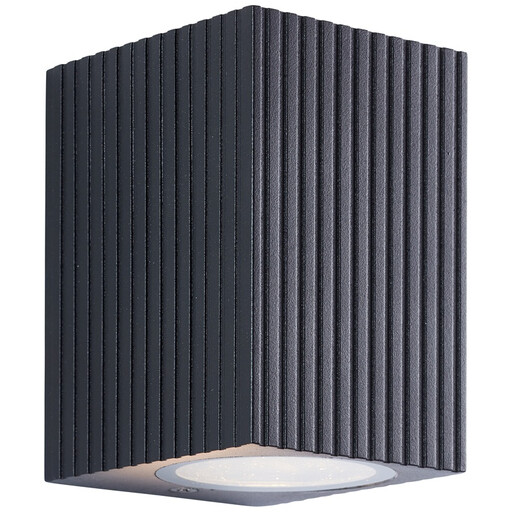
Why it suits this profile: This compact wall light is a good fit for a sheltered entrance, balcony or canopy where you want to choose your own GU10 light source.
The light is supplied without a bulb. This is clearly stated in the product information, so you can factor in the extra purchase and the maximum power of 10W.
GU10 fitting, aluminium and glass construction, compact size and IP44 protection for sheltered outdoor locations.
We’ve put together a complete, up-to-date list of products that meet these strict selection criteria and current European safety regulations.
IP44 may be suitable for a sheltered location. If the light is exposed to rain, dust or jets of water, consider IP65 instead. Always check the installation instructions too, and make sure water can’t collect around the fitting.
A solar outdoor light doesn’t use electricity from the mains during normal operation. However, its performance depends on the amount of sunlight, its positioning, the battery and the season. In winter or during prolonged cloudy weather, it may stay lit for less time.
Lifespan varies by light source and product. For example, the product specifications for the Philips Cylr ground spotlight state 15.000 uur for the light source. This is a stated technical value, not a guarantee for every use case. Also check whether the LED bulb can be replaced or is integrated into the fitting.
