
Vandaag of morgen in huis

Kwaliteit gegarandeerd

Welkomstaanbiedingen ontgrendelen: GRATIS bezorging | Tot 80% korting | Gratis 30 dagen JoyPlus-proefperiode
Download de app
Good outdoor lighting should suit the location, the level of light you want and the conditions around your home. A light for a sheltered balcony needs different features from one by the driveway or on an exterior wall exposed to heavy rain. Yet many buyers focus mainly on lumens, design or a low price. This can often lead to disappointment.
A high lumen count doesn’t automatically mean a light will be comfortable or suitable. A powerful light may be ideal for a driveway, but too bright for a patio or garden path. Also consider the light colour, beam angle and whether you can adjust the direction of the light.
Warmer tones around 2700K to 3000K are common for ambient lighting. A more neutral or cooler colour may be better for task lighting. A light with multiple heads, such as a floodlight, spreads light over a larger area.
The IP rating indicates what the casing is protected against. IP44 outdoor lighting is protected against solid objects larger than 1 millimetre and splashing water from different directions. This makes IP44 suitable for many sheltered exterior walls, balconies and patios, but not necessarily for areas exposed to direct jets of water or prolonged heavy rain.
IP65 outdoor lighting offers greater protection against dust and jets of water. This can be a practical choice for an open garden, driveway or wall where the light is directly exposed to rain. Always check the installation instructions: incorrect fitting can reduce the intended level of protection.
Solar outdoor lighting uses a panel and an integrated battery. The stated run time depends on the amount of direct sunlight, the season, the temperature and how the light is used. In a Dutch garden shaded by trees or a house, charging performance may be lower.
So don’t choose a solar garden light based on appearance alone. Check whether the panel will receive several hours of direct daylight. Keep it clear of leaves, dirt and grime.
Lumens indicate the amount of visible light. A modest light output is often enough to make a garden path visible. For a driveway, garage or back door, an outdoor light with a motion sensor and a higher light output may be more practical.
When choosing a sensor, check:
A sensor helps prevent the light from staying on unnecessarily, but walls, shrubs and passing traffic can affect how it works.
Solar garden lights are usually wireless and can be installed using ground stakes or mounting hardware. This is handy if you don’t want to run a cable. Check whether the battery is replaceable, how long it takes to charge according to the product details, and whether the light still provides enough illumination after a cloudy day.
A fixed, mains-powered LED outdoor light can provide a constant source of light, but usually needs to be connected to 230 volts. For wall lights with a GU10 or E27 fitting, also check whether the bulb is included. With some fittings, you can choose your own LED bulb with the colour temperature and brightness you want.
Aluminium, plastic, glass and stainless steel are all common materials for outdoor lights. Consider more than just the material: check the fixings, cable entry and finish too. A heavy light needs a sturdy wall and suitable wall plugs. For ground spotlights or garden path lights, consider how stable the ground is and whether there’s a risk of tripping.
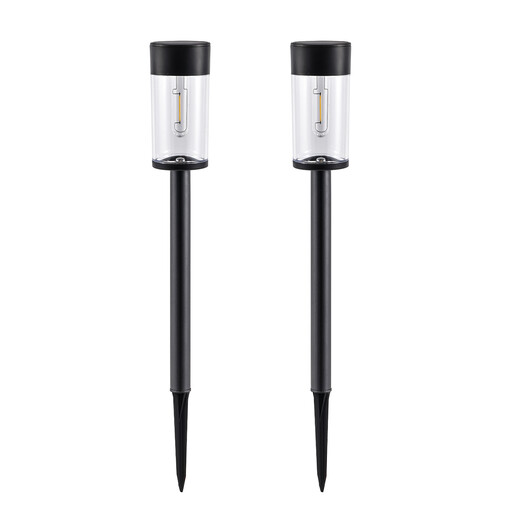
Why it suits this buyer: This set is designed for anyone who wants to mark out a garden path, border or driveway without wiring. The two lights are installed using ground stakes.
The stated IP65 rating is higher than IP44. The lights are designed for outdoor use, but should still be placed somewhere with enough sunlight.
Two lights per set, warm white 3000K light, automatic dusk-to-dawn operation and, according to the product details, 10 lumens per light.

Why it suits this buyer: This solar wall light is a good fit for a front door, patio or exterior wall where you want a trusted brand, a sensor and fixed wall mounting.
The product specifications list two lighting modes, a dusk function and a motion sensor. Its IP44 rating makes sheltered installation a more suitable choice than placing it where it will be exposed to direct jets of water.
According to the product details, it offers 1000 lumens, 3000K light, an integrated LED and a minimum two-year statutory guarantee within the EU.

Why it suits this buyer: This solar floodlight is designed for larger areas such as a garage, driveway, back garden or patio where wide-reaching, powerful lighting is needed.
The three adjustable heads and stated 270° coverage help spread light over a larger area. IP65 is better suited to a more exposed installation location than IP44.
According to the product description, it has 302 LEDs, 3000 lumens, three lighting modes, a 180° motion detection angle and a range of around 18 metres.
We’ve put together a complete, up-to-date list of products that meet these strict selection criteria and the applicable European safety regulations.
The run time each night depends on the battery capacity, the amount of sunlight and the lighting mode selected. Manufacturers may state a number of operating hours under certain conditions. Treat this as a product specification, not a guarantee of how long the light will last every night. Clean the solar panel regularly and place the light somewhere as sunny as possible.
It depends on where you install it. IP44 is suitable for many sheltered outdoor locations and protects against splashing water. For a fully exposed area with lots of rain or dust, IP65 outdoor lighting may be a better choice. Also check whether the manufacturer recommends installing the light under a canopy.
A solar garden light uses solar energy during the day to charge its internal battery. It doesn’t need to be connected to the mains during normal use. The actual run time varies with the season and weather conditions. For fixed, mains-powered LED lighting, you can estimate energy use based on the wattage and the number of hours it’s switched on.
