
Vandaag of morgen in huis

Kwaliteit gegarandeerd

Welkomstaanbiedingen ontgrendelen: GRATIS bezorging | Tot 80% korting | Gratis 30 dagen JoyPlus-proefperiode
Download de app
Good outdoor lighting should suit the location, purpose and power supply you want to use. A light for creating an inviting atmosphere on the patio needs different features from a bright outdoor light with a motion sensor by the driveway. Yet many products can seem similar, with claims such as “waterproof”, “powerful” and “energy-efficient”.
So focus on product specifications you can verify. This helps you avoid choosing a light that stops working properly after a few months, doesn’t provide enough light or isn’t suitable for the location you have in mind.
An IP44 outdoor light is protected against solid objects larger than 1 mm and splashing water. This doesn’t mean it can withstand immersion, direct jets of water or prolonged exposure to heavy rain. IP44 is often suitable for a sheltered wall, balcony, covered area or entrance, but not automatically for every exposed spot in the garden.
For a more exposed location, a higher rating such as IP65 is a more sensible choice. Always check the installation instructions too.
Solar outdoor lights work without a fixed power connection, but their solar panels need enough daylight. A light under a solid canopy, next to a tall fence or on the north-facing side of a house may not stay lit for as long as you expect.
Check the stated charging time, battery life and placement advice. For example, the Aigostar Solar Lawn Light has a stated charging time of 4 to 6 hours and a battery life of 8 to 12 hours. These figures depend on the amount of sunlight and the conditions.
Wattage indicates power consumption, not the amount of light produced. So when choosing LED outdoor lighting, focus on lumens. An outdoor wall light with 300 lumens is suitable for helping you find your way or providing accent lighting, while 1000 lumens gives much more light for an entrance or security lighting.
The colour temperature also affects the atmosphere:
Solar garden lighting is easy to install because it doesn’t need fixed wiring. However, check the battery type, charging time and expected running time. Mains-powered lighting may be more practical for lights you want to use regularly or in a spot with little sunlight.
A fixed outdoor wall light with an E27 or GU10 fitting gives you more flexibility to choose a different LED bulb later. Models running on 220–240 V must be installed by a qualified installer.
Use the IP rating as your first point of reference:
According to the product specifications, the Brilliant GU10 outdoor light and the Philips Fylx outdoor wall light have an IP44 rating. The manufacturer’s information for these models also says they should not be exposed to direct jets of water.
An E27 outdoor light uses a larger standard fitting. A GU10 outdoor light is suitable for compact spotlights. Check whether the bulb is included. The Aigostar A-02 E27 and Brilliant Newport are supplied without a bulb. According to the product information, a GU10 LED spotlight is included with the Philips Cylr ground spotlight.
Also consider how the light is installed:

Why it suits this type of user: This stake light is designed to help you find your way along a garden path, flower bed or patio. No fixed wiring is needed.
The product information specifies IP44, a polycrystalline solar panel, a charging time of 4–6 hours and a battery life of 8–12 hours. Be sure to place the light somewhere sunny.
Stainless steel housing, 550 mm tall and solar-powered. The stated colour temperature is 6500 K.

Why it suits this type of user: This solar outdoor wall light is a good fit for an entrance, patio or shed where you want automatic lighting without a cable.
The product specifications state 1000 lumens, 3000 K, IP44, a dusk sensor and a motion sensor. So you don’t have to rely on a broad marketing claim such as “security lighting”.
Two light modes, an integrated LED and installation without a mains cable. IP44 protects against splashing water, not jets of water.

Why it suits this type of user: The three adjustable light heads are designed for a driveway, garage, courtyard or larger garden where you want wide coverage.
The stated specifications include IP65, three modes, a motion detection range of 60 feet and a detection angle of 180 degrees. Check beforehand that this range suits your property.
302 LEDs, with 3000 lumens stated in the product information, and three adjustable heads. Keep the solar panel and sensor free from dirt and obstructions.
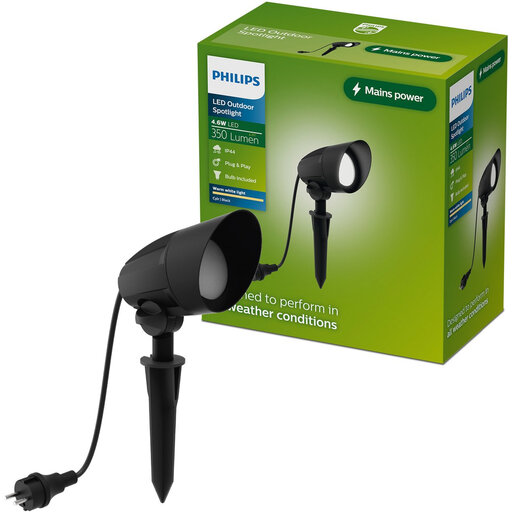
Why it suits this type of user: This outdoor ground spotlight is ideal for highlighting a tree, shrub, fence or part of a wall.
The product information specifies 350 lumens, 2700 K, IP44 and a 150 cm cable. This makes it clear in advance that it provides warm accent lighting, not broad coverage of an outdoor area.
Adjustable spotlight, GU10 LED bulb included and installation with a ground stake. Use a suitable outdoor socket that’s protected against splashing water.
We’ve put together a complete, up-to-date list of products that meet these strict selection criteria and the applicable European safety regulations.
A lower lumen output may be enough for a garden path or decorative garden light. More light is usually more practical for an entrance, driveway or outdoor light with a motion sensor. Compare the lumens for each light, and consider the beam too: a spotlight directs the light, while a wall light often spreads it more widely.
Solar lighting doesn’t use mains electricity while it’s on. This keeps running costs low, but performance depends on sunlight, battery capacity and the number of hours it stays lit. A fixed LED outdoor light may be more reliable in a shady spot.
Lifespan varies by model, operating conditions and maintenance. Some product descriptions, for example, state a lifespan of 15,000, 25,000 or 50,000 hours for the light source. Check whether the LED is integrated or replaceable. With a GU10 or E27 fitting, you can replace the bulb later; with an integrated LED, you’ll generally need to replace the entire fitting.
