
Vandaag of morgen in huis

Kwaliteit gegarandeerd

Welkomstaanbiedingen ontgrendelen: GRATIS bezorging | Tot 80% korting | Gratis 30 dagen JoyPlus-proefperiode
Download de app
A well-lit garden makes a path easier to see, creates atmosphere on the patio, and can make a dark façade feel more welcoming. Yet many people buy outdoor lighting based on one standout feature, such as “waterproof”, “extra bright” or “lasts all night”. That can lead to disappointment.
The main problems usually come from three pitfalls:
The IP code indicates how a product is protected against solid particles and moisture. The first digit relates to solid objects, the second to water.
A product with a higher IP rating is not automatically better for every application. For a covered patio, IP44 may be sufficient, while solar path lights along an open lawn may need more protection.
Lumens indicate how much visible light a lamp produces. A path light with 10 lumens mainly provides orientation and decoration. A wall light with hundreds of lumens is better suited to clearly illuminate an entrance, shed or driveway.
Also pay attention to colour temperature:
According to the product information, the UME solar path lights deliver 10 lumens per lamp at 3000 K. That’s a different application from a solar wall light with a much higher light output.
Solar-powered garden lights don’t need a fixed connection, but they depend on enough direct sunlight. So check:
An outdoor light with a motion sensor is practical near a front door, garage or driveway. For a seating area, a fixed low light level or dimming function is often more pleasant. With a fixed wall light that has a GU10 or E27 fitting, you also need to check whether the bulb is included. For several Philips and Brilliant models in this overview, the fitting is present but the bulb is not included.
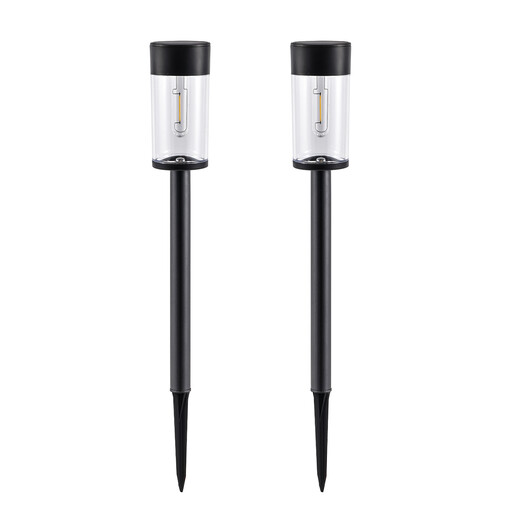
Why this fits the profile: A set of two lights is ideal for marking a short garden path, border or driveway edge clearly without any wiring.
The product specification states IP65, automatic operation and a clear light output of 10 lumens per lamp. So you know this is mainly orientation and decorative light, not a powerful floodlight.
3000 K warm white light, ground spikes, IP65 rating and a stated burn time of 8–12 hours with enough sun.

Why this fits the profile: This solar wall light suits an entrance or façade where automatic lighting and a higher light output are important.
The stated specifications mention 1000 lumens, 3000 K, a motion sensor and IP44. This allows you to compare the light more accurately with other outdoor garden lights.
Two light modes, integrated LED, motion sensor and installation without a mains connection.

Why this fits the profile: For a wide driveway, garage or large garden area, a light with three adjustable heads and a motion sensor is more practical than several small light points.
The product description states a detection range of 60 feet, a 180-degree angle and three light modes. Placement and range still depend on the surroundings.
302 LEDs, according to the specification 3000 lumens, IP65 rating and three adjustable light heads.
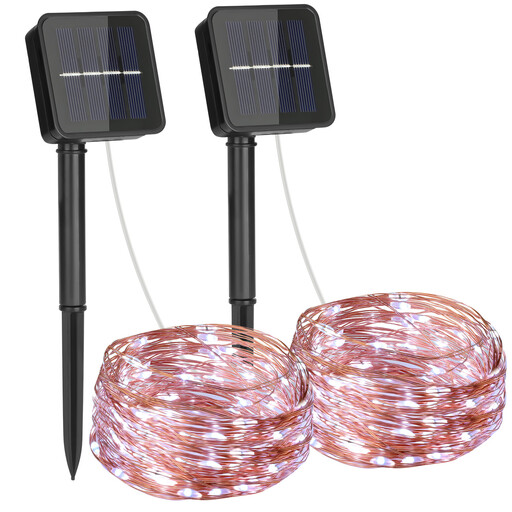
Why this fits the profile: This solar string light is designed for decoration around a balcony, fence, planter or patio, not for lighting a walkway.
The product information states eight light modes, a memory function, a length of 8 metres per string and IP65. The solar panel does need direct sunlight.
Two strings, 80 LEDs each, cool white light, eight modes and automatic on/off switching.
We’ve put together a full, up-to-date list of products that fully meet these strict selection criteria and current European safety regulations.
It can be, but performance varies due to fewer daylight hours, cloud cover and shade. Place the solar panel in a spot that gets as much direct daylight as possible and clean it regularly. Don’t expect the same burn time from solar garden lights every day.
IP44 protects against splashing water and is mainly suitable for sheltered outdoor spots. IP65 offers, according to the classification, more protection against dust and water jets. Neither means the light can be placed underwater. Also check that the plug, cable and connection have the same level of protection.
Solar outdoor lights don’t use mains electricity while they’re on, but the purchase price and any battery replacement are part of the total cost. Lights with a plug or fixed connection consume electricity depending on wattage and burn time. When choosing LED outdoor lighting, don’t just look at lumens – also consider wattage, run time and the desired brightness.
