
Vandaag of morgen in huis

Kwaliteit gegarandeerd

Welkomstaanbiedingen ontgrendelen: GRATIS bezorging | Tot 80% korting | Gratis 30 dagen JoyPlus-proefperiode
Download de app
Good outdoor lighting should suit the location, the weather and how you plan to use it. A light for creating ambience on a balcony has different requirements from a bright light by the driveway. Yet many buyers focus mainly on the number of LEDs, the colour of the light or an attractive product photo. This can lead to predictable problems: a light turns out not to be suitable for rain, the cable is too short or the lighting is less practical than expected.
This guide compares garden lighting, an outdoor light, an outdoor wall light, solar outdoor lighting, LED outdoor lighting and an outdoor string light based on verifiable features.
IP44 outdoor lighting is protected against splashes, but not necessarily against heavy rain, direct jets of water or immersion. IP44 is therefore best suited to a covered balcony, a sheltered wall or a patio beneath a canopy.
For an open garden, driveway or wall where rain falls directly on the light, a higher protection rating such as IP65 is often more practical. Always check that the product description supports your intended use. Marketing copy may describe a product as “waterproof”, while its IP rating and installation instructions tell a more nuanced story.
A high number of LEDs does not automatically mean a light will illuminate an area well. Also consider the light spread, mounting height and colour of the light. A string light with lots of small LEDs is suitable for ambience, but usually won’t replace a functional light by your front door.
For practical lighting along a path or at an entrance, direction, sensor range and mounting are more important than the total number of LEDs alone. For ambient garden lighting, a warm colour and even distribution are often more pleasant.
A mains-powered light needs a suitable connection and may require installation by a qualified electrician. A GU10 or E27 wall light may also not come with a bulb. Check whether you need to buy one separately and what the maximum wattage is.
Solar lighting does away with a power cable, but works most reliably in a spot with plenty of direct sunlight. A battery-powered model needs regular charging. For an outdoor string light, also consider its length, the distance to the socket and the protection provided for the plug and connections.
The IP code consists of two digits. The first relates to protection against solid objects, and the second to protection against water. In practice, this means:
Install a wall light according to the manufacturer’s instructions. An IP44 wall light, for example, is not an obvious choice for a completely exposed location where water hits the housing directly.
Check whether the light has an integrated LED or needs a separate GU10 or E27 bulb. Integrated LED outdoor lighting is ready to use straight away, but the light source often cannot be replaced. With a fitting, you can choose the colour and brightness of the bulb yourself.
Warm white light of around 2700 to 3000 K usually suits a patio or entrance. Cooler light can be more practical for a driveway, shed or security light. Also check the lumen output, but assess it alongside the beam spread. A light with a motion sensor is especially useful in places where you don’t need constant lighting.
Solar outdoor lighting often switches on automatically at dusk, but how long it stays on depends on sunlight, the season and battery capacity. A battery-powered model is easy to position, but needs periodic maintenance. Mains power is suitable when you want continuous, reliable light.
Look out for features such as a timer, memory function, dimming and replaceable bulbs. A timer can stop decorative lighting from staying on unnecessarily all night. For a string light with several settings, it’s useful if it remembers the setting you chose.
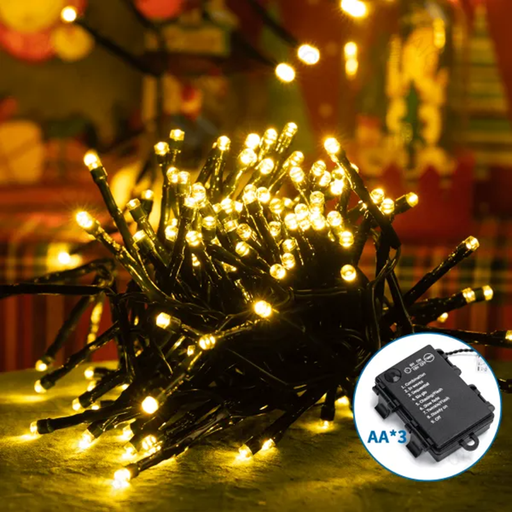
Why it suits this profile: This 5-metre string light runs on 3 AA batteries, making it easy to place on a balcony, patio or in a small garden without a fixed connection.
The IP44 rating is clearly stated. Use the string light in a sheltered spot and avoid direct contact with jets of water.
200 LEDs, 8 lighting modes, a timer and memory function; 5-metre length.
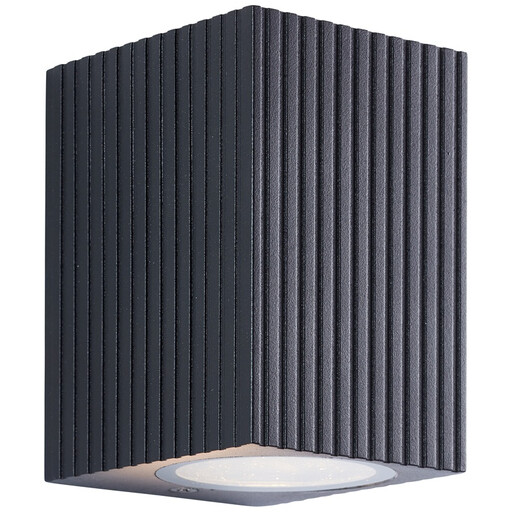
Why it suits this profile: This compact outdoor wall light suits a modern exterior wall, fence or covered entrance, and lets you choose a suitable GU10 LED bulb.
The maximum load of 10 W and the fact that no light source is included are clearly stated upfront. This helps you avoid choosing the wrong bulb.
Aluminium, glass and plastic; IP44; suitable for external dimming with a compatible bulb and dimmer.

Why it suits this profile: For a driveway, garage or larger garden area, this model offers multiple light heads, solar power and motion detection without a fixed power cable.
According to the product description, the model has IP65 protection and a sensor range of 60 feet. Make sure you position the solar panel where it will receive plenty of direct sunlight.
Three light heads, three modes, a stated brightness of 3000 lumens and a 180-degree detection angle, according to the product information.
We’ve put together a complete, up-to-date list of products that meet these strict selection criteria and the applicable European safety regulations.
IP44 protects against splashes and can be suitable for a covered veranda, balcony or sheltered wall. It does not mean the light is completely waterproof. A higher IP rating may be more suitable for an exposed location.
That depends on the wattage, how many hours the light is on and its power source. An LED bulb generally uses less electricity than a comparable traditional bulb, but you can check the actual consumption from the stated wattage. Solar lighting does not use mains electricity while operating, but its performance depends on sunlight and battery capacity.
Lifespan varies by product and conditions of use. Check the stated lifespan, warranty and whether the light source can be replaced. With an integrated LED, you usually need to replace the entire light if the light source fails.
